There are nine common types of fiber supplement: psyllium, PHGG, acacia, inulin, wheat dextrin, methylcellulose, glucomannan, beta-glucan and guar gum. They differ in three ways: whether they thicken into a gel, whether gut bacteria ferment them, and whether they hold an EU health claim.
All of them count as fiber under EU law because the small intestine cannot digest them.1 What happens after that depends on the type. If you are new to the topic, start with what dietary fiber is and soluble vs insoluble fiber.
What are the main types of fiber supplements?
The table sorts the nine by the three properties. Each name links to our full page where one exists.
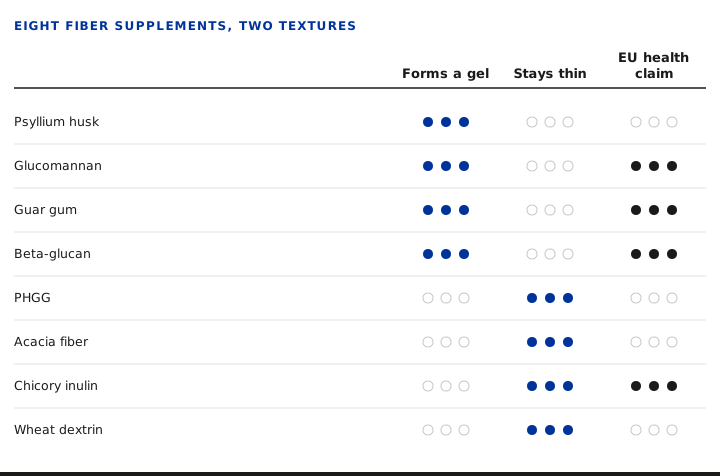
Four of the eight form a gel and four stay thin. Three of the gel-formers and one thin fiber hold an authorised EU health claim. Methylcellulose, which gut bacteria do not ferment, is in the table below. Sources: EMA ispaghula husk monograph; EFSA Journal 2017 (acacia gum, konjac); Yoon 2008; Holscher 2017; Reichert 2016; Commission Regulations (EU) No 432/2012 and 2015/2314; EU Register of nutrition and health claims.
| Fiber | Source | In water | Fermented by gut bacteria | Authorised EU health claim |
|---|---|---|---|---|
| Psyllium husk | Seed coat of Plantago ovata | Gel | Partly | None (EU herbal medicine for constipation) |
| PHGG | Guar bean, enzyme-cut | Thin | Yes, slowly | None |
| Acacia fiber | Acacia tree resin | Thin | Slightly | None |
| Chicory inulin | Chicory root | Thin | Yes | Bowel function, 12 g/day |
| Wheat dextrin | Wheat starch | Thin | Yes | None |
| Methylcellulose | Modified plant cellulose | Used as a food thickener | No | None |
| Glucomannan | Konjac tuber | Gel | Yes | Cholesterol, 4 g/day; weight, 3 g/day |
| Beta-glucan | Oats, barley | Gel | Yes | Cholesterol, 3 g/day; blood sugar after meals |
| Guar gum | Guar bean | Gel | Not covered here | Cholesterol, 10 g/day |
Which fiber supplements form a gel?
Psyllium, glucomannan, guar gum and beta-glucan form a gel. They soak up water and thicken it.
Psyllium absorbs up to 40 times its own weight in water.2 Glucomannan absorbs up to 200 times its weight, depending on purity.3 Guar gum is so thick that a 1% solution measures 2,000 to 3,000 mPa·s.4
The gel does two jobs. In the small intestine it slows how fast food moves and is absorbed. One review links the cholesterol and blood sugar effects of fiber to this thickness.5 In the large intestine, a gel that bacteria do not break down holds water in stool and keeps it soft.5 Psyllium does this, and it is the only fiber on the list approved in the EU as a herbal medicine for constipation, at 7 to 11 grams a day.2
A gel needs water. EU rules require a choking warning on guar gum and HPMC claims, and EFSA’s 2017 review records seven cases of the throat being blocked by swollen glucomannan tablets in Australia in 1984 and 1985.36 Take any gel-forming fiber with a full glass of liquid, and not as a dry tablet.
Which fiber supplements stay thin in a drink?
PHGG, acacia, inulin and wheat dextrin dissolve and stay thin. You can stir them into water or coffee without changing the texture.
PHGG is guar gum cut by an enzyme into pieces under a tenth of the original length. A 5% solution measures under 10 mPa·s, compared with 2,000 to 3,000 for guar gum at 1%.4 One gram of acacia dissolves in 2 millilitres of cold water and still flows easily.7 Wheat dextrin, the fiber in Benefiber, was too thin for a viscometer to measure in one study.8
Thin fibers are easier to drink every day. They cannot form the gel that holds water in stool, so their effects depend on what gut bacteria do with them. Our explainer on whether fiber still works if it dissolves covers this in more detail.
Which fiber supplements cause the most gas?
Gas comes from gut bacteria fermenting fiber, so fibers that ferment quickly tend to make more of it.
Inulin vs psyllium. In an MRI study of 19 people with IBS, inulin produced the most gas in the colon and psyllium produced little.9 Psyllium is only partly fermented: in a lab test, 72% of it was left undigested.2
Acacia and PHGG. EFSA calls acacia “slightly fermented”, and in its review adults took up to 30 grams a day with flatulence in only some of them.7 PHGG ferments slowly. No human study has compared either one with inulin or psyllium for gas.
Methylcellulose. EFSA’s 2018 review found that methylcellulose is not fermented and leaves the body intact.10 It is the one fiber on the list that bacteria do not use.
For psyllium, the EMA notes that flatulence generally fades as treatment continues.2 Our guide on how to start a fiber supplement without bloating covers how to build up the dose.
Which fiber supplements have an EU health claim?
Four of the nine hold an authorised EU health claim, each tied to a set daily amount.611
- Chicory inulin: “contributes to normal bowel function by increasing stool frequency”, at 12 grams a day of native chicory inulin.
- Glucomannan: blood cholesterol at 4 grams a day, and weight loss as part of an energy-restricted diet, taken as three 1-gram doses with water before meals. A 2023 trial of 3 grams a day found no significant change in weight compared with placebo.12
- Guar gum: blood cholesterol at 10 grams a day.
- Oat and barley beta-glucan: blood cholesterol at 3 grams a day, and a smaller rise in blood sugar after a meal at 4 grams per 30 grams of carbohydrate.
HPMC, a relative of methylcellulose, also holds cholesterol and blood sugar claims. Methylcellulose itself does not.6
Psyllium, PHGG, acacia and wheat dextrin hold none. PHGG has 13 refused submissions and acacia has 12.13 A refusal means the evidence sent to EFSA did not meet its standard. It does not prove the fiber has no effect. EFSA refuses most fiber claims, as our explainer on EFSA fiber claims shows.
How do you choose a type of fiber supplement?
Choose by what you need the fiber to do, and by what you will keep taking.
For hard, dry stools, a gel-former that is not fully fermented, such as psyllium, has the most trial evidence. See the best fiber for constipation.
For cholesterol, the fibers with EU claims are beta-glucan, glucomannan and guar gum. Psyllium has no EU claim, but a pooled analysis of 28 trials found it lowered LDL cholesterol.14 See fiber and cholesterol.
For a fiber you do not notice, PHGG and acacia stay thin and ferment slowly. Our inulin vs psyllium comparison covers the two most common powders.
On a GLP-1 medication, start low, use one ingredient at a time, and keep fiber half an hour to an hour away from other oral medicines.2 Our guide on taking fiber with a GLP-1 has the full routine.
The ingredient list names the fiber, and that name tells you whether it will gel, how much it will ferment, and whether it carries an EU claim.
Sources
Footnotes
-
Regulation (EU) No 1169/2011, Annex I, point 12: fibre means “carbohydrate polymers with three or more monomeric units, which are neither digested nor absorbed in the human small intestine.” ↩
-
European Medicines Agency, Committee on Herbal Medicinal Products. Community herbal monograph on Plantago ovata Forssk., seminis tegumentum (ispaghula husk), EMA/HMPC/199774/2012, well-established use. Water absorption up to 40 times its weight; in vitro 72% unfermentable residue; adult dose 7–11 g/day for constipation; spacing of ½–1 hour from other medicines. ↩ ↩2 ↩3 ↩4 ↩5
-
EFSA Panel on Food Additives and Nutrient Sources added to Food (ANS). “Re-evaluation of konjac gum (E 425 i) and konjac glucomannan (E 425 ii) as food additives.” EFSA Journal 2017. PMID 32625526. Water absorption “up to 200 times of their weight”; “significantly fermented by intestinal microbiota”; seven cases of oesophageal obstruction from glucomannan tablets reported to the Australian Adverse Drug Reactions Committee, 1984–1985. ↩ ↩2
-
Yoon S-J, Chu D-C, Juneja LR. “Chemical and Physical Properties, Safety and Application of Partially Hydrolized Guar Gum as Dietary Fiber.” Journal of Clinical Biochemistry and Nutrition 2008;42:1-7. PMID 18231623. All authors at Taiyo Kagaku, maker of the PHGG brand Sunfiber. ↩ ↩2
-
McRorie JW Jr, McKeown NM. “Understanding the Physics of Functional Fibers in the Gastrointestinal Tract.” Journal of the Academy of Nutrition and Dietetics 2017;117(2):251-264. PMID 27863994. The first author was a Procter & Gamble (Metamucil) scientist. ↩ ↩2
-
Commission Regulation (EU) No 432/2012 establishing a list of permitted health claims made on foods, consolidated text of 17 May 2021. Entries for glucomannan, guar gum, beta-glucans and hydroxypropyl methylcellulose (HPMC), including the choking warnings on guar gum and HPMC. ↩ ↩2 ↩3
-
EFSA ANS Panel. “Re-evaluation of acacia gum (E 414) as a food additive.” EFSA Journal 2017;15(4):4741. PMID 32625453. ↩ ↩2
-
Reichert RG / Vuksan group. Viscous vs non-viscous fiber, satiety and glycaemia. Nutrients 2016;8(2). PMC4882681. Wheat dextrin viscosity below the viscometer’s detection limit. ↩
-
Gunn D, Abbas Z, Harris HC, et al. “Psyllium reduces inulin-induced colonic gas production in IBS: MRI and in vitro fermentation studies.” Gut 2022;71(5):919-927. Randomised crossover study, 19 people with IBS. ↩
-
EFSA ANS Panel. “Re-evaluation of celluloses E 460(i), E 460(ii), E 461, E 462, E 463, E 464, E 465, E 466, E 468 and E 469 as food additives.” EFSA Journal 2018. PMC7009359. Modified celluloses including methyl cellulose (E 461) “are not absorbed intact, not fermented and are excreted intact via the faeces.” ↩
-
Commission Regulation (EU) 2015/2314, authorising the chicory inulin bowel-function claim at 12 g/day of native chicory inulin. ↩
-
Five-arm randomised controlled trial of fiber supplements under energy restriction, 8 weeks. Foods 2023;12(11):2122. ↩
-
European Commission, Food and Feed Information Portal, EU Register of nutrition and health claims, retrieved 23 September 2026: 13 non-authorised PHGG entries; 12 non-authorised acacia entries. ↩
-
Jovanovski E, Yashpal S, Komishon A, et al. “Effect of psyllium (Plantago ovata) fiber on LDL cholesterol and alternative lipid targets, non-HDL cholesterol and apolipoprotein B: a systematic review and meta-analysis of randomized controlled trials.” American Journal of Clinical Nutrition 2018;108(5):922-932. 28 trials, 1,924 participants. ↩