
Metamucil is psyllium husk, a fibre that forms a thick gel in water. Benefiber is wheat dextrin, which dissolves clear and does not gel. For constipation or fullness on a GLP-1, psyllium is the better-supported choice, because both of those effects depend on the gel. Benefiber’s advantage is that it is easier to drink.
Two household brands sit next to each other on the pharmacy shelf, and the label copy makes them sound interchangeable. They are not. That one physical difference, gel versus no gel, decides most of what follows, and for a GLP-1 user it matters more than usual. This guide is about which trade you are actually making. For how fibre fits into GLP-1 treatment more broadly, start with our complete guide to fibre and GLP-1 medications.
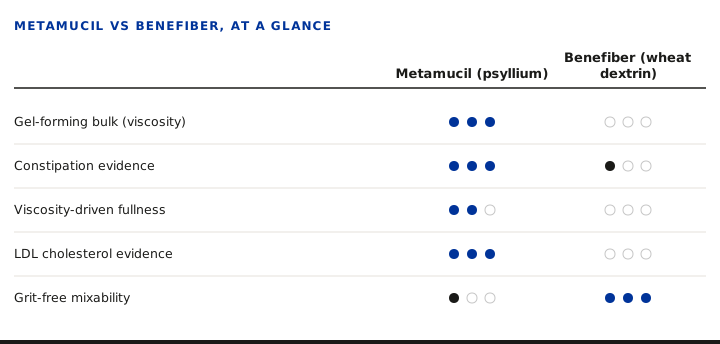
At a glance: Metamucil (psyllium) leads on everything the gel drives, bulk, constipation evidence, fullness and cholesterol; Benefiber (wheat dextrin) leads only on grit-free mixability. More filled dots mean greater relative strength. Source: this article’s cited trials (Reichert 2016; Perreau 2026; Jovanovski 2018).
| Metamucil (psyllium) | Benefiber (wheat dextrin) | |
|---|---|---|
| What it is | Plantago ovata seed husk | Soluble fibre made from wheat starch |
| How it works | Gel-forming bulk: absorbs water into a viscous gel | Non-viscous: fermented by gut bacteria, no gel |
| Gel-forming bulk (viscosity) | High | Below the limit of detection |
| Constipation evidence | Broadest of any supplemental fibre | Direct trial null; resistant-dextrin class mixed |
| Viscosity-driven fullness | Engages the mechanism (viscous class) | Less than half a viscous fibre’s satiety response |
| LDL cholesterol evidence | Meta-analysis: about 11 mg/dL lower | No comparable evidence |
| Grit-free mixability | Thickens and needs a full glass of water | Dissolves clear and tasteless |
| EU authorised health claim | None | None |
What is actually in each one?
Metamucil is psyllium husk. Psyllium (from Plantago ovata) is a soluble, gel-forming fibre. It absorbs many times its weight in water and turns into a viscous gel that adds bulk and softness to stool. It is the fibre type most widely recommended by US healthcare professionals for regularity, and it carries the largest clinical evidence base of any supplemental fibre for constipation.1 The plain, unflavoured version is essentially just psyllium powder; a teaspoon provides roughly 2.4 g of soluble fibre, and research doses sit around 7 to 10 g per day.1
Benefiber is wheat dextrin. Wheat dextrin is a soluble fibre made by treating wheat starch. Unlike psyllium, it is non-viscous: it dissolves completely, does not thicken liquid, and has no gel to form. Its effects, whatever they are, come from being fermented by bacteria in the colon rather than from bulking with a gel.2 Our own back catalogue has always described this class of processed soluble fibres the same way: easy to take, well tolerated, and less well evidenced for specific benefits than the fibres above it.3
That is the whole comparison in miniature. One fibre works by forming a gel; the other works by being eaten by your gut bacteria. They are not two versions of the same thing.
Why does viscosity decide what a fibre can do?
Viscosity is not a marketing word here. It is the measurable thickness of the gel a fibre forms, and it is the property that most of a soluble fibre’s mechanical benefits depend on. A viscous gel slows the stomach’s emptying, blunts the rise in blood sugar after a meal, binds bile acids on the way through, and holds water in the stool. A fibre that forms no gel can do very little of that by the same route.
The gap is not subtle. When researchers measured wheat dextrin’s viscosity directly, it came in below the detection limit of the instrument, while a viscous comparator fibre reached tens of thousands of centipoise.4 In the same line of work, wheat dextrin produced less than half the fullness response of the viscous fibre it was tested against (a satiety score roughly 215 versus 470, a statistically significant gap), and the authors attributed the fullness and glucose benefits explicitly to the viscous fibre slowing gastric emptying.4 Psyllium is a viscous gel-former in the same class as that comparator, so the mechanism carries over: the gel is doing the work. The same viscosity logic separates psyllium from the other common soluble fibre people weigh it against, chicory inulin.
What this means for a GLP-1 user. The medication already slows your gastric emptying and blunts appetite. Fibre is not going to out-muscle the drug on fullness. But if you are choosing a fibre partly for satiety, the honest read is that a gel-forming fibre engages the same lever the drug uses, and a non-viscous one barely touches it.
Which one actually helps constipation?
For psyllium, the evidence is broad and old. It is the reference fibre for chronic constipation, used at 7 to 10 g per day, and it improves stool frequency and consistency by holding water in a gel.1 On a GLP-1 medication, where slowed transit is a common cause of new constipation, that water-holding gel is exactly the property you are reaching for.
For wheat dextrin, the picture is thinner and more mixed. The resistant-dextrin family it belongs to does have supporting data: a pooled analysis of randomised trials found resistant maltodextrin increased stool frequency and volume versus placebo.5 Two caveats keep that from settling the question. First, most of that positive data is for a corn-derived resistant maltodextrin, not the wheat dextrin in Benefiber, and the pooled analysis was authored by people affiliated with the ingredient’s manufacturer.5 Second, and more directly, the one recent trial that tested wheat dextrin itself, at 15 g per day for four weeks, found no statistically significant change in stool frequency or consistency versus placebo, even though it did shift the gut microbiome.6 It even measured lower butyrate, a fermentation by-product usually treated as a benefit, on the fibre than on placebo.6
So the fibre with the direct, on-target trial came back flat for regularity, and the fibre with the deep evidence base is the gel-former. For constipation, that points to psyllium.
Is Benefiber better tolerated, then?
In one specific sense, yes, and it is a real advantage. Wheat dextrin dissolves clear and tasteless and does not change the texture of a drink. Psyllium’s gel is the thing some people cannot get past: it thickens water into something closer to a thin pudding if you drink it slowly, and it demands a full glass of water each time so it does not sit heavy. If the reason you stopped taking fibre before was the grit or the gel, Benefiber genuinely solves that problem.
Gas and bloating are a separate question, and here the honest answer is that it varies by person and by fibre. Any fermentable fibre can cause wind while your gut adjusts, and no trial has put Metamucil and Benefiber head to head for GI comfort. What our corpus has consistently found is that the gentlest options for a sensitive or nausea-prone gut on a GLP-1 tend to be the slow-fermenting, low-FODMAP fibres such as PHGG, rather than either of these two by default.3 If tolerability is your single priority, that is worth knowing before you assume Benefiber is automatically the kindest choice.
What we do not know yet
The comparison has real gaps, and naming them is the honest way to hold the answer.
There is no direct Metamucil-versus-Benefiber trial. Nobody has put psyllium and wheat dextrin in the same study and measured who wins on constipation, fullness or comfort. This comparison is built from each fibre’s own evidence plus a shared mechanism, not from a head-to-head.
The wheat dextrin evidence leans on substitutes. The positive regularity data is mostly a corn-derived cousin, and the satiety mechanism was demonstrated against a different viscous fibre, not psyllium itself. The direct wheat-dextrin trial is a single small pilot in healthy men, not people on a GLP-1.6
Cholesterol and blood-sugar comparisons are one-sided. Psyllium has a meta-analysis showing it lowers LDL cholesterol by around 11 mg/dL, through the same bile-acid-binding gel.7 No comparable wheat-dextrin evidence surfaced, so this is not a fair fight so much as an absence on one side.
None of that changes the direction of the answer. It changes how loudly you should hold it.
Can either one make an EU health claim?
If you compare the two boxes in a European pharmacy, neither can legally claim a specific health benefit for its fibre. Under EU Regulation 432/2012, there is no authorised health claim for psyllium and none for wheat dextrin.8 The authorised bowel-function claims belong to wheat bran, oat and barley grain fibre and rye; the cholesterol and post-meal glucose claims belong to oat and barley beta-glucan.8 That is a quirk of which companies submitted which dossiers, not a ruling that these fibres do nothing. The clinical evidence for psyllium exists regardless of what the label is allowed to say.
Psyllium is the better-evidenced fibre for the things a GLP-1 user usually wants from one. Benefiber is the easier one to drink. Knowing which of those you are buying is most of the decision.
Footnotes
-
Psyllium husk composition, viscosity, professional recommendation status and dosing summarised in our best fibre supplements guide; psyllium research doses of 7 to 10 g per day. ↩ ↩2 ↩3
-
Wheat dextrin and resistant maltodextrin are non-viscous, water-soluble, fermentable fibres derived from starch; their effects come from colonic fermentation rather than gel formation. Watanabe et al., Clinical and Experimental Gastroenterology, 2018 (PMID 29535547); Reichert et al., Nutrients, 2016. ↩
-
Wheat dextrin and resistant dextrins “dissolve easily and are well tolerated, but the evidence for specific health benefits is less robust” than for gel-forming fibres; slow-fermenting low-FODMAP PHGG is the gentlest option for sensitive digestion. See what is dietary fibre and OptiFibre alternatives. ↩ ↩2
-
Reichert RG et al. Viscous versus non-viscous fibre, satiety and glycaemia: wheat dextrin viscosity below the limit of detection versus a viscous comparator at tens of thousands of centipoise; satiety area-under-curve roughly 215 versus 470 cm·min (p<0.001), benefits attributed to viscosity-driven slowing of gastric emptying. Nutrients. 2016;8(2). ↩ ↩2
-
Watanabe T, et al. Systematic review and meta-analysis: resistant maltodextrin significantly increased stool frequency (mean difference 0.71, 95% CI 0.48–0.94) and volume versus placebo. Clinical and Experimental Gastroenterology. 2018 (PMID 29535547). Most trials used corn-derived resistant maltodextrin, not wheat dextrin, and authors were affiliated with the ingredient manufacturer. ↩ ↩2
-
Perreau C, et al. Wheat dextrin (NUTRIOSE, the Benefiber class) at 15 g/day for four weeks: no statistically significant difference from placebo in stool frequency or consistency despite significant microbiota shifts, and significantly lower butyrate than placebo (15.2 vs 19.3 µmol/g, p=0.0113). Randomised, double-blind, placebo-controlled pilot in healthy men. Frontiers in Nutrition. 2026. ↩ ↩2 ↩3
-
Jovanovski E, et al. Psyllium reduced LDL cholesterol by approximately 0.28 mmol/L (about 11 mg/dL) versus placebo via viscous gel binding bile acids. American Journal of Clinical Nutrition. 2018;108(5):922–932. See fibre and cholesterol. ↩
-
Commission Regulation (EU) No 432/2012, Annex (authorised health claims). No authorised claim is listed for psyllium/ispaghula or wheat dextrin; bowel-function claims apply to wheat bran, oat and barley grain fibre and rye fibre, and cholesterol/post-meal-glucose claims to oat and barley beta-glucan. See EFSA health claims explained. ↩ ↩2