
Psyllium husk is the seed coat of Plantago ovata, a fiber that absorbs up to 40 times its own weight in water and sets into a gel.1 Europe regulates it as a herbal medicine for constipation, and as a food it holds no authorised EU health claim.
That split is the most useful thing to know about it. The same powder sits on a pharmacy shelf with an official dose and a choking warning, and on a supermarket shelf where the label may not say what it does. Both describe the same seed coat. The difference is which law is doing the talking.
→ Read: Types of fiber supplements compared
The mechanism is simple enough to watch in a glass. Stir a spoonful into water and within minutes it thickens into something closer to jelly. Nearly everything psyllium does in the gut, and nearly everything that can go wrong with it, follows from that one property. If the idea that thickness predicts a fiber’s behaviour better than the soluble and insoluble label is new, our guide to particle size and chain length sets out the framework this page uses.
Where does psyllium husk come from?
Plantago ovata is a plantain. Its seeds carry a thin outer coat, and that coat, milled away from the seed, is the husk. The European Medicines Agency files it under the Latin Plantaginis ovatae seminis tegumentum and the English name ispaghula husk.1 The German version of the same monograph calls it Indische Flohsamenschalen, and most people reading a tub label will simply see psyllium.
Chemically, the husk is mostly an arabinoxylan: a long, heavily branched chain of sugars with a high degree of polymerisation.2 Human digestive enzymes cannot break it down, so it travels through the small intestine intact.
How does psyllium behave in the gut?
It holds water, and it holds on to it.
The EMA monograph describes a fiber that absorbs up to 40 times its own weight in water, is about 85 percent water-soluble, and is only partly fermented: in laboratory fermentation, 72 percent of it remained as unfermented residue.1 Psyllium dissolves, swells, and then largely refuses to be eaten.
The consequences run in a straight line. Because the gel survives to the colon, it carries water into the stool, which is how psyllium bulks and softens it at the same time. Because little of it is fermented, it produces little gas. In a 2022 crossover study using MRI and breath hydrogen in 19 people with IBS, psyllium produced very little colonic gas, while inulin produced the most, and taking the two together brought inulin’s gas down to near-placebo levels.2 The researchers traced that to psyllium’s viscosity, not to any block on fermentation.
The gel also slows things down. A 2026 crossover trial in 30 people found psyllium slowed transit from mouth to colon compared with both maltodextrin and methylcellulose.3 That trial measured gas production, not how anyone felt, but it is the same mechanism behind psyllium’s interaction with tablets taken at the same moment.
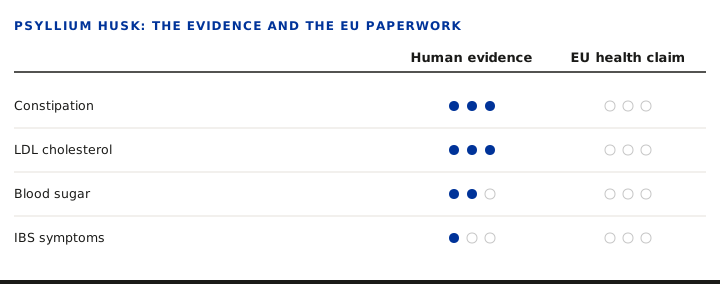
How deep the human evidence runs for psyllium, outcome by outcome, against its EU claim status. Three dots: a meta-analysis of trials in which psyllium itself showed a significant effect. Two: a sponsor-authored meta-analysis with the effect confined to people whose glucose was already raised. One: a single randomised trial. Sources: van der Schoot et al., AJCN 2022; Jovanovski et al., AJCN 2018; Gibb et al., AJCN 2015; Bijkerk et al., BMJ 2009; Regulation (EU) No 432/2012 and the EU Register of health claims, retrieved 23 September 2026.
| Outcome | What the human evidence found | EU health claim |
|---|---|---|
| Constipation | Meta-analysis, 16 trials of fiber, 1,251 adults; psyllium among the fibers with a significant effect | None |
| LDL cholesterol | Meta-analysis, 28 psyllium trials, 1,924 people; LDL 0.33 mmol/L lower | None |
| Blood sugar | Meta-analysis, 35 psyllium trials; effect only where glucose was already raised | None |
| IBS symptoms | One trial, 275 people in general practice | None |
What do the human trials on psyllium show?
More than for most supplement fibers, and less evenly than the marketing suggests. The evidence is broad for two outcomes, narrow for one, and conditional for the fourth.
Constipation. A 2022 meta-analysis pooled 16 randomised trials of fiber supplements in 1,251 adults with chronic constipation. Across fibers, 66 percent of people responded compared with 41 percent on control, and psyllium was one of two fibers with a significant effect on its own.4 The benefit showed up at doses above 10 grams a day, and the rise in stool frequency only after four weeks or more. The same review found flatulence was higher in the fiber groups than on control, which is worth holding next to the gas study above: less gas than inulin is not the same as no gas at all.
LDL cholesterol. A 2018 meta-analysis of 28 trials in 1,924 people, at a median of about 10.2 grams of psyllium a day for at least three weeks, found LDL cholesterol 0.33 mmol/L lower than control.5 The authors graded that estimate as moderate quality, downgraded because the trials disagreed with each other more than chance would explain. Our guide to fiber and cholesterol puts that figure next to the fibers that do carry an EU claim.
IBS. The best single trial is Dutch and ran in general practice. It gave 275 patients 10 grams a day of psyllium, bran or a rice-flour placebo for 12 weeks.6 In the first month, 57 percent on psyllium reported adequate relief against 35 percent on placebo, and 59 against 41 percent in the second. By month three, symptom severity had fallen 90 points on psyllium and 49 on placebo. Quality of life did not differ. Bran did worse: it only beat placebo in the third month, not robustly, and bran was where early dropouts clustered, mostly because symptoms got worse. One trial, well run, and it points the same way as the gas data.
Blood sugar. A 2015 meta-analysis of 35 trials found psyllium lowered fasting glucose and HbA1c in people being treated for type 2 diabetes, modestly in people with prediabetes, and not significantly in people with normal glucose.7 The effect was proportional to how far glucose had already drifted. Two caveats belong next to it: the first three authors worked for Procter & Gamble, and the search included the company’s own clinical records. That does not make the result wrong. It does make it the one finding here we would most like to see replicated independently.
Does psyllium husk have an EU health claim?
No, not as a food. Commission Regulation (EU) No 432/2012, the list of health claims a food may lawfully carry, does not mention psyllium, plantago or ispaghula anywhere.8 The EU Register holds exactly one entry that includes it: a cholesterol claim for “soluble fibre (from oat, psyllium, pectin or guar gum),” marked non-authorised.8
The fibers that do carry EU claims in psyllium’s territory are other ones. Barley, oat and wheat bran fiber hold the authorised claims for faecal bulk; beta-glucans, pectins and guar gum hold the cholesterol claims.9
This is not a verdict on psyllium. EFSA turns down roughly nine submissions in ten, most often because the dossier did not establish cause and effect for the specific wording filed.10 The United States went the other way: its food regulator has allowed a heart-health claim for soluble fiber from psyllium seed husk since 1998, at 7 grams of soluble fiber a day.11 Same husk, same trials, different paperwork. Our explainer on how EFSA health claims work covers why the European bar sits where it does.
How is psyllium regulated as a medicine in Europe?
Here the record is much fuller. The EMA’s Committee on Herbal Medicinal Products adopted a monograph on ispaghula husk in 2013 under “well-established use.”1 It lists three indications: habitual constipation, conditions in which easy passage of a soft stool is desirable, and raising daily fiber intake, for example alongside diet in raised cholesterol or in constipation-predominant IBS.
The monograph is also where the safety rules come from. Take at least 30 ml of liquid for every gram. Keep it half an hour to an hour away from other medicines. Do not take it immediately before bed. With too little fluid, bulk-forming agents can obstruct the throat, oesophagus or intestine.1 Our psyllium husk dosage guide works through each of those numbers in practice.
That monograph is now under periodic review. The EMA ran a call for new scientific data from February to May 2024, and as of today no revised text has been published.12
Who does psyllium suit, and who does it not?
It suits people whose problem is hard or infrequent stools. That is the outcome with the widest trial base, and the one the monograph is written around.
It tends to suit people who react badly to fermentable fibers. Slow fermentation means little gas, and in the IBS trial psyllium was the fiber people stayed on while bran was the one they left.
It asks for water and patience. The effect starts 12 to 24 hours after a dose and can take two to three days to peak.1 A tub that is taken with a sip of water is a tub doing its job badly, and potentially a hazard.
It is a poor fit for anyone with difficulty swallowing, a narrowing anywhere in the gut, or a suspected blockage; the monograph lists those as reasons not to use it.1
It needs spacing from tablets. The gel can delay absorption of medicines taken with it, and the monograph names minerals, vitamin B12, warfarin-type anticoagulants, carbamazepine and lithium, and asks that people with diabetes or on thyroid hormones use it only under medical supervision.1 If you take a GLP-1 medicine, our guide to taking fiber with GLP-1 medication sets out the timing.
How does psyllium compare with inulin and PHGG?
They sit at three different points on the same map. PHGG was engineered to lose its thickness and does its work by fermenting. Chicory inulin is thin too, ferments quickly, and holds the only EU bowel-function claim of the three. Psyllium is the thick one, and the slow one to ferment. For the head-to-head on gas and gel, see inulin vs psyllium; for choosing by goal, our guide to the best fiber for constipation.
Most people reading this are already short of fiber; most Europeans eat well under the recommended intake. Psyllium is one of the better-documented ways to close some of that gap, provided the glass is full.
Sources
Footnotes
-
European Medicines Agency, Committee on Herbal Medicinal Products. Community herbal monograph on Plantago ovata Forssk., seminis tegumentum (ispaghula husk). EMA/HMPC/199774/2012, final, adopted 14 May 2013. Well-established use; indications, posology (7 to 11 g a day for constipation; 7 to 20 g a day to raise fiber intake), fluid rule of 30 ml per gram, spacing from other medicines, contraindications, interactions, onset 12 to 24 hours; pharmacodynamics: absorbs up to 40 times its weight in water, about 85 percent water-soluble, 72 percent unfermented residue in vitro. ↩ ↩2 ↩3 ↩4 ↩5 ↩6 ↩7 ↩8
-
Gunn D, Abbas Z, Harris HC, et al. Psyllium reduces inulin-induced colonic gas production in IBS: MRI and in vitro fermentation studies. Gut 2022;71(5):919-927. Randomised four-treatment crossover in 19 IBS patients; psyllium described as a Plantago ovata arabinoxylan of high degree of polymerisation. ↩ ↩2
-
Crossover randomised trial (n=30), Food & Function 2026, NCT06291272. Psyllium slowed orocaecal transit versus maltodextrin (p=0.046) and methylcellulose (p=0.033). Measures gas production, not symptom severity. ↩
-
van der Schoot A, Drysdale C, Whelan K, Dimidi E. The effect of fiber supplementation on chronic constipation in adults: an updated systematic review and meta-analysis of randomized controlled trials. American Journal of Clinical Nutrition 2022. PMID 35816465. 16 RCTs, 1,251 participants; 66 percent versus 41 percent response; psyllium and pectin significant; benefit at doses above 10 g a day and durations of at least 4 weeks; flatulence higher with fiber. ↩
-
Jovanovski E, Yashpal S, Komishon A, et al. Effect of psyllium (Plantago ovata) fiber on LDL cholesterol and alternative lipid targets, non-HDL cholesterol and apolipoprotein B: a systematic review and meta-analysis of randomized controlled trials. American Journal of Clinical Nutrition 2018;108(5):922-932. PMID 30239559. 28 RCTs, n=1,924; median dose about 10.2 g a day; LDL −0.33 mmol/L (95% CI −0.38 to −0.27); moderate-quality evidence. ↩
-
Bijkerk CJ, de Wit NJ, Muris JW, Whorwell PJ, Knottnerus JA, Hoes AW. Soluble or insoluble fibre in irritable bowel syndrome in primary care? Randomised placebo controlled trial. BMJ 2009;339:b3154. PMID 19713235. ↩
-
Gibb RD, McRorie JW Jr, Russell DA, Hasselblad V, D’Alessio DA. Psyllium fiber improves glycemic control proportional to loss of glycemic control. American Journal of Clinical Nutrition 2015;102(6):1604-14. PMID 26561625. Three of five authors affiliated with Procter & Gamble; search included company clinical records. ↩
-
Commission Regulation (EU) No 432/2012, consolidated text, and the European Commission EU Register of nutrition and health claims (2,331 entries), both retrieved 23 September 2026. One psyllium-related entry: “Soluble Fibre (from oat, psyllium, pectin or guar gum)”, non-authorised. ↩ ↩2
-
EU Register of nutrition and health claims: authorised faecal-bulk claims for barley grain fibre, oat grain fibre and wheat bran fibre; authorised cholesterol claims for beta-glucans, pectins and guar gum. ↩
-
Authorisation rates as set out in our review of the EFSA claims process, which cites more than 2,300 applications and approximately 267 authorisations. ↩
-
US Food and Drug Administration. Soluble fiber from certain foods and risk of coronary heart disease. 21 CFR 101.81 (1998). Psyllium seed husk, 7 g a day of soluble fiber. ↩
-
European Medicines Agency, herbal medicine page for Plantaginis ovatae seminis tegumentum, retrieved 24 September 2026: call for scientific data for the periodic review of the monograph, EMA/HMPC/62844/2024, consultation 15 February to 15 May 2024, closed. ↩