Glucomannan is the soluble fiber from the root of the konjac plant. It soaks up water and turns into a thick gel. It holds two EU health claims, one for cholesterol and one for weight loss, and it must always be taken with plenty of water.
It is sold as a powder, capsule or tablet, and it is the same material as food additive E 425. Among fiber supplements it sits next to psyllium husk as a gel-former, and far from PHGG, which stays thin in a drink.
→ Read: Types of fiber supplements compared
Where does glucomannan come from?
Glucomannan comes from the tuber of Amorphophallus konjac. The raw tuber is ground into konjac flour, and glucomannan is its main component.1 EFSA notes a long history of safe use of konjac in Far Eastern countries.1
Chemically, it is a long chain of two sugars, mannose and glucose, in a ratio of about 1.6 to 1.1 The purified form sold as konjac glucomannan (E 425 ii) is at least 95% dietary fiber by dry weight.1
How does glucomannan behave in water?
It swells. Depending on purity, glucomannan absorbs up to 200 times its weight in water and forms a very thick solution in hot or cold water.1 Psyllium, the best-known gel-forming fiber, absorbs up to 40 times its weight.2
Food makers use it as a thickener for the same reason, and the swelling is also behind its main safety rule.
In the gut, glucomannan is not absorbed. It passes to the colon, where gut bacteria break down a large share of it.1 Psyllium is the opposite on this point: most of it passes through unfermented.2
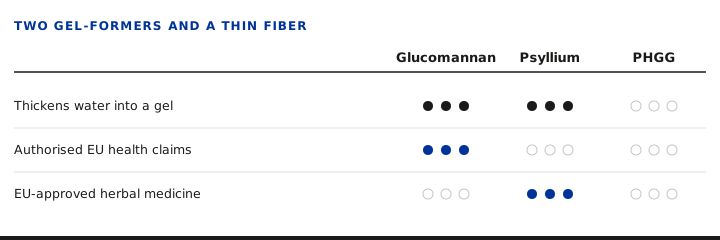
Glucomannan and psyllium both form a gel, but only glucomannan holds EU health claims, and only psyllium is approved as a herbal medicine. Sources: EFSA Journal 2017;15(6):4864 (E 425); EMA ispaghula husk monograph; Commission Regulation (EU) No 432/2012; EU Register of nutrition and health claims.
| Property | Glucomannan | Psyllium husk | PHGG |
|---|---|---|---|
| Thickens water into a gel | Yes | Yes | No |
| Authorised EU health claims | Two (cholesterol, weight) | None under its own name | None |
| EU-approved herbal medicine | No | Yes (ispaghula husk) | No |
Which EU health claims does glucomannan hold?
Two, each with set conditions of use.
Cholesterol. “Glucomannan contributes to the maintenance of normal blood cholesterol levels.” The food must provide 4 grams of glucomannan a day.3
Weight. “Glucomannan in the context of an energy restricted diet contributes to weight loss.” The conditions are 3 grams a day, taken as three 1-gram doses with 1 to 2 glasses of water before meals, within an energy-restricted diet.3
Both claims must carry a warning about choking for people with swallowing difficulties or who drink too little with it, and advice to take it with plenty of water so it reaches the stomach.3
Other submissions for glucomannan, on bowel function, blood sugar after meals and gut bacteria, were not authorised.4 Our explainer on how EFSA judges fiber claims covers what a refusal does and does not mean.
What does the research on glucomannan show?
Cholesterol. A 2024 review pooled 11 small trials with 334 adults, lasting 3 to 12 weeks.5 Total and LDL cholesterol fell, and triglycerides did not change. The results varied a lot between trials, and the reviewers rated the certainty of the evidence as low. They judged the drop too small to count as clinically important and described glucomannan as a possible add-on, not a treatment. Our guide to the best fiber for cholesterol compares it with oat beta-glucan and psyllium.
Weight. A 2023 Slovenian trial gave 100 adults with overweight or obesity a reduced-calorie diet plus one of four fiber supplements or a placebo for 8 weeks.6 One group took 3 grams of glucomannan a day, two doses before each main meal, which matches the EU claim. That group did not lose significantly more weight than the placebo group. The authors wrote that their results do not support the EU recommendation. The trial was not blinded, and a supplement maker supplied the products and helped fund it. Our guide to the best fiber for weight loss covers the wider evidence.
Constipation. The results point both ways. In a 2004 crossover trial, 31 children with chronic constipation were treated successfully more often on glucomannan (45%) than on placebo (13%).7 In a 2011 trial of 80 children, 2.52 grams a day as the only treatment did no better than placebo.8 A 2025 trial in China randomised 48 male taekwondo athletes with functional constipation to glucomannan or a control group for 8 weeks.9 The glucomannan group had better symptom scores and more frequent bowel movements, but stool consistency did not change. The EU bowel-function claim for glucomannan was not authorised.4
What are the side effects of glucomannan?
Digestive discomfort is the common one. In human studies reviewed by EFSA, people reported flatulence, a feeling of fullness, bloating, diarrhoea or constipation. At 3 grams a day for 12 weeks, several people had abdominal discomfort.1 Our guide on starting a fiber supplement without bloating covers how to build up a dose.
Choking is the serious one. Glucomannan can swell before it reaches the stomach if it is taken with too little liquid. Between 1984 and 1985, seven cases of a blocked oesophagus caused by swelling glucomannan tablets were reported in Australia.1 The EU banned konjac in jelly mini-cup sweets in 2003 after fatal choking accidents, mainly in children.1 This is why the EU claims require a choking warning.
EFSA saw no safety concern for the general population at the levels used in food and set no numerical limit on daily intake.1
How do you take glucomannan safely?
Take it with plenty of water, every time. The EU claim conditions describe 1-gram doses, each with 1 to 2 glasses of water, before meals.3 The Australian cases of a blocked oesophagus all involved tablets.1 People who have difficulty swallowing should not take it.
If you take other medicines, ask a pharmacist about timing. Our page on taking fiber with a GLP-1 medication explains when spacing matters.
Who might glucomannan suit?
People who want a fiber with an EU cholesterol claim and can manage 4 grams a day with water.
People who like a thick, filling drink. It forms a gel, the opposite of PHGG or acacia.
It is less suited to people who want an easy daily habit. It thickens fast, needs a lot of water, and is not for anyone who has trouble swallowing. For regularity, psyllium has more evidence.
Glucomannan is the gel-forming fiber with two EU claims, and the trials behind those claims are smaller and less consistent than the claims suggest.
Sources
Footnotes
-
EFSA Panel on Food Additives and Nutrient Sources added to Food (ANS). “Re-evaluation of konjac gum (E 425 i) and konjac glucomannan (E 425 ii) as food additives.” EFSA Journal 2017;15(6):4864. doi:10.2903/j.efsa.2017.4864. Covers the source (tuber of Amorphophallus konjac), composition (mannose and glucose, molar ratio 1.6:1.0; E 425 ii at least 95% total dietary fibre), water absorption (“up to 200 times of their weight”), fermentation (“significantly fermented by intestinal microbiota”), gastrointestinal effects in human studies including 3 g/day for 12 weeks, the seven Australian cases of oesophageal obstruction from tablets (1984–1985), the jelly confectionery ban (Directive 2003/52/EC), and the conclusion that no numerical ADI is needed. ↩ ↩2 ↩3 ↩4 ↩5 ↩6 ↩7 ↩8 ↩9 ↩10 ↩11
-
European Medicines Agency, Committee on Herbal Medicinal Products. Community herbal monograph on Plantago ovata Forssk., seminis tegumentum (ispaghula husk), EMA/HMPC/199774/2012. Water absorption up to 40 times its weight; in vitro, 72% of the husk remained unfermented. ↩ ↩2
-
Commission Regulation (EU) No 432/2012 establishing a list of permitted health claims made on foods, consolidated text of 17 May 2021, entries for glucomannan (konjac mannan): blood cholesterol (4 g per day) and weight loss in the context of an energy-restricted diet (3 g per day in three 1 g doses with 1–2 glasses of water before meals), each with a choking warning. ↩ ↩2 ↩3 ↩4
-
European Commission, Food and Feed Information Portal, EU Register of nutrition and health claims: non-authorised entries for glucomannan / konjac on normal bowel function, blood glucose and post-meal glycaemic responses, and gut microorganisms. ↩ ↩2
-
Musazadeh V, Rostami RY, Moridpour AH, et al. “The effect of glucomannan supplementation on lipid profile in adults: a GRADE-assessed systematic review and meta-analysis.” BMC Cardiovascular Disorders 2024. doi:10.1186/s12872-024-04223-0. PMID 39385065. 11 randomised trials, 334 participants, 3 to 12 weeks; low GRADE certainty for total and LDL cholesterol; effect judged not clinically significant against a ±1 mmol/L threshold. ↩
-
Jenko Pražnikar Z, Mohorko N, Gmajner D, Kenig S, Petelin A. “Effects of Four Different Dietary Fibre Supplements on Weight Loss and Lipid and Glucose Serum Profiles during Energy Restriction in Patients with Traits of Metabolic Syndrome.” Foods 2023;12(11):2122. PMID 37297364. ClinicalTrials.gov NCT05333315. Not blinded; supplements provided by Biostile Ltd, which co-funded the study. ↩
-
Loening-Baucke V, Miele E, Staiano A. “Fiber (glucomannan) is beneficial in the treatment of childhood constipation.” Pediatrics 2004;113(3):e259. PMID 14993586. ↩
-
Chmielewska A, Horvath A, Dziechciarz P, Szajewska H. “Glucomannan is not effective for the treatment of functional constipation in children: a double-blind, placebo-controlled, randomized trial.” Clinical Nutrition 2011. PMID 21320737. ClinicalTrials.gov NCT01151878. ↩
-
Zhu Y, Chen X, Song G. “Effects of konjac glucomannan on gastrointestinal symptoms and gut microbiota in athletes with functional constipation: a double-blind randomized controlled trial.” European Journal of Nutrition 2025. PMID 41117955. Randomised: 48 (24 per group), of 56 enrolled; Bristol Stool Scale did not differ between groups. Dose not reported in the abstract. ↩