
If you have landed here, you probably want a straight answer: which type should I be taking? The honest answer is that it depends on what you are trying to fix. This piece explains the difference, why it matters, and how to choose. For the European population context on why fiber type selection matters, see the European fiber gap.
What does “soluble” and “insoluble” actually mean?
The names describe exactly what they say. Soluble fiber dissolves in water. Insoluble fiber does not.1
That physical property is not a trivia point. It determines almost everything about how each type behaves in your digestive system. A fiber that dissolves can form a gel, slow the movement of food, and be fermented by bacteria in your colon. A fiber that does not dissolve stays structurally intact, adds physical bulk, and moves things along mechanically.
This is why “just eat more fiber” is incomplete advice. The two types do different jobs. Someone with constipation who only eats insoluble fiber may see no improvement if their actual problem is slow colonic fermentation. Someone with loose stools who loads up on fermentable soluble fiber may make things worse.
The older nutrition literature treated the soluble/insoluble split as the main classification. More recent work has added a second, arguably more useful distinction: fermentable vs. non-fermentable, and viscous vs. non-viscous.2 We cover both below, because the newer framework explains things the old one cannot.
Soluble fiber: what it does
Soluble fiber dissolves in water and typically forms a gel-like substance in the upper digestive tract. That gel has several effects.
It slows gastric emptying. Food leaves the stomach more gradually, which blunts the post-meal blood sugar spike and increases feelings of fullness.3
It binds bile acids. In the small intestine, soluble fiber (particularly viscous types like beta-glucan and psyllium) binds to bile acids and carries them out of the body. Your liver then uses circulating cholesterol to make more bile, which lowers blood LDL.4
It feeds gut bacteria. In the colon, many soluble fibers are fermented by resident bacteria into short-chain fatty acids (SCFAs): acetate, propionate, and butyrate. Butyrate in particular is the primary energy source for the cells lining your colon and has been studied for its role in gut barrier integrity and inflammation.5
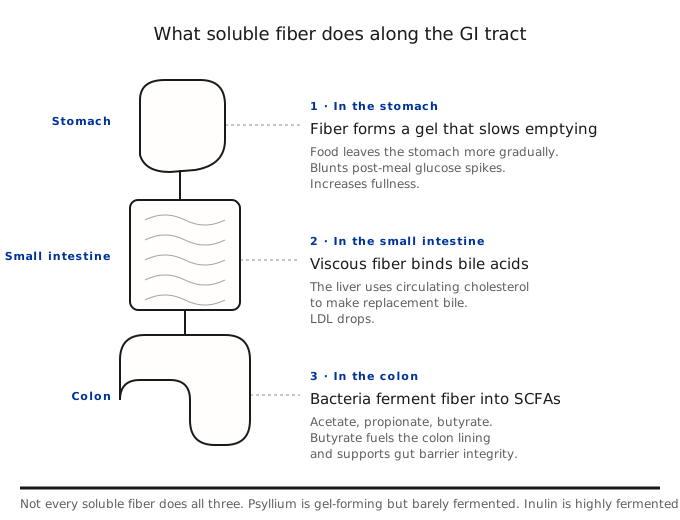
Not every soluble fiber does all three of these things. Psyllium forms a strong gel and binds bile acids but is only weakly fermented. Inulin is highly fermentable and an excellent prebiotic but does not form a gel. Beta-glucan from oats does both. The overlap is not total.
Common soluble fiber sources:
- Oats and barley (beta-glucan)
- Chicory root (inulin)
- Psyllium husk
- Legumes: beans, lentils, chickpeas
- Apples, pears, citrus fruits (pectin)
- Flaxseeds
- Partially hydrolyzed guar gum (PHGG)
Insoluble fiber: what it does
Insoluble fiber does not dissolve in water and is generally not fermented (or is fermented very slowly). Its main job is mechanical.
It adds bulk to stool. Insoluble fiber absorbs water without dissolving, which increases stool weight and softness. Larger, softer stools are easier to pass and stimulate the stretch receptors in the colon that trigger bowel movements.6
It speeds transit time. By adding bulk and stimulating colonic contractions, insoluble fiber reduces the time food spends in the large intestine. This is generally considered beneficial: faster transit means less time for potentially harmful compounds to be in contact with the colon wall, and it prevents the kind of dehydrated, hard stools that cause constipation.
It does not feed gut bacteria much. Because insoluble fiber is largely non-fermentable, it does not produce significant SCFAs and does not act as a prebiotic in the same way soluble fibers do. This is sometimes framed as a limitation. It is more accurately described as a different job.
Common insoluble fiber sources:
- Wheat bran and whole wheat products
- Nuts and seeds (most of the fiber in the skin and hull)
- Vegetable skins and stalks: broccoli stems, celery, cauliflower
- Brown rice
- Green beans
- Root vegetables with skin
Most whole plant foods contain both types. An apple with its skin gives you pectin (soluble) from the flesh and cellulose (insoluble) from the skin. A bowl of oatmeal gives you beta-glucan (soluble) and the cell wall material (insoluble) in roughly equal parts.7 This is one reason food-first advice usually just works: whole foods deliver both without anyone having to think about ratios.
Viscous vs. fermentable: the more useful distinction
The soluble/insoluble split is useful as a first pass. It is not precise enough to explain why some fibers work for some problems and not others.
A better framework asks two separate questions about any given fiber:
Is it viscous? Does it form a gel in water? Viscosity is what drives the blood sugar and cholesterol effects. A high-viscosity fiber like psyllium or beta-glucan will lower LDL and blunt glucose spikes. A low-viscosity fiber like inulin will not, even though both are technically soluble.8
Is it fermentable? Can colonic bacteria break it down into SCFAs? Fermentability is what drives the prebiotic and gut-microbiome effects. A highly fermentable fiber like inulin or resistant starch will feed bifidobacteria and produce butyrate. A minimally fermentable fiber like cellulose or methylcellulose will not, even though they have very different solubility.9
The practical version of this framework looks like a 2x2:
- Viscous and fermentable: beta-glucan (oats), pectin. Good for blood sugar, cholesterol, and gut bacteria.
- Viscous and non-fermentable: psyllium. Good for stool bulk, cholesterol, and glucose control. Minimal gas.
- Non-viscous and fermentable: inulin, PHGG, resistant starch. Good for gut bacteria and bowel function. Can cause gas during adaptation.
- Non-viscous and non-fermentable: wheat bran, cellulose, methylcellulose. Good for stool bulk and transit. Minimal gas.
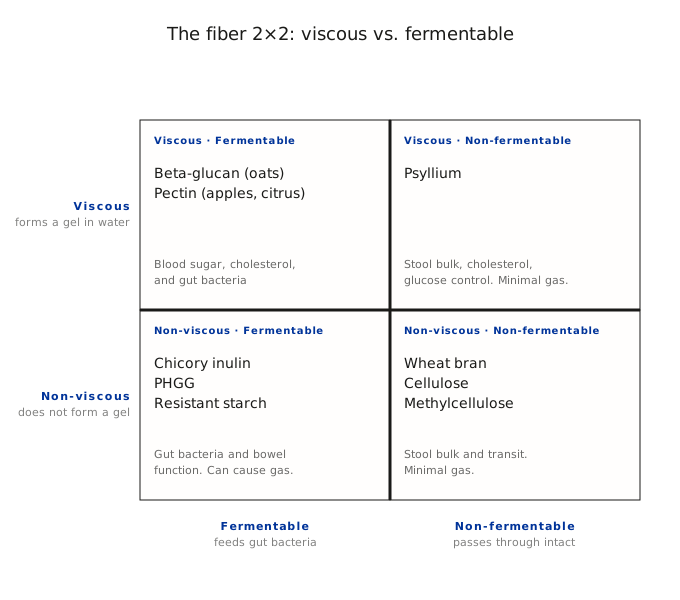
If you know which quadrant a fiber sits in, you can predict what it will and will not do. The old soluble/insoluble label only tells you half of this.
Which type do you need?
The right fiber depends on the problem you are solving.
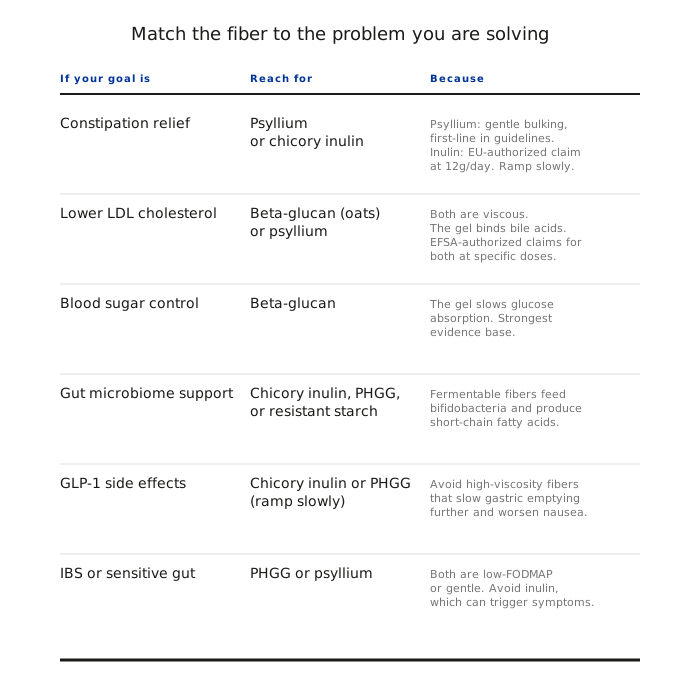
If your goal is regularity and you have constipation. Both soluble and insoluble fiber can help, but through different mechanisms. Psyllium (viscous, non-fermentable soluble fiber) is the first-line recommendation from most gastroenterology guidelines because it works through gentle bulking without significant gas.10 Chicory inulin has the only EU-authorized health claim for increasing stool frequency at 12g per day and works through a different mechanism (fermentation and bacterial mass), but it requires a gradual ramp to avoid bloating. Wheat bran (insoluble) works for some people but can be too abrasive for sensitive guts.
If your goal is lowering LDL cholesterol. You want a viscous fiber. Beta-glucan from oats (3g per day) has an EFSA-authorized claim for cholesterol maintenance; psyllium has strong clinical evidence and a US FDA cholesterol claim but no EU-authorized cholesterol claim.11 Inulin and wheat bran will not do this. The mechanism is gel formation and bile acid binding, which non-viscous fibers cannot do. For the full breakdown of which fibers have EU-authorized cholesterol claims and at what doses, see fiber and cholesterol.
If your goal is blood sugar control. Same answer: viscous fibers. The gel slows glucose absorption, which reduces post-meal spikes. Beta-glucan has the strongest evidence.12
If your goal is gut microbiome support. You want a fermentable fiber. Chicory inulin is the most studied prebiotic and selectively promotes bifidobacteria. Resistant starch and PHGG are alternatives. Psyllium will not do this well. Wheat bran will not do this at all.
If your goal is managing GLP-1 side effects. This is more complex. GLP-1 medications slow gastric emptying, which means you already have food sitting in your stomach longer than normal. Adding a highly viscous fiber that slows things down even more can make nausea worse for some people. A gentler approach often works better: a moderately fermentable, low-viscosity fiber like chicory inulin (ramped slowly) or PHGG. For more on this, see our guide to GLP-1 constipation and our chicory inulin vs. psyllium comparison.
If you have IBS or a sensitive gut. Be cautious with highly fermentable fibers. Inulin is a FODMAP and can trigger symptoms in sensitive individuals. PHGG is low-FODMAP and is often tolerated well. Psyllium is generally well tolerated and has evidence for IBS symptom management.13
The food-first principle still applies
Everything above is about supplements, but the underlying point is that whole plant foods almost always give you both types of fiber together, along with polyphenols, vitamins, and minerals that no supplement replicates.
The case for supplementation is specific: you cannot close the gap from food alone. For most Europeans this is the default situation. Average fiber intake sits between 16 and 24 grams per day against a recommended 25 to 30 grams.14 For GLP-1 users, the gap is typically larger because total food intake drops. See our European fiber gap analysis for the country-by-country data.
Supplements are a tool for closing that gap, not a replacement for eating plants. If you can reach 25g from food alone, you probably do not need one. If you cannot, the question becomes which type, and the framework above is how to answer it.
The practical summary
A short version, for bookmarking:
- Soluble fiber dissolves in water. Sources: oats, legumes, chicory root, psyllium, fruit. Main effects: blood sugar, cholesterol, gut bacteria.
- Insoluble fiber does not dissolve. Sources: wheat bran, nuts, vegetable skins, whole grains. Main effects: stool bulk, transit time.
- Viscous fibers (a subset of soluble) form gels and are best for LDL and glucose control: beta-glucan, psyllium.
- Fermentable fibers (mostly soluble, plus resistant starch) feed gut bacteria and produce SCFAs: inulin, PHGG, pectin, resistant starch.
- Most whole foods contain both types. Most supplements contain one.
- Match the fiber to the problem you are solving, not the other way around.
For a deeper look at specific supplement types and what each one is best for, see our What Is Dietary Fiber guide and our chicory inulin vs. psyllium husk comparison. And if you want to go further into why two products with the same label can behave like different fibers, see our piece on particle size and degree of polymerization.
Footnotes
-
EFSA Panel on Dietetic Products, Nutrition and Allergies. Scientific opinion on dietary reference values for carbohydrates and dietary fibre. EFSA Journal (2010) 8(3):1462. ↩
-
Gill SK, Rossi M, Bajka B, Whelan K. Dietary fibre in gastrointestinal health and disease. Nature Reviews Gastroenterology & Hepatology (2021) 18:101-116. ↩
-
Jenkins DJ, Wolever TM, Leeds AR, et al. Dietary fibres, fibre analogues, and glucose tolerance: importance of viscosity. BMJ (1978) 1(6124):1392-1394. ↩
-
Gunness P, Gidley MJ. Mechanisms underlying the cholesterol-lowering properties of soluble dietary fibre polysaccharides. Food & Function (2010) 1(2):149-155. ↩
-
Koh A, De Vadder F, Kovatcheva-Datchary P, Backhed F. From dietary fiber to host physiology: short-chain fatty acids as key bacterial metabolites. Cell (2016) 165(6):1332-1345. ↩
-
de Vries J, Miller PE, Verbeke K. Effects of cereal fiber on bowel function: a systematic review of intervention trials. World Journal of Gastroenterology (2015) 21(29):8952-8963. ↩
-
Stephen AM, Champ MM, Cloran SJ, et al. Dietary fibre in Europe: current state of knowledge on definitions, sources, recommendations, intakes and relationships to health. Nutrition Research Reviews (2017) 30(2):149-190. ↩
-
Dikeman CL, Fahey GC. Viscosity as related to dietary fiber: a review. Critical Reviews in Food Science and Nutrition (2006) 46(8):649-663. ↩
-
Slavin J. Fiber and prebiotics: mechanisms and health benefits. Nutrients (2013) 5(4):1417-1435. ↩
-
American Gastroenterological Association. Clinical practice guidelines on the management of chronic idiopathic constipation. Gastroenterology (2013) 144(1):211-217. ↩
-
EFSA Panel on Dietetic Products, Nutrition and Allergies. Scientific opinion on the substantiation of health claims related to beta-glucans from oats and barley. EFSA Journal (2011) 9(6):2207. Psyllium (Plantago ovata) holds no EU-authorized cholesterol claim under Commission Regulation (EU) No 432/2012; its cholesterol evidence is clinical, and it carries a US FDA claim (7g/day soluble fibre, 1998). Verified against the consolidated EU register, 2026-07-15. ↩
-
Tosh SM. Review of human studies investigating the post-prandial blood-glucose lowering ability of oat and barley food products. European Journal of Clinical Nutrition (2013) 67(4):310-317. ↩
-
Moayyedi P, Quigley EM, Lacy BE, et al. The effect of fiber supplementation on irritable bowel syndrome: a systematic review and meta-analysis. American Journal of Gastroenterology (2014) 109(9):1367-1374. ↩
-
Stephen AM et al. (2017), as above. ↩