Yes. Dissolving spreads fiber out in the water, but it does not break it down. Your digestive enzymes cannot split fiber, so it passes the small intestine unabsorbed and reaches the colon, where gut bacteria break it down.
We have heard the same question more than once: if a fiber powder vanishes into a glass of water, how can it do anything? The worry makes sense, because we are used to seeing fiber as something solid, like bran or the skin of an apple. Most Europeans eat less fiber than recommended (see Europe’s fiber gap), and a fiber you cannot see or taste is one of the easier ways to add some.
What happens when fiber dissolves in water?
When fiber dissolves, its molecules spread out evenly through the water. They are still there, only too small and too evenly mixed to see.
Salt does the same thing. Stir a spoon of salt into water and it disappears, but you can still taste it. Nothing has been destroyed. The salt has just moved from a crystal into the space between water molecules.
Soluble fibers differ in what they do to the water once they are in it.
Some thicken it. Guar gum and psyllium form long, tangled chains that hold water in place. Thickness is measured in mPa·s: the higher the number, the thicker the liquid. A 1 percent solution of guar gum measures 2,000 to 3,000 mPa·s.1
Some leave it thin. PHGG, acacia fiber and inulin dissolve without changing much about how the water pours. A 5 percent PHGG solution measures under 10 mPa·s, five times more fiber than the guar solution and still thin.1
Both kinds are fully dissolved. What differs is the length and shape of the chains. Heat and processing can shift this, and some fibers can even move between soluble and insoluble depending on how they are cooked.2 Our soluble vs. insoluble guide covers the fibers that do not dissolve at all.
If sugar dissolves and gets absorbed, why does fiber not?
Because absorption depends on digestion, and dissolving is not digestion.
Sugar and starch are made of sugar units joined by links that our digestive enzymes can cut. Once cut, single sugars pass through the wall of the small intestine into the blood.
Fiber is also made of sugar units, but they are joined by links that human enzymes cannot cut.32 Think of our enzymes as a set of keys. They fit the locks on starch and table sugar. They do not fit the locks on fiber, so fiber chains stay whole and too large to cross the gut wall. Dissolved or not, they carry on down the gut.
This is also how EU law defines fiber. Regulation (EU) No 1169/2011 says fiber means carbohydrate polymers with three or more units “which are neither digested nor absorbed in the human small intestine.”4 The definition says nothing about whether the fiber dissolves.
Where does dissolved fiber go?
Dissolved fiber follows the same path as the rest of your meal, without being taken up along the way.
- The glass. The fiber spreads through the drink. You cannot see it.
- The stomach. The fiber passes through with the rest of the meal. PHGG, for example, is described as stable against stomach acid and digestive enzymes.1
- The small intestine. This is where digested food is absorbed into the blood. Fiber is not absorbed here, because it has not been broken down.4
- The colon. The fiber arrives mostly intact. This is where the gut bacteria are, and where it meets enzymes that can break it down.3
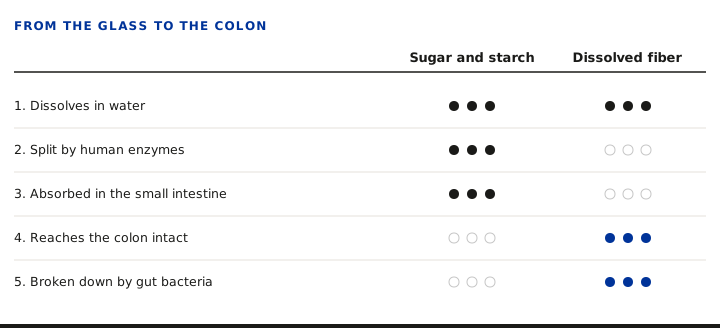
Sugar and dissolved fiber both disappear in water. Only sugar is split and absorbed on the way down; fiber reaches the colon, where bacteria break it down. Sources: Regulation (EU) No 1169/2011, Annex I; Holscher, Gut Microbes 2017.
| Stage | Sugar and starch | Dissolved fiber |
|---|---|---|
| Dissolves in water | Yes | Yes |
| Split by human enzymes | Yes | No |
| Absorbed in the small intestine | Yes | No |
| Reaches the colon intact | No | Yes |
| Broken down by gut bacteria | No | Yes |
What happens to it in the colon?
In the colon, gut bacteria break fiber down. This is called fermentation.
Bacteria carry a large set of enzymes that can cut the links human enzymes cannot.3 Different bacteria handle different fibers, and a single fiber is often broken down by several kinds working in turn.3
Fermentation produces short-chain fatty acids, mainly acetate, propionate and butyrate, along with gases such as hydrogen and carbon dioxide.3 Butyrate is the main energy source for the cells lining the colon.3 Between 90 and 99 percent of short-chain fatty acids are absorbed in the gut or used by the bacteria themselves.3
Not every soluble fiber ferments. Psyllium is soluble and thick but is hardly fermented, so it travels through the colon as a gel that holds water.35 Inulin and PHGG are thin and are fermented. So a fiber can work in the colon in two ways: by being eaten by bacteria, or by staying intact and holding water. Some fibers, such as beta-glucan and pectin, are both thick and fermented.3
Is a fiber you can see stronger than one you cannot?
No. A gel you can see and a thin fiber you cannot see are doing different things, and neither is simply the stronger one.
Thickness matters for the jobs that depend on a gel. One review links several effects in the small intestine to how viscous a fiber is, and names psyllium, beta-glucan and uncut guar gum as the gel-formers.5
Fermentation does not need a gel. A thin fiber reaches the colon just as surely as a thick one, and bacteria can break it down there.3 How fast a fiber ferments, and where in the colon, depends on its chain length and structure, which our piece on particle size and chain length covers in more detail.
PHGG is one example of a fiber you cannot see in the glass. It is guar gum whose chains have been cut by an enzyme to less than a tenth of their original length, so it dissolves clear and stays thin, and it is fermented slowly in the colon.16 It holds no authorised EU health claim.6 Our PHGG monograph covers what the trials on it found.
A fiber that disappears in the glass is still in the drink, and it reaches the colon mostly intact.
Sources
Footnotes
-
Yoon S-J, Chu D-C, Juneja LR. “Chemical and Physical Properties, Safety and Application of Partially Hydrolized Guar Gum as Dietary Fiber.” Journal of Clinical Biochemistry and Nutrition 2008;42:1-7. PMID 18231623. All three authors were at Taiyo Kagaku Co., Ltd., which manufactures the PHGG ingredient Sunfiber. The viscosity figures are measured at different concentrations (1 percent guar gum, 5 percent PHGG). ↩ ↩2 ↩3 ↩4
-
Coker JK, Moyne O, Rodionov DA, Zengler K. “Carbohydrates great and small, from dietary fiber to sialic acids: How glycans influence the gut microbiome and affect human health.” Gut Microbes 2021. PMID 33615984. ↩ ↩2
-
Holscher HD. “Dietary fiber and prebiotics and the gastrointestinal microbiota.” Gut Microbes 2017;8(2):172-184. PMID 28165863. ↩ ↩2 ↩3 ↩4 ↩5 ↩6 ↩7 ↩8 ↩9 ↩10
-
Regulation (EU) No 1169/2011 on the provision of food information to consumers, Annex I, point 12 (definition of “fibre”). ↩ ↩2
-
McRorie JW Jr, McKeown NM. “Understanding the Physics of Functional Fibers in the Gastrointestinal Tract: An Evidence-Based Approach to Resolving Enduring Misconceptions about Insoluble and Soluble Fiber.” Journal of the Academy of Nutrition and Dietetics 2017;117(2):251-264. PMID 27863994. ↩ ↩2
-
Our PHGG monograph and its sources, including the EU Register of nutrition and health claims, entries for partially hydrolysed guar gum (13 submissions, none authorised), retrieved 23 September 2026. ↩ ↩2