Acacia fiber is gum arabic: the dried resin of acacia trees, ground into a powder and sold as a soluble fiber. It dissolves in water without thickening, and gut bacteria break it down slowly.
Most Europeans eat less fiber than recommended, as our overview of Europe’s fiber gap shows, and a powder that mixes into any drink is one of the easier ways to add some. Acacia behaves much like PHGG in a drink and very differently from psyllium husk.
→ Read: Types of fiber supplements compared
Where does acacia fiber come from?
Acacia fiber comes from two tree species, Acacia senegal and Acacia seyal. EU food law defines the material as “a dried exudation obtained from the stems and branches” of these trees.12 The resin hardens on the bark, is collected and cleaned, and is usually spray-dried into a pale powder.
The same material is a common food additive, E 414, used to hold oil and water together in soft drinks and sweets.
It is made mostly of arabinogalactan, a branched chain of sugars. EFSA concluded in 2017 that it is unlikely to be absorbed intact, so it reaches the colon, where gut bacteria ferment part of it.2
How is acacia fiber different from other fibers?
Acacia fiber stays thin in water and is fermented slowly.
It stays thin. One gram dissolves in two millilitres of cold water and still flows easily.2 Solutions are almost odourless, colourless and tasteless.2 PHGG behaves the same way in a drink. Psyllium does the opposite: it absorbs water and forms a gel, and the gel is what softens stool. Acacia cannot do that.
It ferments slowly. EFSA describes acacia gum as only slightly fermented by gut bacteria.2 In a laboratory model of the human gut, acacia was still being fermented in the last section of the colon, while a fast-fermenting fiber (fructo-oligosaccharides) was used up near the start.3 That model was run by researchers at Nexira, an acacia supplier.
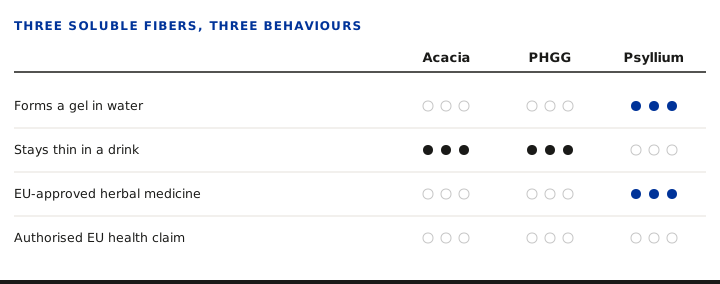
Psyllium husk forms a gel and is approved as a herbal medicine. Acacia and PHGG stay thin in a drink. None of the three holds an authorised EU health claim under its own name. Sources: Commission Regulation (EU) No 231/2012, E 414; EFSA Journal 2017;15(4):4741; EMA ispaghula husk monograph; EU Register of nutrition and health claims, 2026.
| Property | Acacia fiber | PHGG | Psyllium husk |
|---|---|---|---|
| Forms a gel in water | No | No | Yes |
| Stays thin in a drink | Yes | Yes | No |
| EU-approved herbal medicine | No | No | Yes (ispaghula husk) |
| Authorised EU health claim | None | None | None under its own name |
Does acacia fiber cause gas?
Some people get more gas, especially at high doses. In the human studies EFSA reviewed, adults tolerated up to 30 grams a day for up to 18 days. Some of them had flatulence. At 53 grams a day, people had mild flatulence.2 EFSA judged this unpleasant but not harmful, and set no upper limit.
No study we found compared acacia with other fibers for gas, so we cannot say whether it causes more or less.
What does the research on acacia fiber show?
There are two useful studies on acacia alone, and both have links to suppliers.
A trial in IBS with constipation. In the Dutch NUTRIC study, 180 adults with constipation-predominant IBS took acacia fiber, a probiotic or a placebo for four weeks.4 The acacia group started at 5 grams a day for five days and then took 10 grams, split into two doses. Compared with placebo, they had more bowel movements: on average 1.3 more a week than before the trial. Stool consistency, stool weight and quality of life did not change compared with placebo. One author works for Nexira, which supplied the fiber and helped fund the study.
A study of gut bacteria. Healthy adults took 5, 10, 20 or 40 grams of gum arabic a day for four weeks.5 Their stool had more Bifidobacteria and Lactobacilli, and 10 grams worked best. The lead author worked for Kerry, another gum arabic supplier. The study counted bacteria and did not measure symptoms.
Other trials tested acacia mixed with a probiotic or with other fibers, so they cannot tell us what the acacia did on its own.
Does acacia fiber have an EU health claim?
No. The EU Register of nutrition and health claims lists twelve submissions for acacia, covering bowel function, gut comfort, gut bacteria, cholesterol, blood sugar and kidney function.6 None was authorized, and the EU list of permitted claims does not include acacia.7
A refusal means the evidence submitted did not meet EFSA’s standard. It does not prove the fiber has no effect. Most fiber claims are refused, as our explainer on how EFSA judges fiber claims shows. In practice, it means acacia fiber may not be sold in the EU with claims about digestion, gut bacteria, cholesterol or blood sugar.
How much acacia fiber do people take?
The trials used 10 grams a day. The IBS trial built up to it over five days, starting at 5 grams and splitting the dose between morning and evening. The higher amounts in EFSA’s review, 30 and 53 grams, are safety data. They do not show that more works better.2
Acacia mixes into water, coffee, tea or soup at any temperature. Our guide on how to start a fiber supplement without bloating covers how to build up the dose.
Who might acacia fiber suit?
People who stopped taking fiber because of the texture. Acacia does not thicken a drink or change its taste.
People who want to add a few grams of fiber without changing their meals. It mixes into what you already drink.
It is less suited to hard, dry stools. Psyllium forms a gel that softens stool and has more trial evidence for constipation, which is why it leads our guide to the best fiber for constipation.
Acacia fiber is easy to take and well tolerated, and the research on what it does in the body is still small.
Sources
Footnotes
-
Commission Regulation (EU) No 231/2012 laying down specifications for food additives, entry E 414 Acacia gum (synonym: gum arabic). The definition reads: “Acacia gum is a dried exudation obtained from the stems and branches of strains of Acacia senegal (L) Willdenow or closely related species of Acacia (family Leguminosae). It consists mainly of high molecular weight polysaccharides and their calcium, magnesium and potassium salts, which on hydrolysis yield arabinose, galactose, rhamnose and glucuronic acid.” ↩
-
EFSA Panel on Food Additives and Nutrient Sources added to Food (ANS). “Re-evaluation of acacia gum (E 414) as a food additive.” EFSA Journal 2017;15(4):4741. PMID 32625453. Covers the extension of the specification to Acacia seyal (JECFA, 1998), solubility (“one gram dissolves in 2 mL of cold water forming a solution which flows readily”), fermentation, and the human tolerance data at 30 g and 53 g per day. ↩ ↩2 ↩3 ↩4 ↩5 ↩6 ↩7
-
Terpend K, Possemiers S, Daguet D, Marzorati M. “Arabinogalactan and fructo-oligosaccharides have a different fermentation profile in the Simulator of the Human Intestinal Microbial Ecosystem (SHIME).” Environmental Microbiology Reports 2013. PMID 23864575. Author affiliation includes Nexira. Laboratory model, not a human study. ↩
-
JanssenDuijghuijsen L, van den Belt M, Rijnaarts I, et al. “Acacia fiber or probiotic supplements to relieve gastrointestinal complaints in patients with constipation-predominant IBS: a 4-week randomized double-blinded placebo-controlled intervention trial.” European Journal of Nutrition 2024. PMID 38653808. ClinicalTrials.gov NCT04798417. One author is employed by Nexira; Nexira was among the co-funders. ↩
-
Calame W, Weseler AR, Viebke C, Flynn C, Siemensma AD. “Gum arabic establishes prebiotic functionality in healthy human volunteers in a dose-dependent manner.” British Journal of Nutrition 2008. PMID 18466655. First author affiliated with Kerry Group. ↩
-
European Commission, Food and Feed Information Portal, EU Register of nutrition and health claims, entries under “Acacia gum (gum arabic)” (nine) and “Galactoligo-saccharide (Arabino-galactans or Gum Acacia)” (three), retrieved 23 September 2026. ↩
-
Commission Regulation (EU) No 432/2012 establishing a list of permitted health claims made on foods, consolidated text of 17 May 2021. ↩