
If you have gone looking for the best fiber for constipation, you have probably found a wall of supplement ads and very little that explains why one fiber works and another does nothing, or even backfires. The honest short answer: the best fiber for constipation is a soluble fiber that holds water and bulks stool, and the single best-evidenced choice is psyllium husk. Chicory inulin is a strong second option with a unique regulatory pedigree. The type matters far more than the brand, which is what this guide is about. For the wider picture of how the two broad fiber families behave, start with soluble vs. insoluble fiber; for why most of us are short on fiber in the first place, see the European fiber gap.
Why fiber helps constipation (and why some types do not)
Constipation is, mechanically, stool that is too hard, too small, or moving too slowly through the colon. Fiber can fix each of those, but different fibers do different jobs.1
Water-holding and bulking. Soluble, gel-forming fibers absorb water in the gut and form a soft, bulky mass. That larger, softer stool is easier to pass and stimulates the stretch receptors that trigger a bowel movement.1
Speeding transit. Insoluble fiber adds mechanical bulk that stimulates the colon to contract and move contents along faster.1
Feeding bacteria. Fermentable fibers are broken down by gut bacteria, which increases bacterial mass in the stool and can increase stool frequency, but the same fermentation produces gas.
This is why “just eat more fiber” is incomplete advice, and why the wrong fiber can disappoint. Someone with hard, infrequent stools who loads up on a highly fermentable fiber may get more gas without much relief. The useful question is not “how much fiber” but “which fiber.”
Psyllium: the first-line choice
What it is. Psyllium husk (from Plantago ovata) is a soluble, viscous fiber that forms a gel and holds water, but it is only weakly fermented, so it bulks and softens stool with very little gas.
The evidence. Psyllium is the fiber that gastroenterology guidelines name first for chronic constipation.2 A 2022 systematic review and meta-analysis pooled 16 randomised controlled trials covering 1,251 adults with chronic constipation: fiber increased stool frequency and improved consistency, and about 66% of people responded to fiber compared with about 41% on control. When the researchers looked at fiber types individually, psyllium was one of the few with a clear, significant effect on stool frequency.3
That combination, strong evidence plus low gas, is why psyllium is the sensible default for most people. For a direct head-to-head with the main alternative, see inulin vs. psyllium.
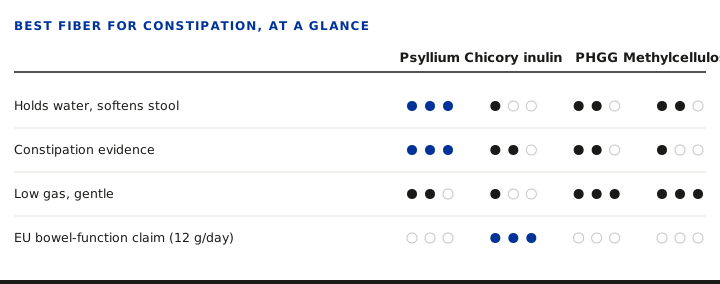
How the four leading soluble fibers compare for constipation. Psyllium leads on water-holding and evidence; chicory inulin is the only one carrying the EU-authorized bowel-function claim (12g/day); PHGG and methylcellulose are the gentlest. Sources: AGA 2013; AJCN 2022 meta-analysis (16 RCTs, 1,251 adults); Commission Regulation (EU) 2015/2314.
Chicory inulin: the EU-authorized option
What it is. Inulin is a soluble but non-gelling fiber that is highly fermentable. It works through fermentation rather than bulking: gut bacteria break it down, bacterial mass increases, and stool frequency goes up.
The evidence. Chicory inulin holds the only EU-authorized health claim for bowel function. Under Commission Regulation (EU) 2015/2314, the authorized wording is that “chicory inulin contributes to normal bowel function by increasing stool frequency,” at a daily intake of 12g of native chicory inulin.4 That is a genuine mark of regulatory scrutiny that almost no other fiber can show.
The catch. Inulin is high-FODMAP and gas-producing. Starting at the full 12g can cause real bloating and discomfort, so it needs a careful, gradual ramp. It is an excellent option, especially if a prebiotic benefit matters to you, but it is not the “start here” fiber that psyllium is.
The gentle alternatives: PHGG and methylcellulose
If psyllium or inulin do not agree with you, two soluble fibers are known for being easy on the gut:
- Partially hydrolyzed guar gum (PHGG) is a soluble fiber prized for being low-gas and well tolerated, which makes it a common recommendation when tolerance is the priority. See OptiFibre and PHGG alternatives.
- Methylcellulose is a soluble bulk-former that is not fermented at all, so it produces essentially no gas.
Neither has inulin’s EU claim or psyllium’s depth of constipation trials, but both are reasonable choices for sensitive systems.
What about wheat bran and other insoluble fiber?
Insoluble fiber, such as wheat bran, works for some people by adding bulk and speeding transit. But because it does not gel or hold water the way soluble fiber does, it can be too abrasive for sensitive guts and sometimes worsens symptoms rather than easing them.2 It is worth trying from whole foods, but it is not the first thing to reach for as a constipation supplement.
How to use fiber for constipation without the bloat
The most common reason fiber “does not work” is how it is taken, not which one.
- Start low. Begin with about 3 to 5g a day for the first week, whatever the fiber.
- Ramp slowly. Increase by a few grams each week over one to two weeks until you reach the target dose (psyllium around 7 to 10g a day; chicory inulin 12g a day).
- Drink water. Take every serving with at least a full glass (250 to 300ml). Gel-forming fibers need water to soften stool; without it, they can do the opposite.
Rushing the dose or skimping on water is what turns a helpful fiber into bloating and harder stools.
If your constipation comes from a GLP-1 medication
Constipation is one of the most common side effects of GLP-1 medications: semaglutide (Ozempic, Wegovy) and tirzepatide (Mounjaro) slow gastric emptying while cutting how much food and water you take in.5 The fiber logic above still applies, but with two adjustments: start even lower and go even slower, because the gut is already slowed, and pay extra attention to hydration, because these medications can blunt thirst. For the mechanism and a full protocol, see our complete guide to fiber and GLP-1 medications and the focused GLP-1 constipation guide, and if you are on the dual agonist specifically, Mounjaro (tirzepatide) and constipation. The bigger context, that most people are already short of fiber before a medication reduces intake, is the European fiber gap.
When to see a doctor
Fiber and hydration handle most everyday constipation, but some situations need medical attention rather than self-treatment. See a doctor if constipation comes on suddenly and severely, if it lasts more than about two weeks despite fiber and fluids, or if it comes with blood in the stool, unexplained weight loss, or severe abdominal pain.
Footnotes
-
de Vries J, Miller PE, Verbeke K. Effects of cereal fiber on bowel function: a systematic review of intervention trials. World Journal of Gastroenterology (2015) 21(29):8952-8963. See also Gill SK, Rossi M, Bajka B, Whelan K. Dietary fibre in gastrointestinal health and disease. Nature Reviews Gastroenterology & Hepatology (2021) 18:101-116. ↩ ↩2 ↩3
-
American Gastroenterological Association. Clinical practice guidelines on the management of chronic idiopathic constipation. Gastroenterology (2013) 144(1):211-217. ↩ ↩2
-
Systematic review and meta-analysis of fiber supplementation in chronic constipation, The American Journal of Clinical Nutrition (2022): 16 randomised controlled trials, 1,251 adults; approximately 66% response to fiber vs 41% control; psyllium showed a clear, significant effect on stool frequency. ↩
-
Commission Regulation (EU) 2015/2314 authorising the health claim that chicory inulin contributes to normal bowel function by increasing stool frequency (condition of use: 12g of native chicory inulin per day). Based on the EFSA scientific opinion of 9 January 2015. ↩
-
European Medicines Agency product information for tirzepatide (Mounjaro) and semaglutide (Ozempic, Wegovy): constipation is a commonly reported gastrointestinal side effect, linked to delayed gastric emptying. ↩