PHGG, partially hydrolyzed guar gum, is guar gum whose chains have been cut by an enzyme until the thickness is gone. It is the same galactomannan from the same bean, at roughly one tenth the chain length, and it dissolves into water without changing how the water pours, tastes or looks.
Guar gum is one of the most viscous fibers in the food supply, and that viscosity is what makes it hard to put into a drink at a dose that matters. Hydrolysis is the fix, and the EU specification for guar gum as a food additive says so in four words: the gum may be partially hydrolyzed “for viscosity adjustment.”1
→ Read: Types of fiber supplements compared
That trade is why the powder disappears into coffee, why it turns up in tube feeds and clear beverages, why it keeps coming up for people whose guts react badly to other fibers, and why it cannot do the jobs a fiber does by forming a gel. That most Europeans already fall well short of the recommended fiber intake is what makes the differences between fiber types practical rather than academic. If the distinction between a thick fiber and a thin one is new to you, our guide to particle size and chain length covers why those properties predict behaviour better than the soluble and insoluble split most labels still use.
What is PHGG made from?
Guar gum is the ground endosperm of the seed of Cyamopsis tetragonolobus, the guar bean, a legume grown mainly in India and Pakistan. Chemically it is a galactomannan: a backbone of mannose sugars carrying galactose side groups, at a ratio of roughly two mannose to one galactose.2 Human digestive enzymes cannot break those linkages, so the whole molecule arrives in the colon, where gut bacteria ferment it.
PHGG is that same molecule, shortened. Production uses beta-endo-mannanase, an enzyme that cuts the mannose backbone while leaving the galactose side groups attached, followed by sterilization and spray drying.2 The chemistry is unchanged. The chain is not.
Two numbers describe the result. Intact guar gum runs to a molecular weight in the hundreds of thousands of daltons and above. PHGG, measured by gel-filtration chromatography, ranges from 1,000 to 100,000 daltons with an average around 20,000.2 Its makers describe the chain as less than one tenth the original length.
A note on where those figures come from: the paper that reports them was written by researchers at Taiyo Kagaku, the company that manufactures Sunfiber, the best known branded PHGG. The measurements are the most detailed published characterization available, and they are also the manufacturer’s own. Read them as a specification, not as an independent audit.
Why does removing the viscosity matter?
Because viscosity is the mechanism behind a large share of what viscous fibers do, and PHGG has almost none of it.
The comparison in the published characterization is stark. A 1 percent solution of food-grade guar gum measures between 2,000 and 3,000 mPa·s. A 5 percent solution of PHGG measures under 10.2 Note the mismatch in the concentrations, which is worth stating plainly: even at five times the concentration, PHGG is thinner by orders of magnitude. Water sits at about 1.
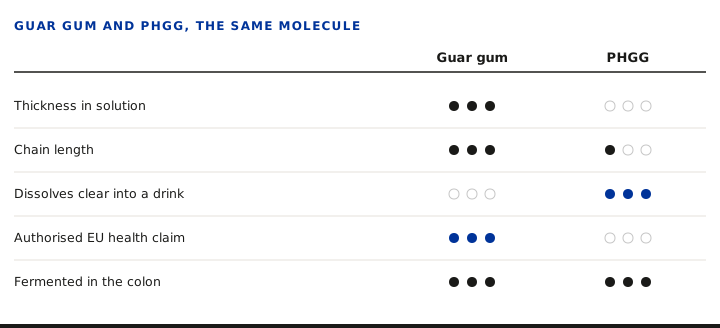
The same galactomannan, before and after the enzyme. Hydrolysis changes the physics and the paperwork; it does not change the chemistry or the fate in the colon. More filled dots mean more of the property named, not a better fiber. Sources: Yoon, Chu and Juneja 2008 (viscosity, chain length, solubility); Regulation (EU) No 231/2012 E 412 (hydrolysis for viscosity adjustment); Regulation (EU) No 432/2012 and the EU Register of health claims, retrieved 23 September 2026.
| Guar gum | PHGG | |
|---|---|---|
| What it is | Ground endosperm of the guar bean, a galactomannan | The same galactomannan, cut by beta-endo-mannanase |
| Thickness in solution | 2,000 to 3,000 mPa·s at 1 percent | Under 10 mPa·s at 5 percent |
| Chain length | Long; hundreds of thousands of daltons and above | Average 20,000 Da, range 1,000 to 100,000 |
| Dissolves clear into a drink | No, forms a viscous colloid | Yes, clear and tasteless |
| Authorised EU health claim | One, for blood cholesterol at 10 g a day | None; 13 register entries, all non-authorised |
| Fermented in the colon | Yes | Yes |
This is why PHGG shows up where other fibers cannot go. It stays clear, it does not thicken a drink, it survives low pH and heat, and it resists digestive enzymes.2 A fiber that can be stirred into a liquid feed or a bottled tea at a useful dose without turning it into a gel is solving a formulation problem, and PHGG was engineered to solve exactly that one.
The cost is the other half of the ledger. Gel formation is how psyllium bulks and softens stool, and how beta-glucan and pectin blunt the glucose rise after a meal, which is why both hold authorized EU claims for post-meal blood sugar and PHGG does not. A fiber built to stop being thick has given up the mechanism those claims rest on. Whatever PHGG does, it does by fermenting, not by gelling.
What do the human trials on PHGG actually show?
Three randomized controlled trials survive close reading, and they total roughly 200 participants between them. None ran longer than 12 weeks. None was multi-centre. This is a thin evidence base, and what it points at is stool consistency and bloating rather than the outcomes most people buy fiber for.
In irritable bowel syndrome. A 12-week trial gave 3 grams a day for one week and then 6 grams a day, against placebo, in patients with IBS.3 Of 121 randomized, 108 had complete data. PHGG beat placebo on bloating (P=0.03) and on bloating and gases combined (P=0.035). It did not beat placebo on abdominal pain (P=0.334), on stool frequency (P=0.713), on the Francis overall severity score (P=0.421) or on quality of life (P=0.788). Six endpoints were reported with no stated correction for multiple comparisons, and the two that crossed significance did so at 0.03 and 0.035. Treat the bloating result as one small trial’s signal.
In people with loose stools. A 12-week double-blind trial in 44 volunteers with a loose-stool tendency, taking 5 grams a day, found stool form moving toward Bristol type 4, with between-group significance at weeks 7 and 11.4 On frequency the paper is unambiguous: “There were no significant inter-group differences at any time point concerning stool frequency.” These were healthy volunteers selected for soft stools, not patients with diagnosed IBS-D, and the trial was funded by the manufacturer of the PHGG used. The null result runs against the sponsor’s interest, which makes it the more trustworthy half of the paper.
In frail elderly residents with constipation. A four-week trial gave 52 long-term-care residents, mean age 84, either 5 grams of PHGG in 200 ml of water or 200 ml of water, while they continued taking laxatives as they chose.5 Total laxative use separated from placebo in week 3 (p=0.047) and week 4 (p=0.037), with no difference in weeks 1 and 2. Lactulose use separated in weeks 3 and 4, senna in week 4, bisacodyl not at all. The separation appearing only in the second half is what the data show; why it appeared then is not something this trial establishes.
Stack the three together and a pattern emerges that is narrower than the marketing around this fiber. Stool form moved. Bloating moved in one trial. Stool frequency did not move in either trial that measured it directly.
How well tolerated is PHGG?
Well enough, on thin data, with a caveat that most write-ups drop.
The care-home trial is the only verified one that gave a fixed 5 grams a day with no build-up period. Its authors report that gastrointestinal symptoms were infrequent with no significant difference between groups: bloating 3 versus 2 (p=1.000), abdominal pain 1 versus 2 (p=1.000), increased flatulence 8 versus 3 (p=0.173).5
That flatulence line deserves a second look. Twenty-six people per arm is far too few to detect a difference in side effects, and p=0.173 on 8 versus 3 is roughly 31 percent against 12 percent. A non-significant result in a trial this small means the difference was not detected, not that it was absent. A larger trial could resolve that gap as real.
What we cannot tell you is how PHGG compares to other fibers on gas. The comparison is made constantly, including in our own earlier writing, and the studies behind it are closed-vessel laboratory fermentations rather than trials in people. A batch fermenter is not a colon. PHGG is fermented slowly and completely; ranking it against inulin, FOS or psyllium for how much wind it produces in a human being is not something the published human evidence supports yet.
Monash University, which runs the FODMAP research programme and its certification laboratory, classifies PHGG as low FODMAP, and several PHGG supplements carry Monash certification.6 That is a statement about composition, tested in a laboratory. It is not a clinical finding that any given person will tolerate it.
Does PHGG have an EU health claim?
No. The parent material does, and PHGG does not, which is a distinction worth following carefully.
Guar gum holds exactly one authorized claim in EU law: “Guar gum contributes to the maintenance of normal blood cholesterol levels,” usable only on a food delivering 10 grams of guar gum a day, and carrying a warning about choking for people with swallowing difficulties.7
PHGG holds nothing. It appears in the EU Register of nutrition and health claims under three different spellings, across thirteen entries covering bowel function, gastrointestinal discomfort, short-chain fatty acid production, cholesterol, triglycerides, blood glucose, post-meal glycaemic response, satiety, body weight, immune function and gut flora.8 All thirteen are non-authorized. A search of the authorized annex for any hydrolyzed form returns nothing at all.
Two readings of that record are wrong, in opposite directions.
It does not mean PHGG was disproven. EFSA rejects roughly nine of every ten submissions, most often because the claimed effect was not accepted as a beneficial physiological effect or because cause and effect was not established from the studies filed.9 A non-authorization records what a dossier failed to demonstrate. Our explainer on how EFSA health claims work walks through the standard in detail.
It also does not mean PHGG inherits the guar gum claim. The authorized entry names guar gum and writes its conditions of use in grams of guar gum, and the cholesterol effect of intact guar is driven by the viscosity that PHGG has deliberately had removed. Whether a PHGG product may lawfully carry that wording is a question for a regulator or a food-law specialist, and not one this article is going to answer for you.
How much PHGG do people take?
The trials cluster tightly. Three used 5 to 6 grams a day, and nothing above 6 grams has been tested in the studies reviewed here. No dose-finding trial has been published, so there is no evidence-based ceiling and no demonstrated dose-response curve. The 5 to 10 gram range quoted on retail sites comes from product labels, not from trials.
Two build-up schedules exist in the record. The IBS trial used 3 grams a day for seven days before moving to 6.3 OptiFibre, which is 100 percent PHGG sold as a food for special medical purposes, instructs one 5 gram scoop on days 1 to 3 and two scoops from day 4, under medical supervision for at least 14 days.10 The care-home trial used a fixed 5 grams from day one with no titration at all, and reported no significant excess of symptoms, in 26 people.5
A gradual build-up is therefore a sensible convention with one trial-level precedent behind it, not a schedule the evidence has established. Our guide to starting a fiber supplement without bloating covers the general practice, which applies to any fermentable fiber.
Who does PHGG suit, and who does it not?
It suits people for whom texture is the obstacle. A fiber that vanishes into coffee, soup or a glass of water solves the problem of fiber supplements that are unpleasant enough to abandon in week two. Adherence is not a clinical endpoint, but a fiber nobody takes has an effect size of zero.
It suits people whose stools are loose rather than absent. That is the outcome with the clearest signal, from the Bristol-scale trial, and it is a real and specific use.
It is a poor fit where a gel is the point. For the mechanical work of bulking and softening hard stool, psyllium has the broader evidence base, which is why it leads our guide to the best fiber for constipation. For the post-meal glucose rise, the fibers that hold authorized EU claims are the viscous ones and the pectins. For a documented bowel-function claim at a defined dose, chicory inulin is the only fiber in Europe that has one.
Caution applies to anyone with swallowing difficulty. The choking warning attached to the guar gum claim exists for a reason, and any powdered fiber belongs in a full glass of liquid.
PHGG is a fiber with a precise design brief and a quiet evidence base. The first is documented in regulation and in the chemistry. The second is what most of its marketing is built on.
Sources
Footnotes
-
Commission Regulation (EU) No 231/2012 laying down specifications for food additives, entry E 412 Guar Gum. The definition reads: “Guar gum is the ground endosperm of the seeds of strains of the guar plant, Cyamopsis tetragonolobus (L.) Taub. (family Leguminosae) … The gum may be partially hydrolysed by either heat treatment, mild acid or alcaline oxidative treatment for viscosity adjustment.” This entry specifies guar gum as a food additive; the hydrolysis routes it names are heat, acid and alkaline oxidative treatment, whereas supplement-grade PHGG is produced enzymatically. ↩
-
Yoon S-J, Chu D-C, Juneja LR. “Chemical and Physical Properties, Safety and Application of Partially Hydrolized Guar Gum as Dietary Fiber.” Journal of Clinical Biochemistry and Nutrition 2008;42:1-7. PMID 18231623. All three authors were at the Central Research Laboratories of Taiyo Kagaku Co., Ltd., which manufactures Sunfiber. ↩ ↩2 ↩3 ↩4 ↩5
-
Niv E, Halak A, Tiommny E, et al. “Randomized clinical study: partially hydrolyzed guar gum (PHGG) versus placebo in the treatment of patients with irritable bowel syndrome.” Nutrition & Metabolism (London) 2016;13:10. PMID 26855665. ↩ ↩2
-
Yasukawa Z, Inoue R, Ozeki M, et al. “Effect of Repeated Consumption of Partially Hydrolyzed Guar Gum on Fecal Characteristics and Gut Microbiota: A Randomized, Double-Blind, Placebo-Controlled, and Parallel-Group Clinical Trial.” Nutrients 2019. PMID 31509971. Funded by Taiyo Kagaku Co., Ltd. ↩
-
Chan TC, Yu VMW, Luk JKH, Chu LW, Yuen JKY, Chan FHW. “Effectiveness of Partially Hydrolyzed Guar Gum in Reducing Constipation in Long Term Care Facility Residents: A Randomized Single-Blinded Placebo-Controlled Trial.” The Journal of Nutrition, Health and Aging 2022. PMID 35297467. Trial registration NCT05037565. ↩ ↩2 ↩3
-
Monash University FODMAP programme, monashfodmap.com, 26 March 2025, on PHGG’s low FODMAP status and the certification testing standard; and “Fibre supplements and IBS,” Lyndal Collins and Dr Marina Iacovou, research dietitians, 10 November 2017, which describes the PHGG evidence in IBS as preliminary and states that more studies are needed. ↩
-
Commission Regulation (EU) No 432/2012 establishing a list of permitted health claims made on foods, consolidated text, Annex entry for Guar Gum. EFSA opinion 2010;8(2):1464, consolidated list entry 808. ↩
-
European Commission, Food and Feed Information Portal, EU Register of nutrition and health claims, entries under “Guar gum partially hydrolyzed,” “Hydrolised guar gum” and “Partially Hydrolysed Guar Gum (PHGG),” retrieved 23 September 2026. ↩
-
Authorization rates as set out in our own review of the EFSA claims process, which cites more than 2,300 applications and approximately 267 authorizations. ↩
-
Nestlé Health Science, OptiFibre product information: 100 percent partially hydrolysed guar gum; 5 g per scoop; one scoop on days 1 to 3 and two scoops from day 4; use under medical supervision for at least 14 days. Classified as a food for special medical purposes under Commission Delegated Regulation (EU) 2016/128. ↩