Beta-glucan is the soluble fiber in oats and barley. It thickens water into a sticky solution and holds EU health claims for normal blood cholesterol at 3 grams a day and for a smaller rise in blood sugar after a meal. The effect depends on the form: it works in oats and barley, and a tablet in one recent trial did not.
Among fiber supplements, it sits with psyllium husk and glucomannan as a gel-forming fiber. Of the three, it is the only one with EU claims for both cholesterol and blood sugar.
→ Read: Types of fiber supplements compared
Where does beta-glucan come from?
Beta-glucan sits in the cell walls of the oat and barley grain. Oat grain contains 2 to 7% beta-glucan, depending on the variety and where it was grown.1 Barley grain typically contains about 4%, and some varieties reach 10%.2
In practice, that is a small amount per bowl. A 40 gram serving of oats carries roughly 1 to 3 grams of beta-glucan (a worked example from the typical oat range, not a lab measurement).3 Oat bran and barley are the denser sources, and the authorised EU claims name four: oats, oat bran, barley and barley bran.4
What is beta-glucan, chemically?
It is a long, straight chain of glucose units. The units are joined by two kinds of link, called β-(1→3) and β-(1→4), in a ratio of about 2 to 1.5
The length of the chain varies a lot. EFSA reports a molecular weight from about 65 to 3,100 kDa, depending on the grain, the weather, the processing and even how the food is cooked.5 A longer chain that dissolves well makes a thicker solution in the gut.5 The cholesterol and blood-sugar effects are thought to depend on that thickness.6
In the colon, gut bacteria break beta-glucan down readily.7 Psyllium is different on this point: most of it passes through without being broken down.8
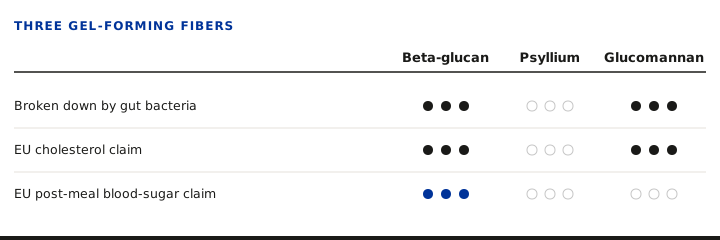
Three gel-forming fibers. Only beta-glucan holds EU claims for both cholesterol and blood sugar after a meal. Sources: Commission Regulation (EU) No 432/2012 (consolidated 20 August 2025); EU Register of nutrition and health claims; Holscher, Gut Microbes 2017; EMA ispaghula husk monograph; EFSA Journal 2017;15(6):4864.
| Property | Beta-glucan | Psyllium husk | Glucomannan |
|---|---|---|---|
| Broken down by gut bacteria | Yes | Mostly not | Yes |
| EU cholesterol claim | Yes (3 g a day) | No | Yes (4 g a day) |
| EU post-meal blood-sugar claim | Yes | No | No |
Which EU health claims does beta-glucan hold?
Three kinds, all tied to oats and barley.
Cholesterol. “Beta-glucans contribute to the maintenance of normal blood cholesterol levels.” The food must contain at least 1 gram of beta-glucan from oats, oat bran, barley or barley bran per portion, and the label must say the effect comes with 3 grams a day.4
Blood sugar after a meal. “Consumption of beta-glucans from oats or barley as part of a meal contributes to the reduction of the blood glucose rise after that meal.” The meal must carry at least 4 grams of beta-glucan for every 30 grams of available carbohydrate.4 In February 2026, EFSA backed a new oat-only wording at a lower threshold of 3 grams per 30 grams of carbohydrate, after reviewing 16 human studies.5 The EU list in force still carries the 4 gram wording.4
Heart disease risk. Oat beta-glucan and barley beta-glucan each hold a disease-risk claim: “has been shown to lower/reduce blood cholesterol. High cholesterol is a risk factor in the development of coronary heart disease.” It applies at 3 grams a day.910
Some submissions failed. Claims that oat or barley beta-glucan increases fullness, and that oat beta-glucan supports “digestive function”, were not authorised.11 Our explainer on how EFSA judges fiber claims covers what a refusal means.
Does beta-glucan lower cholesterol?
In food, yes, by a modest amount. A 2014 meta-analysis pooled 28 trials of 3 grams a day or more of oat beta-glucan. LDL cholesterol fell by 0.25 mmol/L and total cholesterol by 0.30 mmol/L, with no change in HDL or triglycerides.12 People who started with higher LDL saw a larger drop. The authors also searched unpublished reports held by CreaNutrition AG, part of an oat-fiber company.
A larger 2016 analysis of 58 trials and 3,974 people found a drop of 0.19 mmol/L at a median of 3.5 grams a day.13 The results varied a lot between trials.
The size of the molecule matters. In a 2010 trial, 345 adults ate a breakfast cereal with different kinds of oat beta-glucan for four weeks.6 Three grams of the long-chain form lowered LDL by 0.21 mmol/L. Four grams of a broken-down, short-chain form lowered it by 0.10 mmol/L, which was not a significant change. The authors concluded that cutting the chain length that far halved the effect.
A tablet did not work. A 2023 trial gave 263 adults with raised LDL a beta-glucan tablet at 1.5, 3 or 6 grams a day, or a placebo, for 12 weeks.14 LDL did not fall in any group compared with placebo, and neither did any other blood fat measured. A company that makes the ingredient collaborated on the trial.
Our guide to the best fiber for cholesterol compares beta-glucan with psyllium and the other options.
Does beta-glucan lower blood sugar or keep you full?
Blood sugar after a meal: yes, when it is part of the meal. That is the authorised claim, and EFSA’s 2026 review found that most of 16 pertinent studies showed lower glucose peaks when oat beta-glucan was eaten with carbohydrate-rich food.5 Our guide to the best fiber for blood sugar covers how it compares.
Fullness: people report feeling fuller, and in one trial they still ate the same amount. In a 2018 trial, 4 grams of oat beta-glucan at breakfast made 33 adults feel fuller, but they ate the same amount at their next meal, and their GLP-1 hormone level was lower at 90 minutes.15 A 2026 review found more fullness in 6 of 9 beta-glucan studies and higher GLP-1 in 3 of 9.16 There is no authorised EU claim for fullness or weight.11 Our article on Oatzempic looks at the viral oat drink built on this idea.
What are the side effects of beta-glucan?
Gas and bloating, and more of it at higher doses. In the 2023 tablet trial, digestive complaints were reported by 23.4% of people on 1.5 grams a day, 34.8% on 3 grams and 66.7% on 6 grams. On placebo the figure was 36.9%.14 Flatulence affected 17 of 66 people at 6 grams, against 8 of 65 on placebo.17 Our guide on starting a fiber supplement without bloating covers how to build up slowly.
Gluten. Barley contains gluten. EU law notes that most people with gluten intolerance can eat oats, but oats are often contaminated with wheat, rye or barley. Oats in a food sold as “gluten-free” must be specially produced to avoid that, with no more than 20 mg of gluten per kg.18
If you take other medicines, ask a pharmacist about timing. Our page on taking fiber with a GLP-1 medication explains when spacing matters.
Is yeast beta-glucan the same thing?
No. The name covers several molecules. Yeast beta-glucan, for example, is built from β-(1→3) and β-(1→6) links, a different structure from the oat and barley form.11 The EU cholesterol and blood-sugar claims name oats and barley only.4 Immune-system claims for yeast beta-glucans were submitted and not authorised.11
Who might beta-glucan suit?
People who want a fiber with EU claims for cholesterol and blood sugar, and who can get 3 grams a day from oats, oat bran or barley.
People who eat porridge or barley already. A larger serving, or oat bran stirred in, is the simplest way to reach the dose.
It is less suited to people who avoid gluten, unless the oats are labelled gluten-free. Barley contains gluten.
The beta-glucan behind the EU claims comes from oats and barley, at 3 grams a day, and the trials that lowered cholesterol gave it in food.
Sources
Footnotes
-
Havrlentová M, et al. “Relationship between the Content of β-D-Glucans and Infection with Fusarium Pathogens in Oat (Avena sativa L.) Plants.” Plants (Basel) 2020;9(12):1776. PMC7765213. “The content of β-D-glucans in oat grain is 2–7% and is influenced by genetic and/or environmental factors.” ↩
-
Burton RA, Fincher GB. “Current challenges in cell wall biology in the cereals and grasses.” Frontiers in Plant Science 2012;3:130. doi:10.3389/fpls.2012.00130. PMC3375588. Barley grain “typically contains about 4% (w/w) (1,3;1,4)-β-glucan”; Table 1 lists 4–10% for barley. ↩
-
Worked example: USDA FoodData Central SR Legacy 173904, oats (1 cup = 81 g, so ½ cup ≈ 40 g), multiplied by the 2–7% oat range in source 1, gives about 0.8 to 2.8 g. ↩
-
Commission Regulation (EU) No 432/2012 establishing a list of permitted health claims made on foods, consolidated text of 20 August 2025, entries “Beta-glucans” (blood cholesterol; at least 1 g per quantified portion; daily intake of 3 g from oats, oat bran, barley, barley bran or mixtures) and “Beta-glucans from oats and barley” (post-meal blood glucose; at least 4 g per 30 g available carbohydrates, as part of the meal). ↩ ↩2 ↩3 ↩4 ↩5
-
EFSA Panel on Nutrition, Novel Foods and Food Allergens (NDA). “Oat beta-glucans and reduction of postprandial glucose peak: evaluation of a health claim pursuant to Article 13(5) of Regulation (EC) No 1924/2006.” EFSA Journal 2026;24(2):e9942. PMID 41726114. Structure (linear D-glucose, mixed β-(1→3) and β-(1→4) links, about 2:1), molecular weight range (~65 to 3,100 kDa) and its role in viscosity; 16 pertinent human intervention studies; proposed condition of at least 3 g oat beta-glucans per 30 g available carbohydrates. ↩ ↩2 ↩3 ↩4 ↩5
-
Wolever TM, Tosh SM, Gibbs AL, et al. “Physicochemical properties of oat β-glucan influence its ability to reduce serum LDL cholesterol in humans: a randomized clinical trial.” American Journal of Clinical Nutrition 2010;92(4):723-732. PMID 20660224. ClinicalTrials.gov NCT00981981. 3 g high-molecular-weight (2,210,000 g/mol): −0.21 mmol/L; 4 g low-molecular-weight (210,000 g/mol): −0.10 mmol/L, not significant. ↩ ↩2
-
Holscher HD. “Dietary fiber and prebiotics and the gastrointestinal microbiota.” Gut Microbes 2017;8(2):172-184. PMID 28165863. Beta-glucan classed as viscous and readily fermented. ↩
-
European Medicines Agency, Committee on Herbal Medicinal Products. Community herbal monograph on Plantago ovata Forssk., seminis tegumentum (ispaghula husk), EMA/HMPC/199774/2012. In vitro, 72% of the husk remained unfermented. ↩
-
Commission Regulation (EU) No 1160/2011 of 14 November 2011, Annex I: Article 14(1)(a) claim for oat beta-glucan; daily intake of 3 g; at least 1 g per quantified portion. ↩
-
Commission Regulation (EU) No 1048/2012 of 8 November 2012, Annex: Article 14(1)(a) claim for barley beta-glucan; daily intake of 3 g; at least 1 g per quantified portion. ↩
-
European Commission, Food and Feed Information Portal, EU Register of nutrition and health claims. Non-authorised: oat and barley beta-glucan, “increase in satiety leading to a reduction in energy intake”; oat beta-glucan, “digestive function”; yeast beta-glucans (WGP beta-glucan, Saccharomyces cerevisiae beta-glucan, Yestimun, described as “(1,3)-(1,6)-β-D-glucans of brewer’s yeast cell wall”), immune-system and natural-defence claims. ↩ ↩2 ↩3 ↩4
-
Whitehead A, Beck EJ, Tosh S, Wolever TM. “Cholesterol-lowering effects of oat β-glucan: a meta-analysis of randomized controlled trials.” American Journal of Clinical Nutrition 2014;100(6):1413-1421. PMID 25411276. 28 RCTs; in-house study reports of CreaNutrition AG (subsidiary of Swedish Oat Fiber AB) were also searched. ↩
-
Ho HV, Sievenpiper JL, Zurbau A, et al. “The effect of oat β-glucan on LDL-cholesterol, non-HDL-cholesterol and apoB for CVD risk reduction: a systematic review and meta-analysis of randomised-controlled trials.” British Journal of Nutrition 2016;116(8):1369-1382. PMID 27724985. 58 trials, 3,974 participants; LDL heterogeneity I² = 79%. ↩
-
Rioux-Labrecque V, Cossette M, Rufiange M, Bilodeau D, Guertin MC, Tardif JC. “Supplementation with a β-glucan tablet has no effect on hyperlipidemia: a randomized, placebo-controlled clinical trial.” American Journal of Clinical Nutrition 2023;117(6):1232-1239. PMID 37054888. ClinicalTrials.gov NCT03857256. Sponsor: Montreal Heart Institute; collaborator: Ceapro Inc. ↩ ↩2
-
Zaremba SMM, Gow IF, Drummond S, McCluskey JT, Steinert RE. “Effects of oat β-glucan consumption at breakfast on ad libitum eating, appetite, glycemia, insulinemia and GLP-1 concentrations in healthy subjects.” Appetite 2018;128:197-204. PMID 29920323. ↩
-
de Jong JCB, et al. “Dietary fibers to boost endogenous GLP-1 secretion and satiety: a scoping review.” Frontiers in Endocrinology 2026;17:1880500. ↩
-
ClinicalTrials.gov, NCT03857256, posted results, adverse events (first dose to week 14): flatulence 17/66 (6 g) vs 8/65 (placebo). ↩
-
Commission Implementing Regulation (EU) No 828/2014 on the requirements for the provision of information to consumers on the absence or reduced presence of gluten in food: definition of gluten (wheat, rye, barley, oats); Annex, “Additional requirements for food containing oats” (no more than 20 mg/kg). ↩