Oatzempic does not work like Ozempic. The drink is roughly 40g of oats blended with water and lime: about 150 calories, 4g of fiber, and somewhere between 1 and 3g of oat beta-glucan. That fiber does real, modest things. It does not do what a GLP-1 medication does, and no study has tested the drink for any outcome at all.
The name is doing the work. Semaglutide (Ozempic, Wegovy) is a copy of a gut hormone engineered to stay in the blood for about a week. The hormone your own gut releases after a bowl of oats is inactivated before it has even left the gut. The two share a name and a pathway, and almost nothing else. For how fiber actually fits alongside these medications, our complete guide to fiber and GLP-1 is the place to start.
What is oatzempic?
A blended drink of half a cup of rolled oats, a cup of water, and the juice of half a lime, sometimes with cinnamon, drunk in place of breakfast.1 The recipe went viral on TikTok in 2024 and was still being explained by university dietitians in January 2026, which is why the question has not gone away.2 The videos promise dramatic weight loss in weeks. The University of Queensland dietitians who reviewed the trend put the evidence position in one sentence: no scientific study has looked at the oatzempic drink for weight loss, appetite control, or any other outcome.2
So the question is not whether the drink has been proven. It has not been tested. The question is whether the ingredient the name points at, oat beta-glucan, does anything like what the drug does.
Why is it named after Ozempic?
Because oats contain beta-glucan, and beta-glucan is one of the fibers that nudges the gut to release its own GLP-1. That is a real mechanism. What separates it from a GLP-1 medication is dose, duration, and what actually reaches the blood.
The drug. Semaglutide is a GLP-1 analogue with 94% sequence homology to the human hormone. It binds the same receptor the natural hormone uses. According to its EU product information, it reduces body weight through lowered energy intake and an overall reduced appetite, with a minor delay in gastric emptying early after meals.3 Its elimination half-life is approximately one week.3 It sits on the receptor, at a pharmacological dose, all day, every day.
The hormone. Native GLP-1 is, in the words of the standard physiology review, extremely rapidly metabolised and inactivated by the enzyme DPP-IV, before the hormone has even left the gut.4 Whatever a food coaxes out of the L-cells is a brief, local pulse.
The fiber. Viscous fibers, beta-glucan among them, can increase that pulse. A 2026 scoping review mapped the human trials fiber by fiber and found that beta-glucan raised circulating GLP-1 in only 3 of 9 studies, one study found it fell, and yet it increased subjective satiety in 6 of 9.5 The authors’ conclusion is the useful one: beta-glucan enhances fullness through a mechanism that is “complementary to, but not necessarily dependent on, GLP-1 stimulation.”5 The fiber that makes people feel fullest is not the one that best imitates the drug.
A single trial makes the point sharper. Thirty-three healthy adults ate a breakfast with or without 4g of high-molecular-weight oat beta-glucan in a randomised, double-blind crossover. Fullness went up (p=0.048) and so did satiety (p=0.034). The amount they then ate at an unrestricted test meal did not change. And plasma GLP-1 was significantly lower at 90 minutes after the beta-glucan breakfast than after the control.6 The authors’ own summary: 4g of oat beta-glucan lowers appetite but not ad libitum eating, and does not increase plasma GLP-1 secretion.6
Four grams. More than the drink contains, and still no GLP-1 rise.
How much beta-glucan is actually in the drink?
Roughly 1 to 3g, and the arithmetic is short enough to show. Treat it as a worked example, not a measurement of anyone’s kitchen.
Half a cup of dry rolled oats weighs about 40g.7 Dry oats carry 379 calories, 10.1g of fiber, 67.7g of carbohydrate and 13.2g of protein per 100g,7 so the drink lands at about 150 calories, 4g of total fiber, 27g of carbohydrate and 5g of protein. Oat grain is 2 to 7 percent beta-glucan by weight, depending on variety and growing conditions,8 which puts the beta-glucan in that half cup between 0.8 and 2.8g.
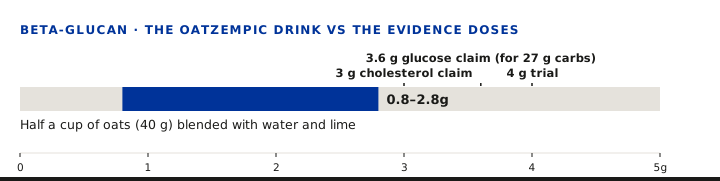
The beta-glucan in half a cup of oats, against the doses that the trial evidence and the EU claims actually rest on. Worked example from USDA FoodData Central (oats, dry, 173904), Havrlentová et al. 2020 (2 to 7 percent beta-glucan), Zaremba et al. 2018 (4g trial dose), and Commission Regulation (EU) No 432/2012 (claim conditions).
| Beta-glucan | Grams | Basis |
|---|---|---|
| Oatzempic drink (half a cup of oats, 40g) | 0.8 to 2.8 | 2 to 7 percent of grain weight7 8 |
| Controlled satiety trial dose | 4.0 | Zaremba et al. 2018, no GLP-1 rise6 |
| EU cholesterol claim, per day | 3.0 | Regulation (EU) No 432/20129 |
| EU post-meal glucose claim, for the drink’s 27g of carbohydrate | 3.6 | 4g per 30g of available carbohydrate9 |
That range matters because the effects beta-glucan has actually earned are dose-conditioned.
What does oat beta-glucan do at the right dose?
Two things the EU has signed off on, and one it has not.
Cholesterol. Beta-glucans from oats or barley “contribute to the maintenance of normal blood cholesterol levels.” The authorised claim requires a daily intake of 3g, and a food can carry it only if it delivers at least 1g per portion.9 The drink sits at or just under that daily figure on its own.
Post-meal blood sugar. Beta-glucans from oats or barley eaten as part of a meal “contribute to the reduction of the blood glucose rise after that meal.” The condition is 4g of beta-glucan for every 30g of available carbohydrate in the meal.9 The drink carries about 27g of carbohydrate, so it would need roughly 3.6g of beta-glucan to meet its own bar. EFSA’s January 2026 opinion on a new application found the effect substantiated at a lower 3g per 30g of carbohydrate, across 16 human intervention studies, and that wording is now with the Commission for authorisation.10 Even at the lower threshold the drink is at the edge of it. This is the one place beta-glucan and a GLP-1 medication overlap in a measurable way: both blunt the glucose rise after a meal, by entirely different routes. We cover the fiber side of that in which fiber is best for blood sugar.
Satiety and weight. EFSA assessed a claim for beta-glucans and “increase in satiety leading to a reduction in energy intake” in 2011.11 It is not among the authorised claims. The only beta-glucan claims that made it into the EU register are the two above.9 The modest fullness effect in trials is real; it has never cleared the bar for a claim, and the trials that measure it are hours long, not months.
So why do people say it works?
Because a 150-calorie breakfast with no protein is a small breakfast, and eating less at breakfast is eating less.1 12 A hospital dietitian reviewing the trend made the same observation: the drink keeps you full for a couple of hours, and there is nothing magical in it.12 The oats are doing what oats do. Whether a person keeps that up for eight weeks, and what they eat at eleven o’clock, is the actual variable, and it is the one no video measures.
The viscosity is genuine, and it is the more interesting part of the recipe than the lime. In a crossover trial of 48 adults, an instant oatmeal delivering 1.6g of beta-glucan increased fullness (p=0.04), reduced the desire to eat (p=0.01), and lowered prospective intake (p<0.01) over four hours compared with a ready-to-eat oat cereal delivering 1.0g, and the kinetics of starch digestion and glucose release did not differ between the meals.13 It was the gel, not the sugar. Blending oats with water is, in effect, making that gel in advance.
Nothing in the published record tests the lime, the cinnamon, or the blending itself.2 They are flavour.
What oats do not do
They do not put a drug’s worth of GLP-1 into your blood. The controlled trial that measured it found no rise at 4g,6 the review that pooled nine such trials found a rise in a third of them,5 and the hormone itself is gone before it reaches the circulation in any quantity.4 Semaglutide works because it is built not to be gone.3
They do not carry an EU claim for appetite, satiety, or body weight.9 11
They have not been studied as a drink called oatzempic.2
What they are is a whole grain with 10g of fiber per 100g, a cholesterol claim you can actually reach with a proper bowl, and a blood-sugar effect that scales with the dose.7 9 If you like the drink, the sensible move is to treat it as breakfast, add the protein it lacks, and not expect it to be anything else.
Is oatzempic safe if you are already on a GLP-1?
Oats are food, and a bowl of them does not interact with semaglutide or tirzepatide (Mounjaro, Zepbound). Fiber is generally well tolerated alongside these medications, and the reasons to add it, slowed transit and the constipation that comes with it, are covered in our guide to taking fiber with a GLP-1. The one timing rule that reaches an oat drink is the oral semaglutide tablet, which is taken on an empty stomach with a small sip of water and a 30-minute wait before anything else, breakfast smoothie included. We walk through that in the Wegovy pill’s fiber and fasting rule.
Half a cup of oats is half a cup of oats. The word on the label is the only thing borrowed from the drug.
Footnotes
-
WebMD. “What Is Oatzempic?” Medically reviewed by Zilpah Sheikh, MD, 23 September 2024. Recipe as circulated: ½ cup oats, 1 cup water, juice of ½ lime, optional cinnamon; used in place of a meal, typically breakfast; approximately 150 calories. https://www.webmd.com/obesity/what-is-oatzempic-diet ↩ ↩2
-
Ball L, Burch E. “What is ‘oatzempic’? Does it actually work for weight loss?” The Conversation, 4 January 2026 (The University of Queensland; Southern Cross University). “There are no scientific studies that look at the ‘oatzempic drink’ for weight loss, appetite control or other health outcomes.” https://theconversation.com/what-is-oatzempic-does-it-actually-work-for-weight-loss-269603 ↩ ↩2 ↩3 ↩4
-
European Medicines Agency. Ozempic (semaglutide): EPAR product information, sections 5.1 and 5.2. “Semaglutide is a GLP-1 analogue with 94% sequence homology to human GLP-1”; reduces body weight “through lowered energy intake, involving an overall reduced appetite”; “a minor delay in gastric emptying in the early postprandial phase”; “elimination half-life of approximately 1 week.” https://www.ema.europa.eu/en/documents/product-information/ozempic-epar-product-information_en.pdf ↩ ↩2 ↩3
-
Holst JJ. “The physiology of glucagon-like peptide 1.” Physiological Reviews 2007;87(4):1409-1439. “GLP-1 is extremely rapidly metabolized and inactivated by the enzyme dipeptidyl peptidase IV even before the hormone has left the gut.” PMID 17928588. https://pubmed.ncbi.nlm.nih.gov/17928588/ ↩ ↩2
-
de Jong JCB, Lentjes MGW, Pietersma KF, Pasman WJ, Wopereis S, Hoevenaars FPM. “Dietary fibers to boost endogenous GLP-1 secretion and satiety: a scoping review.” Frontiers in Endocrinology 2026;17:1880500. Beta-glucans: increased subjective satiety in 6 of 9 studies; increased circulating GLP-1 in 3 of 9 (1 decreased). Mechanism “complementary to, but not necessarily dependent on, GLP-1 stimulation.” https://www.frontiersin.org/journals/endocrinology/articles/10.3389/fendo.2026.1880500/full ↩ ↩2 ↩3
-
Zaremba SMM, Gow IF, Drummond S, McCluskey JT, Steinert RE. “Effects of oat β-glucan consumption at breakfast on ad libitum eating, appetite, glycemia, insulinemia and GLP-1 concentrations in healthy subjects.” Appetite 2018;128:197-204. Randomised double-blind crossover, n=33; 4g high-molecular-weight oat beta-glucan. Fullness p=0.048, satiety p=0.034; no effect on energy or amount eaten at the ad libitum meal; plasma GLP-1 reduced at 90 min (p=0.021); blood glucose lower at 30 min (p=0.008). PMID 29920323. https://pubmed.ncbi.nlm.nih.gov/29920323/ ↩ ↩2 ↩3 ↩4
-
USDA FoodData Central, SR Legacy 173904, “Cereals, oats, regular and quick, not fortified, dry”: per 100g, 379 kcal, 10.1g dietary fiber, 67.7g carbohydrate, 13.2g protein, 6.52g fat; 1 cup = 81g. Half-cup figures in the body are a worked example from these values. https://fdc.nal.usda.gov/food-details/173904/nutrients ↩ ↩2 ↩3 ↩4
-
Havrlentová M, Gregusová V, Šliková S, Nemeček P, Hudcovicová M, Kuzmová D. “Relationship between the content of β-D-glucans and infection with Fusarium pathogens in oat (Avena sativa L.) plants.” Plants 2020;9(12):1776. “The content of β-D-glucans in oat grain is 2–7% and is influenced by genetic and/or environmental factors.” https://pmc.ncbi.nlm.nih.gov/articles/PMC7765213/ ↩ ↩2
-
Commission Regulation (EU) No 432/2012, consolidated text of 17 May 2021, Annex. Beta-glucans: cholesterol-maintenance claim, at least 1g per quantified portion, beneficial effect with a daily intake of 3g. Beta-glucans from oats and barley: post-meal blood-glucose claim, at least 4g per 30g of available carbohydrates, as part of the meal. No satiety, appetite or weight claim for beta-glucans appears in the Annex. Parsed from the EUR-Lex table, 17 September 2026. https://eur-lex.europa.eu/legal-content/EN/TXT/?uri=CELEX:02012R0432-20210517 ↩ ↩2 ↩3 ↩4 ↩5 ↩6 ↩7
-
EFSA NDA Panel. “Oat beta-glucans and reduction of postprandial glucose peak: evaluation of a health claim pursuant to Article 13(5) of Regulation (EC) No 1924/2006.” EFSA Journal 2026;24(2):e9942. Cause-and-effect established across 16 pertinent human intervention studies; conditions of use at least 30g available carbohydrate per portion and at least 3g oat beta-glucans per 30g available carbohydrate. Commission authorisation follows the opinion. PMID 41726114. https://pubmed.ncbi.nlm.nih.gov/41726114/ ↩
-
EFSA NDA Panel. “Scientific Opinion on the substantiation of health claims related to beta-glucans from oats and barley and maintenance of normal blood LDL-cholesterol concentrations (ID 1236, 1299), increase in satiety leading to a reduction in energy intake (ID 851, 852), reduction of post-prandial glycaemic responses (ID 821, 824), and ‘digestive function’ (ID 850).” EFSA Journal 2011;9(6):2207. The satiety claim (ID 851, 852) was assessed in this opinion and is absent from the authorised Annex of Regulation (EU) No 432/2012. https://doi.org/10.2903/j.efsa.2011.2207 ↩ ↩2
-
OSF HealthCare. “Oatzempic smoothie: is it a miracle drink?” 25 April 2024. Jenny Reay, registered dietitian: the recipe contains no protein; it keeps you full for a couple of hours; “there’s nothing magical about it.” https://newsroom.osfhealthcare.org/oatzempic-smoothie-is-it-a-miracle-drink/ ↩ ↩2
-
Rebello CJ, Chu YF, Johnson WD, et al. “The role of meal viscosity and oat β-glucan characteristics in human appetite control: a randomized crossover trial.” Nutrition Journal 2014;13:49. n=48 enrolled, 43 completed. Instant oatmeal (1.6g beta-glucan) vs ready-to-eat cereal (1.0g): fullness p=0.04, desire to eat p=0.01, prospective intake p<0.01 over four hours; starch digestion and glucose release not different (p>0.05). https://pmc.ncbi.nlm.nih.gov/articles/PMC4052334/ ↩