If you want to lower your LDL cholesterol, one fibre stands out: beta-glucan from oats or barley, 3 grams a day. That is about one large bowl of porridge, and it is the only fibre here the EU lets you make a cholesterol claim for.
Psyllium works just as well in the studies. It simply cannot say so on a European label. And the inulin in most GLP-1 fibre supplements does nothing for your cholesterol. Which one you pick comes down to a single thing: how thick a gel the fibre makes in your gut. For the biology behind that, see our companion guide to fiber and cholesterol; for why most of us fall short on fibre in the first place, the European fiber gap.
Which fibre actually lowers LDL?
A short list of fibres lowers cholesterol, and they all work the same way. Each one turns into a thick gel in your gut. The thicker the gel, the more it does.
Beta-glucan, from oats and barley, has the best evidence by far. Across dozens of trials, 3 grams a day lowers LDL by about 10 to 13 mg/dL.1 Three grams is roughly 75 grams of dry oats, one big bowl of porridge. It also carries the EU’s cholesterol claim.
Psyllium husk matches it. In a review of randomised trials, psyllium lowered LDL by about 11 mg/dL, the same drop as beta-glucan and by the same route.2 It is the fibre most people already buy, and for cholesterol that instinct is right. The catch is regulatory, not scientific.
Glucomannan, pectin, chitosan, and HPMC lower cholesterol too, and all carry EU claims. The trouble is getting them into your day. Pectin asks for 6 grams, chitosan comes from shellfish, HPMC is a semi-synthetic thickener. They work. They are just not where most people should start.
What all of these share is the gel. A fibre that dissolves into thin water does little for your cholesterol, however good it is for other things. The gel traps bile acids on their way through, and trapping bile acids is what brings LDL down.
Why is the evidence list different from the EU-approved list?
The fibres with the best evidence and the fibres with an EU claim are almost the same group. Almost. Seeing where they part stops you paying for a label instead of a result.
Under Regulation (EC) No 1924/2006, a health claim has to pass EFSA’s review before it can go on a product, and EFSA turns down about nine in ten.3 The cholesterol claims that made it through sit in Commission Regulation (EU) No 432/2012, all worded the same way: the fibre “contributes to the maintenance of normal blood cholesterol levels.”4
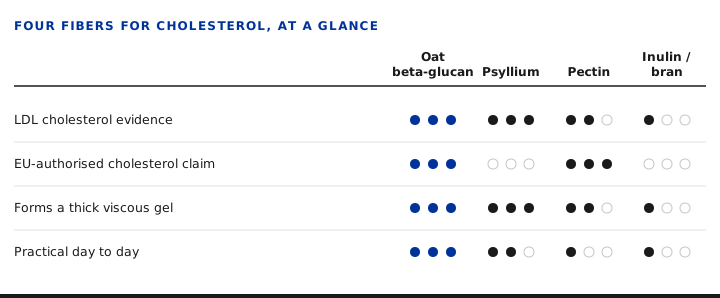
Of the fibers people actually choose between, beta-glucan holds both the strongest evidence and the EU-authorised claim; psyllium is level on trials but carries no EU cholesterol claim, only a US FDA one; and inulin and bran do nothing for LDL because they form no gel. Source: Commission Regulation (EU) 432/2012; Whitehead et al. 2014 and Jovanovski et al. 2018, American Journal of Clinical Nutrition.
| Fiber | Viscous gel | LDL evidence | EU cholesterol claim | Authorised dose |
|---|---|---|---|---|
| Beta-glucan (oats/barley) | Yes | Strong | Yes | 3g a day |
| Psyllium | Yes | Strong | No (US FDA only) | 7g a day (US) |
| Glucomannan | Yes | Moderate | Yes | 4g a day |
| Pectins | Yes | Moderate | Yes | 6g a day |
| Chitosan | Yes | Moderate | Yes | 3g a day |
| HPMC | Yes | Moderate | Yes | 5g a day |
| Inulin, wheat bran, cellulose | No | None | No | not applicable |
Psyllium lowers LDL in trial after trial, and still has no EU cholesterol claim, so a product sold in Europe cannot print one. In the US it can. The FDA approved that exact claim back in 1998, for 7 grams a day of psyllium.5 Same fibre, same evidence, different rule. A claim on a label tells you what a regulator signed off, not what the science says.
How does fibre lower cholesterol?
It comes down to bile acids. Your liver makes them out of cholesterol and sends them into your gut to help digest fat. Normally about 95 percent get reabsorbed further down and used again.6
A thick fibre gel breaks that loop. It traps the bile acids and carries them out with your stool. Your liver, now short, has to make more, and it pulls cholesterol from your blood to do it. So your LDL drops.7
This is why the gel matters more than anything else about a fibre. Jenkins and colleagues showed decades ago that the thicker a fibre gets, the more it lowers cholesterol.8 Fermentable is not the same as viscous. Chicory inulin is the clearest example: it dissolves clean, never thickens, and does nothing for cholesterol. Its EU claim is for regularity, at 12 grams a day.9 Wheat bran and cellulose miss for the opposite reason, they never dissolve at all. Pick the fibre for the job you actually have.
Fibre or a statin?
Fibre does not replace a statin. It is not close.
Statins cut LDL by 30 to 50 percent.10 A fibre supplement, at its best, manages 5 to 10 percent.7 If you have heart disease, or a high risk of it, the statin is the treatment, with decades of evidence that it saves lives.
Fibre earns its place in narrower spots. If your cholesterol is only a little high and not yet at the line for medication, a viscous fibre plus other diet changes might be enough. If you already take a statin, beta-glucan or psyllium can take off another 5 to 10 percent. And if statins do not agree with you, which happens to about 5 to 10 percent of people, fibre is one of the few diet moves with real backing.11 Either way, that call is yours and your doctor’s.
Why does this matter on a GLP-1?
If you are on semaglutide, tirzepatide, or a similar drug, cholesterol is an easy thing to miss.
These medicines shrink your appetite, so you eat less, and a lot of what falls away is fibre, from grains, fruit, and beans. Europe already runs short: 16 to 24 grams a day against the 25 the EFSA recommends, and a GLP-1 usually widens that gap. The morning bowl of oats that was quietly giving you 3 grams of beta-glucan is exactly the meal people skip. Skip it, and the cholesterol benefit goes with it. The drugs do carry their own heart benefit in trials, separate from the weight loss,12 but that is the drug, not the fibre, and it is no reason to let your fibre fall off a cliff. For how to keep it up on these medicines, see our complete guide to fiber and GLP-1 and the companion piece on the best fiber for blood sugar.
So if you want one fibre for your cholesterol, start with the oats. Three grams a day, one bowl, and the evidence has pointed there for a long time.
Footnotes
-
Whitehead A, Beck EJ, Tosh S, Wolever TM. Cholesterol-lowering effects of oat β-glucan: a meta-analysis of randomized controlled trials. American Journal of Clinical Nutrition. 2014;100(6):1413-1421. ↩
-
Jovanovski E, Yashpal S, Komishon A, et al. Effect of psyllium (Plantago ovata) fiber on LDL cholesterol and alternative lipid targets, non-HDL cholesterol and apolipoprotein B: a systematic review and meta-analysis of randomized controlled trials. American Journal of Clinical Nutrition. 2018;108(5):922-932. ↩
-
EFSA, “Health Claims,” efsa.europa.eu. Approximately 267 authorized out of more than 2,300 submitted. ↩
-
Commission Regulation (EU) No 432/2012 of 16 May 2012 establishing a list of permitted health claims made on foods. OJ L 136, 25.5.2012. Beta-glucans 3g/day, glucomannan 4g/day, pectins 6g/day, chitosan 3g/day, HPMC 5g/day, each for “maintenance of normal blood cholesterol levels.” Verified against the EUR-Lex consolidated Annex. ↩
-
US Food and Drug Administration. Soluble fiber from certain foods and risk of coronary heart disease. 21 CFR 101.81. 1998. Psyllium seed husk, 7g per day of soluble fiber. ↩
-
Dawson PA, Karpen SJ. Intestinal transport and metabolism of bile acids. Journal of Lipid Research. 2015;56(6):1085-1099. ↩
-
Brown L, Rosner B, Willett WW, Sacks FM. Cholesterol-lowering effects of dietary fiber: a meta-analysis. American Journal of Clinical Nutrition. 1999;69(1):30-42. ↩ ↩2
-
Jenkins DJA, Wolever TMS, Leeds AR, et al. Dietary fibres, fibre analogues, and glucose tolerance: importance of viscosity. BMJ. 1978;1(6124):1392-1394. ↩
-
Commission Regulation (EU) 2015/2314 of 7 December 2015. Authorized claim: “Chicory inulin contributes to normal bowel function by increasing stool frequency.” Condition: 12g per day of native chicory inulin. ↩
-
Cholesterol Treatment Trialists’ (CTT) Collaboration. Efficacy and safety of more intensive lowering of LDL cholesterol: a meta-analysis of data from 170,000 participants in 26 randomised trials. The Lancet. 2010;376(9753):1670-1681. ↩
-
Stroes ES, Thompson PD, Corsini A, et al. Statin-associated muscle symptoms: impact on statin therapy. European Heart Journal. 2015;36(17):1012-1022. ↩
-
Marso SP, Daniels GH, Brown-Frandsen K, et al. Liraglutide and Cardiovascular Outcomes in Type 2 Diabetes (LEADER trial). New England Journal of Medicine. 2016;375(4):311-322. ↩