
“Best fiber for blood sugar” is really two questions. One is the spike in the hour after a meal. The other is your metabolic health over months. Different fibers answer each, and the ones with the best evidence are not always the ones the EU has authorised. For the biology in full, see our companion guide to fiber and blood sugar, and for why most people fall short of fiber to begin with, the European fiber gap.
Which fiber actually lowers blood sugar?
For the glucose rise right after a meal, the answer is a short list of viscous, gel-forming fibers, and beta-glucan sits at the top of it.
Beta-glucan from oats and barley has the strongest and best-defined evidence. It forms a thick gel in the gut that slows how fast glucose crosses into the blood, and it works at a dose that has been pinned down precisely: 4g of beta-glucan per 30g of available carbohydrate in the meal.1 A generous bowl of oatmeal with some barley in the day gets most people there.
Psyllium husk is comparably viscous and performs well in trials. In practice it is the fiber most people reach for as a supplement, and it earns that. Its one gap is regulatory rather than scientific, which the next section gets to.
Pectin, the soluble fiber from fruit, works at a higher dose (10g per meal). Guar gum and glucomannan are also viscous, though glucomannan carries an EU caution over choking risk in certain dry formats.
The common thread is viscosity. A fiber that dissolves to a thin liquid does little to the post-meal curve, whatever else it does well. The thicker the gel, the more it slows gastric emptying and the flatter the spike.
Why are the evidence list and the EU-approved list different?
The fibers with the best trial evidence and the fibers with an official EU claim are not the same set. Knowing which is which keeps you from paying for a label instead of an effect.
Under Regulation (EC) No 1924/2006, a health claim has to clear EFSA’s scientific review before it can appear on a product, and EFSA rejects roughly nine in ten applications. The post-meal glucose claims that survived are listed in Commission Regulation (EU) No 432/2012. There are five of them, and they all share the same authorised wording: the fiber “contributes to the reduction of the blood glucose rise after that meal.”1
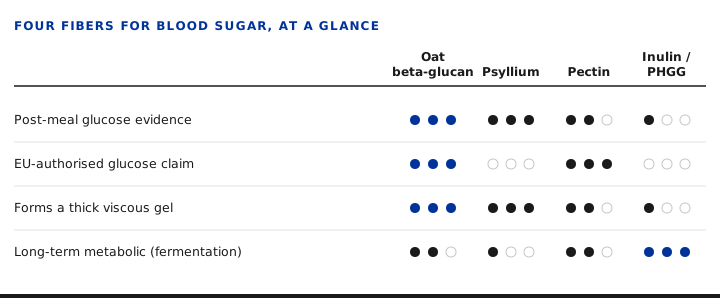
Of the fibers people actually choose between, beta-glucan and pectin are the only two with an EU-authorised claim for the post-meal blood-glucose rise; psyllium matches the trial evidence but holds no glucose claim, and inulin and PHGG work on the slower fermentation pathway rather than the acute spike. Source: Commission Regulation (EU) 432/2012; Lu et al. 2023, Frontiers in Nutrition.
| Fiber | EU-authorised glucose claim | Condition of use |
|---|---|---|
| Beta-glucans (oats/barley) | Yes | 4g per 30g of available carbohydrate |
| Arabinoxylan (wheat endosperm) | Yes | 8g of AX-rich fiber per portion |
| Pectins | Yes | 10g per portion (with water) |
| Hydroxypropyl methylcellulose | Yes | 4g per portion |
| Resistant starch | Yes | replaces ≥14% of total starch |
| Psyllium | No authorised glucose claim | strong trial evidence only |
| Inulin, PHGG, guar gum | No authorised glucose claim | fermentation pathway |
Psyllium blunts the post-meal spike in study after study, yet holds no authorised glucose claim, so a product cannot print one. Inulin and PHGG, the fibers in most GLP-1-companion supplements, are not on the glucose list at all, because they work a different way. A label claim tells you what cleared a regulator, not what leads the evidence.
How does fiber lower post-meal glucose?
Fiber does this two ways, on two timescales.
The fast one is physical. Viscous soluble fiber absorbs water and forms a gel that slows gastric emptying and puts a diffusion barrier between the meal and the gut wall, so glucose is absorbed more gradually and the peak is lower. This was shown as far back as 1978, when the size of the effect was found to track the viscosity of the fiber directly.2 It is the mechanism behind every fiber on the authorised list.
The slow one is fermentation. Fibers that reach the colon intact are fermented by gut bacteria into short-chain fatty acids, and those molecules stimulate the L-cells of the gut to release the body’s own GLP-1, the same hormone the weight-loss drugs are built around.3 This is where inulin and PHGG do their work. It does nothing for today’s lunch, but over weeks it supports insulin sensitivity and steadier glucose. Fermentable fiber plays a long game.
How much do you need, and when does timing matter?
For the acute benefit, the dose and the timing are both fixed by the mechanism: the fiber has to be in the gut with the carbohydrate. Beta-glucan needs 4g per 30g of meal carbohydrate, eaten as part of the meal, not hours apart.1 Take psyllium the same way, with the meal and with enough water.
The trial numbers set honest expectations. Across 42 controlled trials in people with prediabetes or diabetes, raising fiber intake lowered HbA1c by 2.00 mmol/mol, fasting glucose by 0.56 mmol/L, and a marker of insulin resistance by a measurable step.4 A meta-analysis of viscous soluble fiber found HbA1c down 0.47% and fasting glucose down 0.93 mmol/L.5 Over the long run, the people who eat the most fiber have a 15 to 19% lower risk of developing type 2 diabetes, with cereal fiber showing the strongest link.6 Real effects, and modest ones next to medication.
Most people are not close to the dose that produces them. EFSA sets the floor at 25g of fiber a day, and the benefit keeps climbing above 30g.7 European adults eat well under that, and no country meets the target on average, so for most people the first move is not choosing an exotic fiber but closing the gap with any fiber they will keep eating.8
Where do inulin and PHGG fit if you are on a GLP-1?
They fit, just not on the acute-spike question. If you are on a GLP-1 medication, the drug is already reshaping your glucose and appetite, and the reason to add fiber is rarely to flatten a single meal’s curve. It is to cover the fiber gap the medication opens: eating less food usually means eating less fiber, at exactly the point where more would help both blood sugar and the constipation these drugs commonly cause.
For that job, the gentler fermentable fibers are the better fit. Inulin and PHGG are easy to keep taking daily and feed the short-chain-fatty-acid pathway that supports the body’s own glucose regulation over time. If you also want to blunt specific meals, that is where a viscous fiber like beta-glucan or psyllium comes in alongside. There is no rule against using both, and timing only matters for the viscous one. For the broader question of combining fiber with the medication itself, we cover taking fiber with a GLP-1 separately.
Does fiber replace diabetes or GLP-1 medication?
No, and the evidence that makes fiber worth taking is the same evidence that sets its limit. The HbA1c reductions above are real, but a fiber is not a metformin, an insulin, or a GLP-1 receptor agonist. If you have been prescribed one, fiber sits alongside it, not in its place.
It also does not rescue a poor diet. Adding psyllium to a plate built on refined carbohydrate lowers the spike a little and leaves the underlying problem intact. The large risk reductions in the research come from whole dietary patterns, not from a scoop of supplement on top of everything else.
So the viscous fiber goes with your meals, and the fermentable one goes in every day. For most people, the fiber that helps most is the one they will actually keep taking.
Footnotes
-
Commission Regulation (EU) No 432/2012 of 16 May 2012, Annex. EUR-Lex (CELEX:32012R0432). ↩ ↩2 ↩3
-
Jenkins DJA et al. Dietary fibres, fibre analogues, and glucose tolerance: importance of viscosity. BMJ. 1978;1(6124):1392-1394. ↩
-
Tolhurst G et al. Short-chain fatty acids stimulate glucagon-like peptide-1 secretion via the G-protein-coupled receptor FFAR2. Diabetes. 2012;61(2):364-371. Puddu A et al. Evidence for the gut microbiota short-chain fatty acids as key pathophysiological molecules improving diabetes. Mediators Inflamm. 2014;2014:162021. ↩
-
Reynolds AN et al. Dietary fibre and whole grains in diabetes management: Systematic review and meta-analyses. PLOS Medicine. 2020;17(3):e1003053. ↩
-
Lu K et al. Effect of viscous soluble dietary fiber on glucose and lipid metabolism in patients with type 2 diabetes mellitus: a systematic review and meta-analysis. Front Nutr. 2023;10:1253312. ↩
-
McRae MP. Dietary Fiber Intake and Type 2 Diabetes Mellitus: An Umbrella Review of Meta-analyses. J Chiropr Med. 2018;17(1):44-53. InterAct Consortium. Dietary fibre and incidence of type 2 diabetes in eight European countries: the EPIC-InterAct Study. Diabetologia. 2015;58(7):1394-1408. ↩
-
Reynolds A et al. Carbohydrate quality and human health: a series of systematic reviews and meta-analyses. Lancet. 2019;393(10170):434-445. ↩
-
EFSA NDA Panel. Scientific Opinion on Dietary Reference Values for carbohydrates and dietary fibre. EFSA Journal. 2010;8(3):1462. Stephen AM et al. Dietary fibre in Europe: current state of knowledge. Nutr Res Rev. 2017;30(2):149-190. ↩