
Who is this guide for?
You are taking a GLP-1 receptor agonist medication. Maybe semaglutide (Ozempic for diabetes, Wegovy for weight management). Maybe tirzepatide (Mounjaro, Zepbound). Maybe you are considering one.
You have noticed digestive changes. Constipation, bloating, or both. This guide covers what the evidence says about fiber supplementation for GLP-1 users: which types help, how to dose them, when to take them, and what to watch for.
For background on the medications themselves, including how each one is approved, the trial data, side effects beyond the gut, and how access varies by European country, see our companion explainer on GLP-1 medications: a comprehensive guide for adults in Europe.
Why do GLP-1 medications change the fiber equation?
GLP-1 receptor agonists work by mimicking the GLP-1 hormone, which signals satiety and slows gastric emptying.1 That mechanism is what makes them effective for appetite suppression and blood sugar management. It is also what causes the digestive side effects.
Three factors compound to create a specific fiber problem:
Reduced food intake. The medication works. You eat less. The average European diet provides only 16-24g of fiber per day against a recommended 25-30g, so eating less food means an already-insufficient fiber intake drops further. If you were getting 18g from a full diet, you might now be getting 10-12g. The European fiber gap is the baseline problem. GLP-1 medications widen it.
How much fiber do you actually need? EU vs. US guidelines compared
For the medication-specific version of that question, including how to track your intake and close the widened gap, see how much fiber on a GLP-1.
Slowed gastric emptying. Food stays in your stomach longer. This is the core mechanism of appetite suppression, but it also means everything moves more slowly through the entire digestive tract. Slower transit time means more water is absorbed from stool in the colon, making stool harder and more difficult to pass.
Reduced fluid intake. GLP-1 medications can blunt thirst signaling. Many users report drinking less water without realizing it. Dehydration is one of the most common and most overlooked contributors to GLP-1-related constipation.
The result: less food means less fiber, slower digestion means harder stool, less water means everything compounds. The people who need more fiber are physiologically set up to get less of it.
For a detailed breakdown of the constipation mechanism specifically, see our GLP-1 constipation guide. If you are on semaglutide, see Wegovy and Ozempic (semaglutide) constipation; if you are on the dual GIP/GLP-1 agonist, see our dedicated look at Mounjaro (tirzepatide) and constipation. And to choose a fiber type for constipation relief, see the best fiber for constipation.
How common is GLP-1 constipation?
The clinical data is consistent: constipation is one of the most frequently reported side effects of GLP-1 medications.2
Semaglutide (Ozempic/Wegovy): constipation reported in 5-24% of users depending on dose, with higher doses associated with higher rates.
Tirzepatide (Mounjaro/Zepbound): similar range, with some studies reporting slightly higher rates at the 15mg dose.
Median duration: 47 days for GI side effects in clinical trials.
Discontinuation impact: GI side effects are among the top reasons patients stop GLP-1 treatment.
These numbers come from registration clinical trials. Real-world rates may be higher. A 2026 University of Pennsylvania study analyzing 410,000 Reddit posts found that 15.3% of GLP-1 users who posted about side effects mentioned constipation, making it the fourth most commonly discussed complaint. The study also revealed that real-world users frequently report eating less, drinking less, and avoiding fiber precisely when they need it most.
Which fibers help, and which don’t?
Not all fiber is the same. For GLP-1 users, the choice of fiber type matters more than it does for the general population, because the digestive system is already under specific stress.
Understanding the difference between soluble and insoluble fiber is the foundation. Soluble fiber dissolves in water and can form gels, slow digestion, or feed gut bacteria. Insoluble fiber does not dissolve: it adds physical bulk and speeds transit. Most plant foods contain both. Most supplements contain one.
But soluble vs. insoluble is only the first pass. A more useful framework asks whether a fiber is viscous (does it form a gel?) and fermentable (can gut bacteria break it down?). These two properties predict what any given fiber will actually do in the gut.3
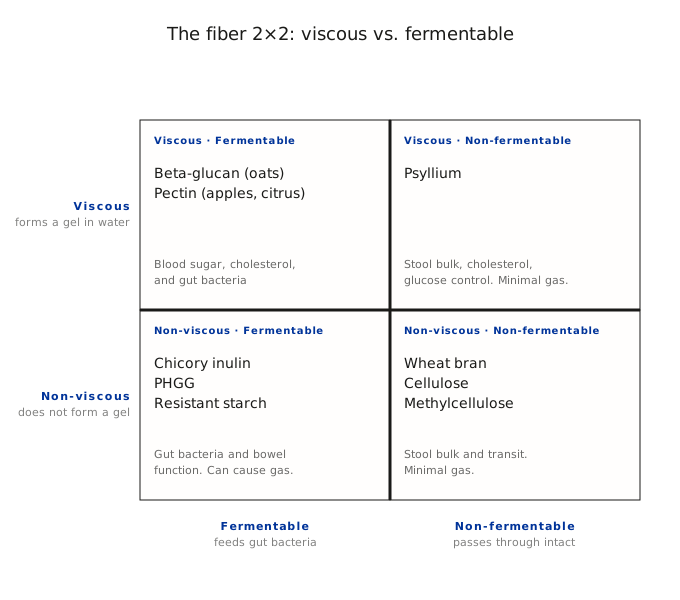
For a deeper dive into the physical properties that determine how fibers behave, including particle size and chain length, see Beyond Soluble and Insoluble.
Here is how the three most relevant fiber types for GLP-1 users compare:
Psyllium husk
What it is: A gel-forming soluble fiber from the Plantago ovata plant. It absorbs water, expands, and adds bulk and softness to stool.
The evidence: Decades of clinical research. Recommended as first-line for constipation by the American Gastroenterological Association.4 Strong evidence for both stool frequency and consistency improvement. EU-authorized health claims for cholesterol, not bowel function specifically.
For GLP-1 users: Often better tolerated initially because it does not cause fermentation-related gas. Works through mechanical bulk rather than bacterial fermentation. Many practitioners recommend psyllium as the starting fiber.
The tradeoff: Requires significant water intake (at least 250ml per serving). If taken without enough water, psyllium can actually worsen constipation by forming a dry mass. It does not have significant prebiotic activity, so it does not address the gut microbiome changes that can accompany reduced food variety.
Chicory inulin
What it is: A soluble prebiotic fiber extracted from chicory root. Non-viscous and highly fermentable. It feeds beneficial gut bacteria (primarily bifidobacteria) in the colon.
The evidence: Chicory inulin at 12g/day is the only fiber with an EU-authorized health claim for bowel function (Commission Regulation (EU) 2015/2314).5 The authorized claim: it contributes to normal bowel function by increasing stool frequency. For the full regulatory story behind this claim, see our EFSA health claims explainer. For the science of chicory inulin specifically, see Chicory Inulin: The Science.
For GLP-1 users: The prebiotic benefit is relevant because GLP-1 medications alter eating patterns, which can shift gut microbiome composition. Inulin supports the bacteria populations that may be disrupted by reduced food variety and volume. For a mechanism-level look at what GLP-1 medications do to the gut microbiome, see GLP-1 medications and the gut microbiome.
The tradeoff: Chicory inulin is a high-FODMAP fiber. It is rapidly fermented in the colon, which produces gas. For GLP-1 users whose digestion is already slowed, this can cause meaningful bloating during the first 1-2 weeks. The bloating is temporary and manageable with gradual dosing, but it is real and worth knowing about in advance.
Partially hydrolyzed guar gum (PHGG)
What it is: A low-FODMAP soluble fiber derived from guar beans. Non-viscous, moderately fermentable. Brand name: Sunfiber.
The evidence: Emerging evidence for digestive regularity. Better tolerated than inulin for IBS and FODMAP-sensitive individuals. No EU-authorized health claim for bowel function.
For GLP-1 users: A good option for people who cannot tolerate inulin’s fermentation effects and want something beyond psyllium’s mechanical action. Dissolves cleanly and is nearly flavorless, which helps with adherence.
The tradeoff: Less clinical evidence than inulin or psyllium for the specific outcomes GLP-1 users care about.
How they compare side by side
| Property | Psyllium | Chicory inulin | PHGG |
|---|---|---|---|
| Solubility | Soluble | Soluble | Soluble |
| Viscosity | High (gel-forming) | Low | Low |
| Fermentability | Low | High | Moderate |
| EU bowel claim | No | Yes (12g/day) | No |
| Gas/bloating risk | Low | High initially | Low |
| Prebiotic effect | Minimal | Strong | Moderate |
| Water requirement | High (300ml+) | Moderate (250ml) | Moderate (250ml) |
| Best for | Fast relief, bulk | Long-term regularity, microbiome | Sensitive systems |
For a detailed head-to-head comparison of the two most studied options, see our chicory inulin vs. psyllium husk guide.
For country-specific product recommendations, see our supplement guides for the UK, US, Australia, Canada, Netherlands, and Nordics.
What is the fiber dosing protocol?
The most common mistake is starting at too high a dose. Your gut bacteria need time to adjust to increased fiber, especially fermentable fibers like inulin. For a detailed walkthrough of the ramp-up process and how to troubleshoot bloating, see our guide to starting fiber without bloating.
For psyllium husk
Week 1: 3-5g per day (one rounded teaspoon) Week 2: 5-7g per day Ongoing: 7-10g per day
Take with at least 300ml of water per serving. This is non-negotiable for psyllium. Insufficient water can cause it to form a dry mass and worsen constipation. Take at least 30 minutes before or after medications, as psyllium can affect absorption of some drugs. For the full dose ranges, the fluid rule, and how long it takes to work, see our guide to psyllium husk dosage.
For chicory inulin
Week 1: 3-4g per day (approximately one-third of target dose) Week 2: 6-8g per day Week 3: 10-12g per day Ongoing: 12g per day (the dose validated by the EFSA health claim)
Take with at least 250ml of water per serving. Can be mixed into any cold or warm beverage, or added to food. Nearly tasteless. If bloating occurs at any step, hold at that dose for an additional 3-5 days before increasing.
For PHGG
Week 1: 3g per day Week 2: 5-6g per day Ongoing: 6-7g per day
Dissolves cleanly in water or any beverage. Generally well tolerated from the start, but gradual introduction is still recommended.
Combined approach
Because these fibers work through different mechanisms (gel-forming bulk vs. bacterial fermentation vs. moderate fermentation), they can be used together. A practical combined protocol:
Start with psyllium (5-7g daily) for immediate constipation relief. After 1-2 weeks, begin adding a fermentable fiber (inulin or PHGG) at the gradual protocol above while maintaining the psyllium dose. Once the fermentable fiber reaches its full dose, you can optionally reduce psyllium to 3-5g or maintain both based on your response.
How does oral semaglutide change fiber timing?
If you take injectable GLP-1 medications (the weekly injection), timing is straightforward. Take your fiber supplement at any consistent time of day that works for your routine.
If you take or plan to take oral semaglutide (the oral Wegovy formulation, approved in the US in December 2025 and authorized in the EU on 14 July 2026), timing becomes more complex. A second oral GLP-1, orforglipron (Foundayo), was authorized in the UK on 10 August 2026, and unlike oral semaglutide it has no fasting rule; our guide to taking fiber with orforglipron covers what that means for timing and constipation. Our guide to what the new GLP-1 pills mean for constipation covers how the two tablets differ on fiber timing.
Oral semaglutide requires a 30-minute empty-stomach fasting period after taking the pill. During this window, you cannot eat, drink anything other than plain water (up to 120ml), or take other supplements.6
The solution: Take your fiber supplement after the 30-minute fasting window, alongside or just before your first meal. Or take fiber in the evening instead of the morning. The key is consistency, not a specific time of day.
For the full breakdown of timing strategies, see our oral Wegovy and fiber timing guide. And if you are wondering whether fiber is even safe to combine with your other medicines, our guide to taking fiber with a GLP-1: timing, safety, and spacing covers which pills to keep it apart from and why the injection is a non-issue.
What about muscle loss?
Muscle loss is the second biggest concern for GLP-1 users, after constipation. Lean mass loss accounts for roughly 25-40% of total weight loss on GLP-1 medications, which has prompted real concern about long-term metabolic health.
Fiber is not a direct muscle-preservation tool. Resistance training and adequate protein (1.2-1.6g per kg body weight per day) are the primary defenses. But adequate fiber intake supports overall diet quality, nutrient absorption, and the metabolic foundation that protein and exercise build on. For the full picture, see Fiber and Muscle Loss on GLP-1: What the Evidence Says.
For a detailed look at what happens after stopping GLP-1 medications, including the weight regain data and how fiber fits into a maintenance strategy, see Weight Maintenance After Stopping GLP-1 Medications.
For the wider context (why GLP-1-related nutrient deficiencies expose a population-level density gap that already affects most European adults), see Nutrient Density for Everyone: The Bigger Lesson From GLP-1 Medications.
What should you know before starting?
The FODMAP question
Multiple practitioners and nutritionists recommend psyllium over inulin as first-line fiber for GLP-1 users specifically because inulin’s fermentation can worsen bloating in people whose digestion is already slowed. This concern is valid. The bloating is temporary and manageable with gradual dosing, but it is a real consideration when choosing your starting fiber.
Fiber is not a replacement for medical advice
If your constipation is severe (no bowel movement for 4+ days, significant pain, blood in stool), see a doctor. Fiber supplementation is a management strategy for the common, mild-to-moderate constipation that GLP-1 medications frequently cause. It is not a treatment for severe constipation or obstruction.
The adherence question
Up to 70% of GLP-1 users discontinue medication within a year. Side effects are a primary driver. If fiber supplementation helps you manage constipation and stay on your medication, the downstream health benefits of continued GLP-1 treatment are substantial.
The same logic applies to the supplement itself: the dose you will actually take beats the dose on paper. Capsules hold about half a gram each, so a research dose is around 20 a day; powder fits it in a scoop. The arithmetic by format is in fiber powder vs capsules vs gummies.
Hydration is half the equation
Every fiber guide focuses on the fiber. Not enough focus on water. GLP-1 medications reduce thirst signaling. You are likely drinking less than you think. Set a daily water target (2-2.5 liters minimum) and track it for the first few weeks. No amount of fiber supplementation will fix constipation if you are dehydrated.
Food first, then supplements
Whole plant foods deliver both soluble and insoluble fiber together, along with polyphenols, vitamins, and minerals that no supplement replicates. The case for supplementation is specific: you cannot close the gap from food alone. For most Europeans, and especially for GLP-1 users eating less overall, that is the default situation. See our guide to high-fiber foods in Europe for practical food-first strategies. For the intentional practice of optimizing fiber intake from all sources, see What Is Fibermaxxing?
Where should you go from here?
This guide is the overview, and the open GLP-1 fiber research library on our homepage indexes everything we publish. For specific topics, go deeper:
What Is Dietary Fiber? Everything You Need to Know covers the fundamentals.
Soluble vs. Insoluble Fiber explains the two main fiber types and introduces the viscous/fermentable framework.
Beyond Soluble and Insoluble goes deeper into particle size and chain length.
GLP-1 Constipation: Causes, Solutions, and What Actually Works covers the constipation mechanism in detail.
Mounjaro (Tirzepatide) and Constipation covers the dual GIP/GLP-1 agonist specifically, with the EMA frequency data.
GLP-1 Side Effects: What 410,000 Reddit Posts Reveal analyzes the largest real-world side effect dataset.
GLP-1 Nausea: How Long It Lasts and What Helps covers the side effect that dominates the early weeks, and why fiber belongs to the constipation problem rather than this one.
GLP-1 Diarrhea: Why It Happens and How Long It Lasts covers how common diarrhea is on each medicine, the 3-day median episode, and why fluids come first.
Weight Loss on GLP-1 Medicines: What to Expect, Stage by Stage covers how much weight people lose in the trials, how many reach 10% or 20%, when it levels off, and what happens on stopping.
GLP-1 Fatigue: What the Label Actually Says covers the side effect the European labels rank alongside nausea, and why no one can yet tell you what causes it.
GLP-1 Weight-Loss Plateau: Why It Happens and When to Expect It covers the point where the scale settles, what the trials say about when it arrives, and why it rarely means the medicine stopped working.
Chicory Inulin vs. Psyllium Husk: Which Fiber for Wegovy Users? provides the head-to-head comparison.
Metamucil vs Benefiber: Which Fibre Works Better on a GLP-1? compares the two household brands, psyllium against wheat dextrin, and why the gel decides it.
Chicory Inulin: The Science Behind the Only EU-Authorized Fiber Claim covers the regulatory evidence.
EFSA Health Claims Explained explains what “normal bowel function” actually means under EU regulation.
Oral Wegovy and Fiber: The 30-Minute Fasting Rule covers timing for the oral formulation.
How to Start a Fiber Supplement Without Bloating walks through the ramp-up protocol.
What to Look for in a Fiber Supplement for GLP-1 Users is the five-criteria buyer’s framework.
The Best Fiber for Semaglutide (Ozempic, Wegovy) gives the medication-specific recommendation by scenario.
The Best Fiber for Tirzepatide (Mounjaro, Zepbound) does the same for the dual GIP/GLP-1 agonist.
Best Fiber for Appetite and Satiety on a GLP-1 covers what the evidence shows about fiber and fullness while the medication is doing the appetite work, and why the effect tracks the gel a fiber forms.
Oatzempic: Does the Viral Oat Drink Work Like Ozempic? weighs the half-cup-of-oats recipe against the beta-glucan doses the trials and the EU claims actually rest on, and explains why a gut hormone and a drug built to copy it are not the same thing.
How to Spot a Fake GLP-1 Pen sets out the checks European regulators published after falsified Ozempic pens reached EU and UK wholesalers in 2023, and why the route a pen travelled matters more than how it looks.
Fiber and Muscle Loss on GLP-1 covers the lean mass question.
GLP-1 Medications and the Gut Microbiome explains what these medications do to gut bacteria, what fiber supports, and what the evidence actually shows.
Best Fiber for Gut Health ranks the fiber types by endpoint, and shows where the popular fermentable-fiber-equals-more-butyrate story breaks down in human trials.
The European Fiber Gap provides the population-level data on fiber intake across Europe.
How Much Fiber Per Day compares EU and US guidelines.
The Best High-Fiber Foods in Europe covers food-first strategies by regional diet.
What Is Fibermaxxing? explains the practice of intentionally optimizing fiber intake.
GLP-1 Voices Worth Following in Europe maps the credible European clinicians, researchers, journalists and patient groups on these medications, country by country.
Supplement guides by country: UK · US · Germany · Spain · France · Australia · Canada · Netherlands · Nordics
Footnotes
-
Product prescribing information for semaglutide (Ozempic, Wegovy) and tirzepatide (Mounjaro, Zepbound). GLP-1 receptor agonist mechanism of action. ↩
-
Bezin J, et al. GLP-1 receptor agonist use and gastrointestinal side effect duration. Constipation prevalence data from STEP and SURMOUNT registration trials (2023). ↩
-
Gill SK, Rossi M, Bajka B, Whelan K. Dietary fibre in gastrointestinal health and disease. Nature Reviews Gastroenterology & Hepatology (2021) 18:101-116. ↩
-
American Gastroenterological Association guidelines on constipation management. Psyllium recommended as first-line fiber supplement. Gastroenterology (2013). ↩
-
Commission Regulation (EU) 2015/2314 of December 7, 2015. Authorized health claim for chicory inulin: “Chicory inulin contributes to normal bowel function by increasing stool frequency.” Condition of use: 12g/day native chicory inulin. ↩
-
Oral semaglutide prescribing information. 30-minute fasting requirement with no more than 120ml of plain water. ↩