
If you have started semaglutide (Ozempic, Wegovy) or tirzepatide (Mounjaro, Zepbound) and gone looking for how much fiber you should be getting, you have probably found general advice that never mentions the medication. That is because there is no GLP-1-specific fiber recommendation. The honest answer is short: aim for the same target as everyone else, at least 25g a day, ideally closer to 30g. The part worth a full guide is not the number. It is why that number suddenly becomes much harder to reach, and what to do about it. For the wider fiber-and-GLP-1 picture beyond dosing, see our complete guide to fiber and GLP-1 medications.
The short answer: the target does not change
Public-health bodies set fiber targets for adults regardless of whether you take a weight-loss medication:
- EFSA (European Food Safety Authority): at least 25g a day, the EU-wide baseline.
- National guidelines: several go higher to 30g, including Germany’s DGE, the UK, and France.
- United States: 25 to 38g, depending on age and sex.
The evidence behind these numbers is consistent: the strongest health benefits show up between roughly 25 and 29g a day, continuing up to about 30g, and below 25g chronic-disease risk rises measurably. None of that changes because you are on a GLP-1. For the full picture of where these recommendations come from, see how much fiber you actually need, EU vs US guidelines compared.
So the target is settled. The problem is arithmetic.
Why the same target is much harder to hit on a GLP-1
GLP-1 medications work by reducing how much you eat. That is the point of them, and the effect is large. In a clinical study, once-weekly semaglutide 2.4mg (the Wegovy dose) reduced ad libitum energy intake by about 35% compared with placebo.1 Tirzepatide, which acts on both the GIP and GLP-1 systems, also substantially cuts appetite and food intake.2
Fiber comes from food. So when total food intake falls by roughly a third, fiber intake falls with it. And it falls from a starting point that was already too low. The average European adult eats only 16 to 24g a day before any medication, against the 25 to 30g target. That is the well-documented European fiber gap. A GLP-1 widens it.
Put concretely: someone getting around 18g of fiber from a full diet can drop to 10 to 12g once the medication takes hold.3 You did not change your food philosophy. You just eat less of everything, fiber included.
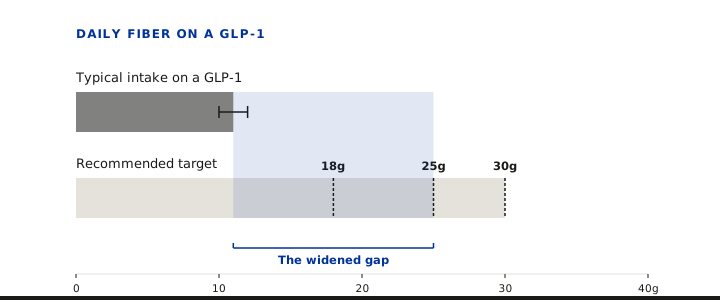
On a GLP-1, a typical diet’s fiber can fall to roughly 10 to 12g a day, down from about 18g before, while the target stays at 25 to 30g. The gap gets wider, not smaller. Source: EFSA 2010; Stephen et al. 2017; Friedrichsen et al. 2021.
| Reference | Daily fiber |
|---|---|
| Typical intake on a GLP-1 | 10-12 g |
| Typical intake before, full diet | ~18 g |
| EFSA minimum | 25 g |
| National target (DGE / NHS / ANSES) | 30 g |
This is also why constipation is so common on these drugs, affecting an estimated 5 to 24% of users: less fiber and less fluid meet a slowed gut all at once. The mechanism is covered in depth in our GLP-1 constipation guide, and the wider strategy in the complete guide to fiber and GLP-1 medications.
Step one: find out where you actually are
You cannot close a gap you have not measured, and intuition is unreliable here, because the food simply is not on your plate to notice. The easiest way to get a real number:
- Track everything you eat for three days using a food-tracking app. Most calculate fiber automatically, and three days is enough to see a realistic daily average.
- No app? Read the labels. The fiber line is on every packaged-food nutrition panel, and a quick food-composition lookup covers whole foods.
- Use the default assumption. If you are not deliberately choosing high-fiber foods, you are almost certainly below 20g, and on a GLP-1 likely lower still.
Once you have your average, the math is simple: target minus current intake equals the gap you need to fill.
Step two: close the gap, food first
Food-based fiber should be the foundation, because it arrives packaged with other nutrients that matter even more when you are eating less overall. On a reduced appetite, prioritise fiber-dense choices: legumes, whole grains, vegetables, fruit, nuts, and seeds, so that the smaller volume of food you do eat carries more fiber per bite.
But honestly, when you are eating a third less, food alone often will not get you from 11g to 25g. That is where a supplement earns its place.
Step three: top up with a supplement, matched to the dose
A supplement providing roughly 5 to 15g a day closes most realistic gaps. Which fiber, and at what dose, depends on what you are solving. No fiber has been tested in GLP-1 users specifically, so these are reasoned extrapolations from the broader evidence, not head-to-head trials in this population.
| Fiber | Best for | Evidence dose | Note on a GLP-1 |
|---|---|---|---|
| Psyllium husk | Constipation relief | >10g/day | Strongest constipation evidence; needs a full glass of water |
| PHGG | The early weeks, a sensitive gut | 5-7g/day | Gentlest; ferments slowly, little gas |
| Chicory inulin | Longer-term gut and regularity support | ~12g/day | Highly fermentable; introduce later, once settled |
| Oat beta-glucan | Blood sugar and cholesterol | 3g/day | Pairs with carbohydrate meals |
For constipation specifically, psyllium husk has the clearest support: a 2022 meta-analysis of 16 randomized controlled trials found it the most efficacious fiber for chronic constipation, and the only one to significantly reduce straining, at doses above 10g a day. Two rules make or break the result, and both matter more on a slowed GLP-1 gut:
- Ramp up slowly. Start at roughly half your target dose for the first week, then increase by a few grams every few days. A fiber you keep taking beats the perfect one you quit in week two.
- Drink more water than feels necessary, especially with psyllium, which absorbs a lot of it.
For the full type-by-type breakdown, see the best fiber for semaglutide and, for the dual agonist, the best fiber for tirzepatide.
Will a supplement actually close the gap?
Mostly, but how much depends on where you start. The chart below runs the same roughly 10g supplement across five realistic starting points: from someone who ate little fiber to begin with and is now heavily suppressed, through to a health-conscious eater with a milder appetite drop. The grey block is the fiber the reduced diet still supplies; the blue block is the supplement on top.
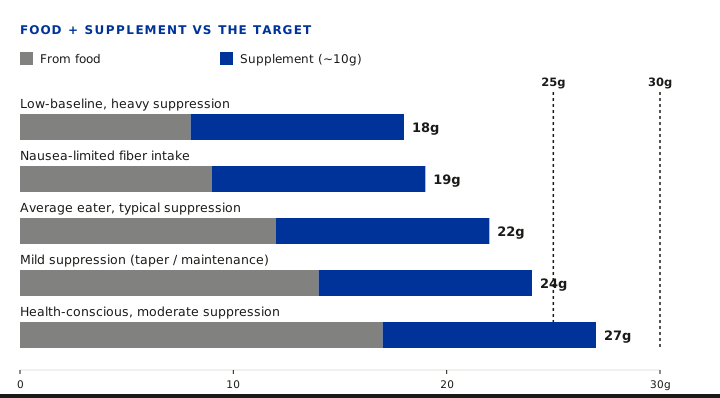
Across five illustrative GLP-1 scenarios, a ~10g supplement lifts total fiber to between 18 and 27g a day. Only the health-conscious, moderately suppressed case clears the 25g minimum, and none reach 30g. Modeled from EU intake data and the ~35% energy-intake reduction on semaglutide, not measured. Source: EFSA 2010; Stephen et al. 2017; Friedrichsen et al. 2021.
| Scenario | Fiber from food on the drug | With a ~10g supplement | vs 25g minimum | vs 30g target |
|---|---|---|---|---|
| Low-baseline, heavy suppression | ~8g | ~18g | −7g | −12g |
| Nausea-limited fiber intake | ~9g | ~19g | −6g | −11g |
| Average eater, typical suppression | ~12g | ~22g | −3g | −8g |
| Mild suppression (taper / maintenance) | ~14g | ~24g | −1g | −6g |
| Health-conscious, moderate suppression | ~17g | ~27g | +2g | −3g |
These are worked examples, not measurements: each combines a plausible pre-medication intake with the drug’s roughly one-third cut in food intake.4 Two things follow from them. First, a supplement does the heavy lifting: it roughly doubles intake in the most-suppressed cases and moves every scenario materially closer to the target. Second, on its own it is often not quite enough, so the last few grams still come from food. The instinct to just double the supplement to force the number is the wrong fix, because piling on fermentable fiber quickly is exactly what overloads a slowed gut (see below); lifting the food floor is the gentler way to close the final gap.
And if you land at 20 to 24g rather than a clean 25? You are still far better off than at the 10 to 12g you started from. Fiber’s benefits, easier stools, steadier post-meal blood sugar, and more fuel for the gut microbiome, accrue across the range rather than switching on at 25g. As noted above, that number marks where the long-term evidence is strongest, not a threshold below which fiber does nothing. Closing most of the gap captures most of the benefit.
A note on timing
For weekly injections (Ozempic, Wegovy, Mounjaro, Zepbound) there is no timing rule for fiber: take it whenever suits you. For oral semaglutide (Rybelsus), timing matters. The pill must be taken on an empty stomach with a small sip of water, and no food, drink, or supplements are allowed for at least 30 minutes, so fiber goes later in the day. As general practice, also space fiber at least two hours from any other oral medication, because it can slow absorption.
Can you overdo it?
There is no official upper limit for fiber, and large reviews have found no evidence of harm at higher intakes. The real ceiling is tolerance, and on a GLP-1 it sits lower than usual, because the slowed gut traps fermentation gas for longer. Rapidly pushing past about 40 to 50g a day is a common trigger for bloating and discomfort. The goal is to reach 25 to 30g comfortably and hold there, not to chase the highest number you can.
What do these numbers assume?
Two things are worth stating plainly. First, the dosing guidance above is extrapolated from constipation and fiber-intake research in the general population; no trial has tested a specific fiber in semaglutide or tirzepatide users. Second, a February 2026 perspective paper argued that fiber may help support appetite, glucose stability, and weight management during and after GLP-1 treatment, while being explicit that fiber cannot replicate what the medication does. That is a reasoned hypothesis, not proof.
None of this is medical advice, and individual needs vary. If you have a gut condition, take other medications, or are unsure, check with your clinician or pharmacist before adding a supplement.
The takeaway is simple enough to act on today: your fiber target on a GLP-1 is the same 25 to 30g it always was. You are just starting further from it than before. Measure where you are, build the floor from food, and top up the rest, slowly and with water. For everything beyond dosing, from fiber types to timing to the constipation mechanism, our open GLP-1 fiber research library indexes every guide we publish.
Footnotes
-
Friedrichsen M, et al. The effect of semaglutide 2.4 mg once weekly on energy intake, appetite, control of eating, and gastric emptying in adults with obesity. Diabetes, Obesity & Metabolism, 2021. Ad libitum energy intake was 35% lower with semaglutide versus placebo (P<0.0001). https://pubmed.ncbi.nlm.nih.gov/33269530/ ↩
-
Tirzepatide on ingestive behaviour in adults with overweight or obesity: a randomized phase 1 trial. Nature Medicine, 2025. Tirzepatide reduced energy intake and appetite versus placebo through combined GIP and GLP-1 receptor agonism. https://www.nature.com/articles/s41591-025-03774-9 ↩
-
Worked example consistent with the European fiber gap (Stephen et al. 2017, EU intake 16-24g) and an approximately one-third reduction in energy intake on semaglutide.1 ↩
-
Illustrative scenarios, not measured data. Each pairs a plausible pre-medication fiber intake (within the 16-24g European range, Stephen et al. 2017) with a reduction in food intake consistent with the ~35% lower energy intake reported on semaglutide 2.4mg (Friedrichsen et al. 2021), then adds a fixed ~10g supplement. The nausea-limited case assumes fibrous foods are cut more sharply than intake overall. Targets are the EFSA 25g minimum and the 30g national target. ↩