
Semaglutide, sold in Europe as Wegovy for weight management and Ozempic for type 2 diabetes, is one of the most effective medicines of its generation. It is also the GLP-1 drug most strongly linked to constipation, and for a lot of people that comes as an unwelcome surprise a few weeks in. If your bowels have slowed to a crawl since starting, you are not doing anything wrong, and you are far from alone.
Semaglutide is a GLP-1 receptor agonist: it acts on the GLP-1 receptor alone, where tirzepatide (Mounjaro) is a dual GIP and GLP-1 agonist.1 The constipation question sits inside the same broader picture as the rest of the category, which we cover in our complete guide to fiber and GLP-1 medications. Here we focus on what the trial data says about semaglutide specifically, and what actually helps.
How common is constipation on semaglutide?
Common enough to plan for. About one in four people at the weight-management dose.
In the pooled STEP 1 to 3 obesity trials of semaglutide 2.4 mg (the Wegovy dose), constipation affected 24.2% of participants versus 11.1% on placebo, alongside nausea (43.9%), diarrhoea (29.7%) and vomiting (24.5%).2 That places constipation firmly among the expected effects of the drug, not a rare or unlucky reaction.
Nausea is the more common of the two, but not the more persistent one: European product information puts the median nausea episode at 8 days against 47 days for constipation, which is why nausea dominates the early weeks while constipation is the problem that outlasts it.
Semaglutide also stands out within its own class. In an analysis of FDA adverse-event reports, it carried the highest constipation reporting signal of any GLP-1 receptor agonist, with a reporting odds ratio of 6.17, ahead of liraglutide, dulaglutide and the rest; a separate, independent analysis of the same database reproduced that ranking.3 A reporting signal is not the same as a precise incidence rate, because it reflects how disproportionately an effect is reported rather than exactly how often it happens. But the direction is consistent across sources: of the GLP-1 medications, semaglutide is the one most associated with constipation.
The reassuring part is that these events are overwhelmingly non-serious (99.5%) and mild to moderate (98.1%) in the obesity trials, and they are transient, clustering during dose escalation and easing with time.2 In the diabetes trials, gastrointestinal disorders appeared in roughly 40% of semaglutide users and were again most prevalent during initiation and titration.4
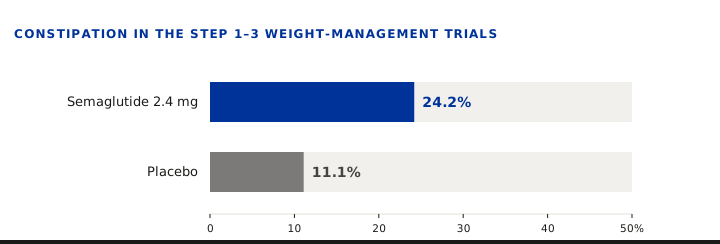
Constipation in the pooled STEP 1–3 weight-management trials: 24.2% on semaglutide 2.4 mg versus 11.1% on placebo, more than double the placebo rate and about one in four people. Source: Wharton et al., pooled STEP 1–3 analysis, Diabetes, Obesity and Metabolism 2022.
Why does semaglutide cause constipation?
The same mechanism that helps you eat less is the one that backs things up.
Slower gastric emptying. Semaglutide delays how quickly food leaves your stomach. This is part of how it curbs appetite, because food sits longer and you feel full sooner. But slower transit through the whole digestive tract means stool spends more time in the colon, where water is steadily reabsorbed. The result is harder, drier, less frequent stool.
Less food, less fiber. When the drug is doing its job, you eat considerably less, and eating less almost always means taking in less fiber. The average European adult already falls short of fiber recommendations before any appetite suppression enters the picture, so a shrinking plate widens the existing fiber gap.
Less to drink. Reduced appetite often comes with reduced thirst and lower fluid intake. Dehydration makes constipation worse, because the colon pulls even more water out of stool when the body is short on fluid.
These three effects stack. The person whose gut most needs fiber and water is, at the same time, taking in less of both.
When is semaglutide constipation likely to be worst?
During dose increases.
Semaglutide is started low and stepped up slowly on purpose, so the digestive system can adjust. The gastrointestinal side effects are highest during the dose-escalation period and decrease over time.24 In practice, the weeks right after each step up are when constipation, nausea and related symptoms are most likely to flare. If you know a dose increase is coming, that is the moment to be most deliberate about fiber and fluids, not after symptoms have already taken hold.
What kind of fiber helps with semaglutide constipation?
Soluble fiber, introduced slowly, with enough water to matter.
Not all fiber behaves the same way. The distinction that counts here is between soluble and insoluble fiber. Soluble fiber dissolves in water and forms a gel in the gut; it can increase stool frequency by drawing water into the colon, and it feeds beneficial gut bacteria. Insoluble fiber adds bulk and speeds transit in a healthy gut, but for someone whose gastric emptying is already slowed by semaglutide, piling on bulk without enough water can make discomfort worse rather than better.
For constipation specifically, psyllium husk has the strongest evidence. A 2022 systematic review and meta-analysis in the American Journal of Clinical Nutrition pooled 16 randomized controlled trials and found psyllium the most efficacious fiber investigated for chronic constipation: it increased bowel movements by about three per week, improved stool consistency, and was the only fiber to significantly reduce straining. Effective relief required doses above 10 g/day.5 Two honest caveats: the trials varied widely in their results, and the participants had chronic constipation, not semaglutide-induced constipation, so the benefit here is a reasonable extrapolation rather than a proven one.
Partially hydrolysed guar gum (PHGG) is the gentlest option, and on a slowed gut “gentle” is a real advantage. Around 5 to 7 g/day is enough to support regularity, it ferments slowly, produces little gas and dissolves clear, which makes it easier to keep taking daily than psyllium in the early weeks.6
In the European context, chicory inulin is worth singling out because it carries an EU-authorized health claim. Under Commission Regulation (EU) 2015/2314, the authorized wording is that chicory inulin contributes to normal bowel function by increasing stool frequency, at a daily intake of 12 grams of native chicory inulin.7 The catch is fermentation: inulin is highly fermentable and high-FODMAP, so on an already-slowed gut it can produce gas and bloating that drives people off it before they feel the benefit. Treat it as a fiber to introduce gradually once your gut has settled. For a fuller comparison of the two leading options, see chicory inulin versus psyllium husk for GLP-1 users, and for the full fiber-by-scenario breakdown, the best fiber for semaglutide.
How do you add fiber without making things worse?
Slowly. This is the part people skip, and it is the part that decides whether fiber helps or backfires.
A full dose of any fermentable fiber on day one can cause gas and bloating, especially in a gut already slowed by medication. A reasonable approach is to start at roughly a third of your target dose for the first few days, increase to about two-thirds after three to five days if you are tolerating it, and reach the full dose after another three to five days. A one to two week ramp is normal, and taking longer is fine. Pick one fiber rather than combining several new ones at once.
Hydration is not optional. Fiber without enough water can deepen constipation instead of relieving it, and this is doubly true for psyllium, which absorbs a lot of water and must be taken with a full glass. Aim for at least 1.5 to 2 litres of fluid a day, with an extra glass alongside each fiber serving. Because semaglutide can blunt thirst, reminders help more than waiting to feel thirsty. We walk through the gentle-start approach in more detail in how to start a fiber supplement without bloating, and what to look for in a product in our buyer’s guide for GLP-1 users.
Does fiber timing interact with your semaglutide dose?
It depends on whether you take the injection or the pill.
For the weekly injection (Ozempic, Wegovy), there is no label-based timing rule for fiber. You can take it whenever fits your routine.
For oral semaglutide (Rybelsus), timing matters. The pill must be taken on an empty stomach in the morning with no more than a small sip of plain water, and no food, drink, other medication or supplements are allowed until at least 30 minutes later.8 A fiber supplement is a supplement, so it is barred from that morning window; take it later in the day instead. This is about to matter for far more people: in May 2026 the EMA’s committee issued a positive opinion recommending an oral semaglutide 25 mg pill (Wegovy) for weight management, with European Commission authorization still pending and a launch outside the US planned for the second half of 2026.9 Our dedicated guide on oral Wegovy and the 30-minute fasting rule covers the routine in depth.
One interaction applies whichever form you take. Semaglutide delays gastric emptying and can slow the absorption of oral medicines, and fiber can do the same. The practical rule is to take fiber at least two hours apart from other oral medications, and to speak with your pharmacist if you take a drug with a narrow therapeutic window, such as certain blood thinners.
When should you talk to your doctor?
Fiber and fluids resolve most cases, but some situations need medical input.
If constipation persists beyond two to three weeks despite adequate fiber and hydration, raise it with your prescribing clinician. If you have severe abdominal pain, blood in your stool, vomiting, or a sudden marked change in bowel habits, seek medical advice promptly, since dehydration from gastrointestinal side effects is a risk worth taking seriously.
This information is educational and does not replace medical guidance. Fiber supplementation complements your treatment; it is not a substitute for it, and your prescriber is the right person to weigh your full picture. If you also want to understand constipation across the whole medication class, see our GLP-1 constipation guide; if you are on the dual agonist instead, see Mounjaro (tirzepatide) and constipation.
Footnotes
-
European Medicines Agency. Ozempic and Wegovy (semaglutide) Summary of Product Characteristics; Mounjaro (tirzepatide) SmPC for the mechanism contrast (dual GIP/GLP-1 vs GLP-1 alone). Accessed via ema.europa.eu. ↩
-
Wharton S, et al. Gastrointestinal tolerability of once-weekly semaglutide 2.4 mg in adults with overweight or obesity, pooled STEP 1-3 analysis. Diabetes, Obesity and Metabolism 2022. Constipation 24.2% vs 11.1% placebo; events 99.5% non-serious, 98.1% mild-to-moderate. ↩ ↩2 ↩3
-
Liu L, et al. Association between different GLP-1 receptor agonists and gastrointestinal adverse reactions: a real-world disproportionality study based on the FDA adverse event reporting system database. Semaglutide constipation reporting odds ratio 6.17 (95% CI 5.72-6.66), the highest of the class; ranking independently reproduced in a 2024 FAERS analysis. ↩
-
Aroda VR, et al. Gastrointestinal tolerability of semaglutide across the SUSTAIN and PIONEER clinical trial programmes (type 2 diabetes). Diabetes, Obesity and Metabolism 2023. GI disorders in roughly 40% of users, most prevalent during initiation and titration. ↩ ↩2
-
van der Schoot A, et al. The effect of fiber supplementation on chronic constipation in adults: an updated systematic review and meta-analysis of randomized controlled trials. American Journal of Clinical Nutrition 2022. Psyllium the most efficacious fiber investigated; effective above 10 g/day; the only fiber to significantly reduce straining. ↩
-
Kapoor MP, et al. Impact of partially hydrolyzed guar gum (PHGG) on constipation prevention: a systematic review and meta-analysis. Journal of Functional Foods 2017. 5-7 g/day sufficient to support regularity. ↩
-
Commission Regulation (EU) 2015/2314 authorizing the health claim for chicory inulin. Authorized wording: chicory inulin contributes to normal bowel function by increasing stool frequency, at 12 g/day native chicory inulin. ↩
-
Rybelsus (oral semaglutide) administration instructions: empty stomach with up to 120 mL plain water, no food, drink, or other oral products, then wait at least 30 minutes. Novo Nordisk / FDA prescribing information. ↩
-
European Medicines Agency. First oral GLP-1 treatment for weight management: CHMP positive opinion for oral semaglutide 25 mg (Wegovy), adopted 22 May 2026; European Commission authorisation pending. ↩