For regularity, the adult dose of psyllium husk is 7 to 11 grams a day, split into one to three servings, taken with at least 30 ml of liquid per gram. Start low, and give it 12 to 24 hours to work.
The tub rarely tells you the rest: how much water actually matters, how to space psyllium around your other tablets, and how long to wait before it works. Get the dose right and it is gentle and reliable. Get the water wrong and the same fibre becomes a genuine hazard. The detail behind each number is below.
How much psyllium husk should you take per day?
The clearest reference point is the European herbal-medicine monograph for ispaghula husk, which is the pharmaceutical name for psyllium. It sets two adult ranges depending on why you are taking it.1
For constipation and easier, softer stools, the daily dose for adolescents, adults and the elderly is 7 to 11 grams, taken in one to three single servings.1 For children aged 6 to 12 the range is 3 to 8 grams a day; it is not recommended below the age of 6.1
If your goal is simply to raise your daily fibre intake, for instance as an adjunct in constipation-predominant irritable bowel syndrome, the adult range is wider, 7 up to 20 grams a day, again in one to three servings.1 This higher range is not recommended below the age of 12.1
Those numbers are worth putting in context. Most people in Europe fall well short of the recommended daily fibre intake in the first place, and how wide that shortfall runs across the continent is its own story, so a psyllium dose in this range is closing a real gap rather than pushing an already-high intake higher. It is also a meaningful dose, not a token sprinkle: a systematic review of fibre for chronic constipation found the benefit was most reliable at doses above 10 grams a day and over treatment periods of at least four weeks.2
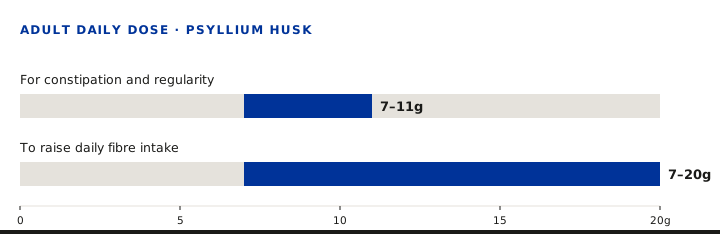
Adult daily dose of psyllium husk, split into one to three servings. Take at least 30 ml of liquid per gram. Source: EMA/HMPC Community herbal monograph on ispaghula husk (EMA/HMPC/199774/2012, 2013).
How much water should you take with it?
This is the number to get right before any other. The monograph is specific: take at least 30 ml of liquid per gram of husk.1 In practice that is roughly 150 ml of water with a 5 gram dose, and around 300 ml with a 10 gram dose. Water, milk, juice or a similar drink all count, and you should keep your fluid intake up across the day.1
The reason is mechanical. Psyllium can absorb up to 40 times its own weight in water, swelling into a gel that is what bulks and softens the stool.1 That gel has to form in your gut, not in your throat. Taken with too little fluid, bulk-forming fibres can obstruct the throat and oesophagus, with choking and intestinal blockage; the warning signs are chest pain, vomiting, or difficulty swallowing or breathing.1 For the same reason, psyllium is not for anyone who has trouble swallowing, a narrowing anywhere in the gut, or an existing blockage.1
None of this makes psyllium dangerous. It makes the water non-negotiable. Mix the husk into a full glass, drink it promptly before it thickens, and follow it with more liquid.
When should you take psyllium, and around your other medicines?
Timing around food is flexible. Timing around other medicines is not. Because psyllium forms a gel that can slow how well a tablet swallowed at the same moment is absorbed, take each dose at least half an hour to an hour before or after any other medicine.1 The monograph names minerals, vitamin B12, cardiac glycosides, warfarin-type anticoagulants, carbamazepine and lithium as drugs whose absorption can be delayed.1 For narrow-margin medicines like warfarin or thyroid hormones, err toward a wider gap and, in those cases, take psyllium only with medical advice.1
Two more timing points. Do not take it immediately before bed.1 And if you use a GLP-1 medication such as semaglutide or tirzepatide, the same spacing rule covers your oral tablets; the injection itself has no known interaction with fibre. Spreading the dose across the day, rather than taking it all at once, is also easier on the gut.
How long does psyllium husk take to work?
The effect usually starts 12 to 24 hours after a dose, and the maximum effect can take 2 to 3 days.1 Psyllium is not a same-hour laxative, and treating it like one, by stacking extra doses when nothing has happened by the evening, is how people end up taking too much.
Give it the day or two it needs. If constipation has not eased after 3 days, or if you are dealing with a change in bowel habit that has lasted more than 2 weeks, undiagnosed rectal bleeding, or abdominal pain, stop and speak to a doctor or pharmacist rather than raising the dose.1
How should you build up to your dose?
Start at the low end of the range and increase over a week or two. Psyllium is gentler to introduce than fermentable fibres because it is only slowly fermented, so it produces very little gas. In a controlled imaging study, psyllium caused almost no rise in colonic gas, while inulin produced a large one.3 Some flatulence can still occur in the first days and generally settles as treatment continues.1
A reasonable schedule is to begin with a single 3 to 5 gram serving a day, taken with a full glass of water, and add a second serving after several days once you know how you respond. If you are combining psyllium with a fermentable prebiotic fibre, the two work through different mechanisms and the difference between inulin and psyllium is worth understanding before you stack them. The gentle-titration approach that keeps bloating down for inulin applies here too, with the water rule doing even more of the work.
Does the type of psyllium change the dose?
The dose ranges above are for plain psyllium husk, the seed coating of Plantago ovata.1 Whole husk and powdered husk carry the same fibre, so the gram amounts hold; a level teaspoon of powder is lighter than the same volume of whole husk, which is exactly why weighing in grams beats measuring in spoons. Flavoured or sweetened blends contain less actual psyllium per scoop, so read the label for the husk content rather than assuming the whole serving is fibre.
One point people often get wrong: in the EU, psyllium carries no authorised health claim, for cholesterol or for anything else.4 It is widely used and well evidenced for regularity, but that is a matter of its mechanism and its place in the herbal-medicine framework, not an EU food health claim. If you are interested in the cholesterol question specifically, we cover which fibres do and do not carry that claim in our guide to fibre and cholesterol.
Weighed out, taken with enough water, and spaced from your other tablets, psyllium is one of the simplest fibres to get right.
Footnotes
-
European Medicines Agency, Committee on Herbal Medicinal Products (HMPC). Community herbal monograph on Plantago ovata Forssk., seminis tegumentum (ispaghula husk). EMA/HMPC/199774/2012, final, adopted 14 May 2013. Posology: 7–11 g/day (constipation, adults) and 7–20 g/day (fibre intake, adults) in 1–3 single doses; children 6–12 y 3–8 g/day; method of administration ≥30 ml liquid per 1 g; take ½ to 1 hour before or after other medicines, not before bedtime; onset 12–24 h, maximum effect 2–3 days; choking/obstruction warning with inadequate fluid; consult a doctor if constipation persists >3 days. ↩ ↩2 ↩3 ↩4 ↩5 ↩6 ↩7 ↩8 ↩9 ↩10 ↩11 ↩12 ↩13 ↩14 ↩15 ↩16 ↩17 ↩18
-
van der Schoot A, Drysdale C, Whelan K, Dimidi E. The effect of fiber supplementation on chronic constipation in adults: an updated systematic review and meta-analysis of randomized controlled trials. The American Journal of Clinical Nutrition, 2022. 16 RCTs, 1,251 adults; benefit most reliable at doses above 10 g/day and over at least 4 weeks; psyllium specifically effective. ↩
-
Gunn D, Abbas Z, Harris HC, et al. Psyllium reduces inulin-induced colonic gas production in IBS: MRI and in vitro fermentation studies. Gut, 2022;71(5):919–927. Randomised crossover, 19 IBS patients; psyllium produced little colonic gas while inulin produced the greatest rise. ↩
-
EU Register on nutrition and health claims (Regulation (EC) No 1924/2006; Commission Regulation (EU) No 432/2012 framework). Psyllium holds no EU-authorised health claim for blood cholesterol or for faecal bulk; the only psyllium-related register entry is a non-authorised cholesterol claim (soluble fibre from oat, psyllium, pectin or guar gum; EFSA Journal 2010;8(10):1735). Verified directly against the EU Register, retrieved 2026-06-02. ↩