Sunfiber is the brand name of partially hydrolyzed guar gum (PHGG) made by Taiyo Kagaku, a Japanese ingredient company. It is guar gum cut by an enzyme until it dissolves clear, and chemically it is the same fiber as any other PHGG.
Three of the four controlled PHGG trials we verified used Sunfiber, and Taiyo paid for two of them. Regulators in the US, Canada and the EU have each classified it differently. Our monograph on PHGG covers the fiber itself: the chemistry, the viscosity numbers and the trial results in full.
→ Read: Types of fiber supplements compared
What is Sunfiber made from?
Sunfiber starts as guar gum, the ground seed of the guar bean. Taiyo treats it with an enzyme from the mould Aspergillus niger that cuts the long fiber chains into short ones.1 The result has an average molecular weight of about 20,000 daltons, under a tenth of the original chain length, and it no longer thickens water.2
Taiyo makes it at its own plant in Aurangabad, India, and sells it through Taiyo International in the US and Taiyo GmbH in Europe.3 Taiyo sells it as a raw material for foods, drinks and supplements, so shoppers meet it inside other companies’ products. Products like these are one way people try to close the gap between what most Europeans eat and the recommended fiber intake.
The raw material comes in several grades. Taiyo lists a regular grade and an agglomerated grade, each above 85 percent soluble fiber, a standard grade above 80 percent for bars and cereals, and organic versions of all three.4 The agglomerated grade is made to dissolve faster in liquids.
In 2017 Monash University, which runs the main FODMAP research programme, certified Sunfiber as low FODMAP. According to Taiyo, it was the first stand-alone ingredient to receive that certification.5 The certification means samples were tested and found low in FODMAPs. It says nothing about how a given person will tolerate it.
Is Sunfiber different from other PHGG?
Other manufacturers make PHGG too, and the products are not identical. A laboratory study by Taiyo scientists compared two of their own grades, one at about 20,000 daltons and one at about 5,000, and found both were fermented by gut bacteria from human stool samples.6 That study was done in a lab vessel, not in people. The two grades it tested differ about fourfold in chain length.
What we could not find is a human trial that puts Sunfiber against another brand of PHGG. Without one, there is no evidence that Sunfiber works better or worse than other PHGG, and no evidence that they work the same.
Which trials used Sunfiber, and who paid for them?
Of the four controlled PHGG trials we have verified, three used Sunfiber. Taiyo funded two of those three.
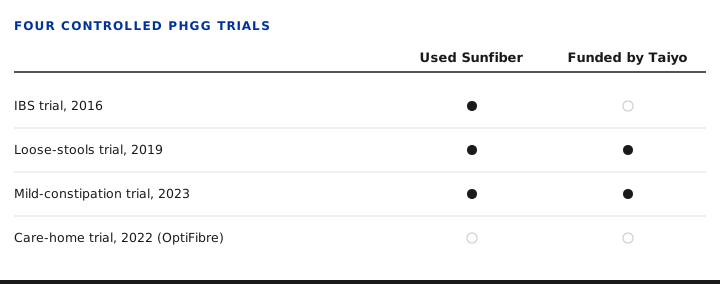
Test product and funder of each trial, as stated in the published papers. A filled dot means yes. Sources: Niv et al. 2016; Yasukawa et al. 2019; Abe et al. 2023; Chan et al. 2022.
| Trial | Test product | Funded by |
|---|---|---|
| IBS, 2016 | Sunfiber | Pro Natura and Sunwic AB |
| Loose stools, 2019 | Sunfiber | Taiyo Kagaku |
| Mild constipation, 2023 | Sunfiber | Taiyo Kagaku |
| Care home, 2022 | OptiFibre (Nestlé) | No conflict of interest declared |
IBS, 2016. A 12-week trial gave Sunfiber at 3 grams a day for one week, then 6 grams a day, against a maltodextrin placebo.7 Of 121 people randomized, 108 were analyzed. Sunfiber reduced bloating more than placebo (P=0.03). It did not beat placebo on abdominal pain, stool frequency, overall symptom severity or quality of life. Two European companies, Pro Natura of Germany and Sunwic AB of Sweden, funded it.
Loose stools, 2019. A 12-week Japanese trial gave 5 grams a day to 44 healthy volunteers who tended toward soft stools.8 Stool form moved toward the middle of the Bristol scale, with a significant difference from placebo at weeks 7 and 11. Stool frequency did not change. Taiyo funded the study and three of its authors were Taiyo employees.
Mild constipation, 2023. An eight-week Japanese trial compared 3 grams, 5 grams and placebo in healthy adults who reported two to five bowel movements a week.9 Sixty were randomized and 51 analyzed. At 5 grams, people reported a better feeling of complete emptying than on placebo (p=0.048), and scores on sleep and motivation questionnaires improved. At 3 grams, the bowel results were not significant. Bowel frequency rose more on 5 grams than on placebo, but the placebo group started with more bowel movements, which the authors point out themselves. Taiyo funded the trial and four of the authors worked for the company.
The fourth trial, in care-home residents with constipation, used OptiFibre, the Nestlé PHGG product, and its authors declared no conflict of interest.10 Our PHGG monograph reports its results.
How do regulators classify Sunfiber?
United States: counted as dietary fiber. US labelling law lets a manufacturer count an isolated fiber toward “dietary fiber” on the label only if the FDA has found a health benefit. The regulation’s list names guar gum, alongside psyllium husk, pectin and beta-glucan.11 It does not name PHGG. According to Taiyo, the FDA confirmed in August 2016 that Sunfiber falls under the guar gum entry.12 That letter has not been published.
Canada: accepted as a fiber source, for blood sugar. Health Canada keeps a list of fibers it has reviewed and accepted as sources of dietary fiber. Its June 2021 edition lists partially hydrolyzed guar gum, by the brand name Sunfiber, as a novel fiber accepted on the basis of “reducing postprandial blood glucose levels”, the rise in blood sugar after a meal.13 This is acceptance as a fiber for labelling purposes. It is not a health claim printed on a product.
European Union: no authorized claim. The EU decides claim by claim. Its register holds thirteen entries for partially hydrolyzed guar gum, under three spellings, and every one is non-authorized.14 One of them is a claim for reducing the blood sugar response after meals, the same effect Canada accepted. None of the entries is filed under the name Sunfiber. Guar gum itself holds one authorized EU claim, for blood cholesterol at 10 grams a day.15
The Canadian and EU decisions apply different tests. Canada asks whether an ingredient counts as a source of fiber; the EU asks whether a food may tell shoppers it has a specific health effect. A non-authorized EU claim records that a dossier did not meet the EU standard. It does not mean the effect was disproven.
Taiyo’s European business describes Sunfiber to manufacturers as supporting weight management by increasing satiety, strengthening the gut immune system and improving the gut microbiome.3 Satiety, body weight, immune function and gut flora are all among the thirteen PHGG claims the EU register lists as non-authorized.
Is Sunfiber safe to take every day?
Sunfiber has been sold as a food fiber for about three decades.8 The controlled trials are small. In the care-home trial, which used OptiFibre, the authors described stomach and bowel symptoms as infrequent, with no significant difference between groups. More wind was reported by 8 of 26 people on PHGG and 3 of 26 on water (p=0.173). With 26 people in each group, a trial cannot tell whether that gap is real.10
On current evidence, Sunfiber is a well-characterised fiber with a small, mostly maker-funded trial record and no EU health claim.
Sources
Footnotes
-
Yasukawa Z, Inoue R, Ozeki M, et al. “Effect of Repeated Consumption of Partially Hydrolyzed Guar Gum on Fecal Characteristics and Gut Microbiota.” Nutrients 2019;11(9):2170. PMID 31509971. Section 2.3 describes Sunfiber as made “by treatment of guar gum with a β-endogalactomannase from a strain of Aspergillus niger.” ↩
-
Yoon S-J, Chu D-C, Juneja LR. “Chemical and Physical Properties, Safety and Application of Partially Hydrolized Guar Gum as Dietary Fiber.” Journal of Clinical Biochemistry and Nutrition 2008;42:1-7. PMID 18231623. All three authors were at Taiyo Kagaku. ↩
-
Taiyo GmbH, Sunfiber brand page, taiyogmbh.com, retrieved 5 October 2026. Manufacturer statements, quoted as such. ↩ ↩2
-
Taiyo International, products page, taiyointernational.com, retrieved 5 October 2026. ↩
-
Taiyo International, “Taiyo’s Sunfiber earns Monash University’s Low FODMAP Certification,” 26 October 2017. Manufacturer announcement. Monash University’s own statement that PHGG is low FODMAP is cited in our PHGG monograph. ↩
-
Sasaki D, Sasaki K, Abe A, Ozeki M, Kondo A. “Effects of partially hydrolyzed guar gums of different molecular weights on a human intestinal in vitro fermentation model.” Journal of Bioscience and Bioengineering 2023. PMID 37105857. In vitro study with Taiyo co-authors. ↩
-
Niv E, Halak A, Tiommny E, et al. “Randomized clinical study: partially hydrolyzed guar gum (PHGG) versus placebo in the treatment of patients with irritable bowel syndrome.” Nutrition & Metabolism (London) 2016;13:10. PMID 26855665. Test product: “Sunfiber produced by Taiyo Kagaku Co., Ltd., Japan.” Funders: Pro Natura (Bad Vilbel, Germany) and Sunwic AB (Kungsbacka, Sweden). ↩
-
Yasukawa et al. 2019, as note 1. Funded by Taiyo Kagaku Co., Ltd.; three authors Taiyo employees. The introduction states PHGG “has been in the market as a dietary fiber for nearly three decades under the trade name Sunfiber.” ↩ ↩2
-
Abe A, Morishima S, Kapoor MP, et al. “Partially hydrolyzed guar gum is associated with improvement in gut health, sleep, and motivation among healthy subjects.” Journal of Clinical Biochemistry and Nutrition 2023;72(2):189-197. PMID 36936875. Trial registration UMIN000045324. Funded by Taiyo Kagaku Co., Ltd.; four authors Taiyo employees. ↩
-
Chan TC, Yu VMW, Luk JKH, Chu LW, Yuen JKY, Chan FHW. “Effectiveness of Partially Hydrolyzed Guar Gum in Reducing Constipation in Long Term Care Facility Residents.” The Journal of Nutrition, Health and Aging 2022. PMID 35297467. Test product: OptiFibre (Nestlé), 5 g sachets. ↩ ↩2
-
US Code of Federal Regulations, 21 CFR 101.9(c)(6)(i), current text via eCFR, retrieved 5 October 2026. ↩
-
Taiyo International, “U.S. Food and Drug Administration confirms that Sunfiber meets its definition of a dietary fiber,” 31 August 2016, which dates the FDA confirmation to 19 August 2016. ↩
-
Health Canada, Food Directorate, Bureau of Nutritional Sciences, “List of Dietary Fibres Reviewed and Accepted by Health Canada’s Food Directorate,” updated June 2021, entry for partially hydrolyzed guar gum (Sunfiber, Taiyo International, Inc.). ↩
-
European Commission, Food and Feed Information Portal, EU Register of nutrition and health claims, entries under “Guar gum partially hydrolyzed,” “Hydrolised guar gum” and “Partially Hydrolysed Guar Gum (PHGG),” retrieved 23 September 2026. ↩
-
Commission Regulation (EU) No 432/2012, Annex entry for Guar Gum: “Guar gum contributes to the maintenance of normal blood cholesterol levels,” 10 g a day, with a choking warning for people with swallowing difficulties. EFSA opinion 2010;8(2):1464. ↩