If you searched for the best fiber for weight loss, you deserve the honest answer before the sales pitch: there is no single fiber that makes you lose weight, and the fibers most often sold for it have weaker evidence than the marketing implies. That does not mean fiber is useless for weight. It means the real story is more interesting, and more useful, than a ranked list of miracle powders. This guide lays out what the evidence actually shows, which fiber to choose for which goal, and how fiber fits a weight plan, especially if you are on a GLP-1 medication. For the wider picture of how fiber works alongside these drugs, our complete guide to fiber and GLP-1 medications is the place to start; this post is about the weight question specifically.
One thing up front. No fiber has been tested head-to-head as a dedicated weight-loss treatment with clean, consistent results. Everything below is drawn from constipation trials, satiety research, mixed weight studies, and population data, not from a trial that crowned a winner. We will flag where the evidence is thin.
Does fiber actually cause weight loss?
This is the question every “best fiber” listicle skips. The careful answer: a little, sometimes, and less reliably than you would hope.
Start with the fiber that has the strongest official credentials. Glucomannan, the soluble fiber from konjac root, holds the European Union’s only authorised weight-loss claim for a fiber: “glucomannan contributes to weight loss in the context of an energy-restricted diet,” with conditions of use of 3g per day in three 1g doses, taken with water before meals.1 On paper, that makes it the front-runner. But the direct trial evidence undercuts the claim. A 2023 randomized controlled trial testing 3g/day of glucomannan alone, matching the claim’s conditions under an energy-restricted diet, found no significant reduction in body weight or BMI versus placebo at either four or eight weeks. The authors stated plainly that their results “do not support the recommendation of the European Food Safety Authority for the use of glucomannan as a weight loss aid.”2 The broader literature is genuinely mixed rather than uniformly negative: some pooled analyses find no significant loss, while one found a modest average of under a kilogram.2 Glucomannan is the best-credentialed option on paper, not a proven one.
Now the fiber most people already own. Psyllium husk is a gel-forming powerhouse for constipation and cholesterol, but it is not a weight-loss fiber. A 2025 dose-response meta-analysis pooling 27 randomized controlled trials found psyllium produced no significant effect on BMI (pooled change of just -0.06) and no significant effect on waist circumference.3 Psyllium earns its place for regularity and other goals; weight is not one of them.
Zoom out to the population level and the picture is consistent: a small, inconsistent association. In the large EPIC cohort, each additional 10g per day of total or cereal fiber tracked with roughly 39 grams less weight gain per year, while fruit and vegetable fiber showed no appreciable association.4 That is a real signal, but what it describes is slightly less weight gain over years, not active weight loss. Higher-fiber eaters tend to drift up the scale more slowly. That is worth having. It is not a diet.
Why fiber should help: the satiety mechanism
If the outcomes are modest, why does fiber keep showing up in weight conversations? Because the underlying biology is genuinely strong, and it overlaps directly with how the new weight-loss drugs work.
Viscous, gel-forming soluble fiber absorbs water and thickens the contents of your stomach. That gel distends the stomach and slows gastric emptying, so a meal leaves the stomach more gradually and you feel full for longer. As unabsorbed nutrients travel deeper into the small intestine, they hit the “ileal brake” and prompt specialised gut cells to release the appetite-regulating hormones CCK, GLP-1, and PYY. Fermentable fibers add a second route: gut bacteria break them down into short-chain fatty acids, which stimulate the same hormone-releasing L-cells. Psyllium specifically has been shown to increase gastric viscosity, delay gastric emptying, and raise CCK and GLP-1.13
That last detail is the connection worth holding onto: GLP-1 is the exact hormone that drugs like semaglutide imitate. Fiber nudges your own production of it. The honest caveat is one of scale. The fiber-driven hormone response is real but modest and short-lived, and parts of it are firmer in laboratory models than in living humans, where some studies of short-chain fatty acid infusions found no change in these hormones at all. So the mechanism explains why fiber belongs in a weight plan. It does not promise the magnitude of a drug.
So which fiber, and for what?
Because no fiber wins on weight outcomes alone, the smart way to choose is by your primary goal and by what you can tolerate and keep taking. Here is how the main viscous fibers line up.
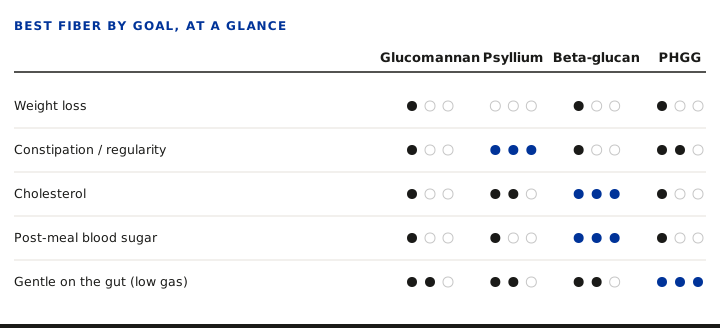
No fiber leads on weight loss: glucomannan holds the only EU weight-loss claim yet a 2023 trial contradicts it, and 27 trials of psyllium show no effect on BMI or waist. Each fiber instead earns its place on a different goal. Source: this article’s comparison table; EFSA authorised claims (Reg (EU) 432/2012; EFSA Journal 2026;24(2):e9942); van der Schoot 2022 (AJCN); Gholami 2025 psyllium meta-analysis.
| Fiber | Strongest evidence is for | Weight-loss evidence | Typical dose | Notes |
|---|---|---|---|---|
| Glucomannan | Weight (EU claim) | Authorised claim, but contradicted by a 2023 trial | 3g/day, before meals, with water | Best credentials on paper; take with plenty of water |
| Psyllium husk | Constipation, cholesterol | Null for BMI and waist (27-trial meta-analysis) | >10g/day for constipation | Strong gel; a regularity and cholesterol fiber, not a weight one |
| Oat beta-glucan | Cholesterol, post-meal glucose | Indirect, via glucose stability | 3g/day | EU-recognised claims; pairs with carbohydrate meals |
| PHGG | Gentle regularity, tolerability | Indirect, via satiety and adherence | 5 to 7g/day | Ferments slowly, little gas, easy to drink daily |
| Chicory inulin | Bowel function, prebiotic | Indirect, via fermentation and fullness | 12g/day | Highly fermentable, can cause gas; introduce gradually |
A few honest reads of that table. If weight is your only goal, glucomannan has the credentials but the thinnest real-world support, so set expectations accordingly. If you also want regularity, psyllium is the better-evidenced fiber even though it will not move the scale by itself. If blood sugar is in the picture, oat beta-glucan carries EU recognition for blunting the post-meal glucose peak at 3g per 30g of carbohydrate in a meal, and steadier glucose is a sensible part of any weight strategy.5 If tolerability is your obstacle, PHGG is the gentlest, and the gentlest fiber you keep taking beats the theoretically optimal one you quit. The detail on the EU claims behind these fibers is in our EFSA health claims explainer.
There is a real-world finding worth more than any single number here. In the same 2023 trial, even where supplements nudged the measurements, only 10 to 20% of participants reported actually feeling less hungry, and palatability complaints drove people to say they would not keep taking it.2 Felt satiety and willingness to continue, not the fiber’s theoretical potency, are what decide whether it works for you over a year.
If you are on a GLP-1 medication
This is where fiber earns its keep for weight, just not in the way people hope. Fiber and semaglutide act on the same GLP-1 pathway, which makes fiber a biologically coherent companion. But the fiber response is a fraction of the drug’s, so the framing has to stay disciplined: fiber is an adjunct, never a substitute. A February 2026 perspective in The Journal of Nutrition argued exactly this, that fiber may support appetite, glucose and insulin stability, and weight management during and after treatment, while being explicit that fiber cannot replicate the pharmacologic effect of a GLP-1.6
Where fiber genuinely helps the GLP-1 user is concrete. It addresses the constipation these drugs commonly cause; in the pooled STEP trials, constipation affected 24.2% of people on semaglutide 2.4mg versus 11.1% on placebo.7 It supports glucose stability. And it may matter most in the regain phase: most of the weight lost on a GLP-1 is regained after stopping, and a fiber routine you already tolerate is a low-risk lever to carry into maintenance. We cover the medication-specific choices in the best fiber for semaglutide and the best fiber for tirzepatide, and the off-ramp in weight maintenance after stopping GLP-1 medications.
Start from the gap, not from a supplement
Before optimising which fiber, it is worth noticing that most of us are not even at baseline. The EU’s EFSA sets an adequate intake of 25g of fiber a day for adults; Germany’s DGE and France’s ANSES point higher, at around 30g.8 Most European adults fall short, and that gap is the single biggest fiber-and-weight opportunity for the average person, ahead of any branded powder. Closing it with food comes with the diet quality, fullness, and gut benefits that supplements only partly mimic. Our guide to how much fiber you need per day sets the targets, and high-fiber foods across Europe is the food-first place to start. A supplement is for closing the remaining gap, not for replacing the plate.
How to start without quitting in week two
The adherence finding above is the whole game. The protocol that keeps you taking fiber long enough for it to matter:
- Pick one fiber that matches your main goal. Do not stack several new fibers at once.
- Start low, around half your target dose, for the first five to seven days.
- Ramp slowly, increasing every few days toward the target.
- Drink more water than you think you need, especially with psyllium and glucomannan.
- Hold, do not push. If bloating gets uncomfortable, stay at the current dose another week.
Our step-by-step guide to starting a fiber supplement without bloating walks through this in detail.
Where to find specific products
This guide recommends fiber types, not brands. For specific products that meet these criteria in your market, with doses and current availability, see our country buyer’s guides:
- Best fibre supplements in the UK
- Best fiber supplements in the US
- Best fibre supplements in Canada
- Best fibre supplements in Australia
- Best fiber supplements in the Netherlands
- Best fiber supplements in the Nordics
The short answer
There is no best fiber for weight loss, because no fiber is a weight-loss drug. Fiber’s satiety mechanism is real and overlaps with how GLP-1 medications work, but the human weight effect is modest and inconsistent: glucomannan holds the EU claim yet a 2023 trial contradicts it, and 27 trials of psyllium show no effect on BMI or waist. So choose by your real goal, weight, regularity, or blood sugar, pick the viscous fiber you can actually keep taking, close the gap to 25 to 30g a day with food first, and if you are on a GLP-1, use fiber as the adjunct it is. That is the version of “best fiber for weight loss” that holds up.
Medical note: This article is for educational purposes and does not constitute medical advice. Fiber can slow the absorption of some oral medications. If you take a GLP-1 medication or any other prescription, or you are managing a health condition, discuss fiber supplementation and its timing with your clinician.
Footnotes
-
Mechanism of fiber-induced satiety: viscosity, delayed gastric emptying, ileal-brake delivery of nutrients, and secretion of CCK, GLP-1, and PYY, with short-chain fatty acids from fermentation stimulating the same L-cells. Review: Critical Reviews in Food Science and Nutrition 2022. https://www.tandfonline.com/doi/full/10.1080/10408398.2022.2130160. Glucomannan weight-loss claim wording and conditions of use (3 g/day in three 1 g doses with water before meals, in the context of an energy-restricted diet): Commission Regulation (EU) No 432/2012. https://eur-lex.europa.eu/LexUriServ/LexUriServ.do?uri=OJ:L:2012:136:0001:0040:en:PDF ↩ ↩2
-
Five-arm randomized controlled trial of fiber supplements under energy restriction (n=100 randomized, 80 completers, 8 weeks). 3 g/day glucomannan alone produced no significant weight or BMI reduction vs placebo at 4 or 8 weeks; authors state results “do not support the recommendation of the European Food Safety Authority for the use of glucomannan as a weight loss aid.” Reported effects were time-limited (weaker by 8 weeks), and only 10 to 20% of participants reported decreased appetite, with palatability driving unwillingness to continue. Broader glucomannan literature is mixed (some null pooled analyses; one finding under 1 kg average loss). Foods 2023;12(11):2122. https://www.mdpi.com/2304-8158/12/11/2122 ↩ ↩2 ↩3
-
Dose-response systematic review and meta-analysis of psyllium (27 randomized controlled trials): non-significant pooled change in BMI of -0.06 (95% CI -0.68, 0.55) and non-significant change in waist circumference; psyllium well tolerated with no serious adverse events. Journal of Health, Population and Nutrition 2025. https://link.springer.com/article/10.1186/s41043-025-01103-x ↩ ↩2
-
EPIC cohort (Du et al., 2010, American Journal of Clinical Nutrition, n=89,432, 6.5 years): each 10 g/day higher total or cereal fiber associated with approximately 39 g/year less weight change; fruit and vegetable fiber not appreciably associated. Cohorts measure long-term weight change and gain-prevention, not active weight loss. Carried in the 2022 Critical Reviews mechanism review. https://www.tandfonline.com/doi/full/10.1080/10408398.2022.2130160 ↩
-
Oat beta-glucan EU recognition: cholesterol-maintenance claim at 3 g/day (Commission Regulation (EU) No 432/2012; EFSA 2010). New EFSA scientific opinion adopted 28 January 2026 on reduction of the post-prandial glucose peak, condition of use at least 3 g oat beta-glucans per 30 g available carbohydrate (EC authorisation follows the opinion). EFSA Journal 2026;24(2):e9942. https://efsa.onlinelibrary.wiley.com/doi/10.2903/j.efsa.2026.9942 ↩
-
Fiber supplementation during and after glucagon-like peptide-1 receptor agonist treatment: a perspective on clinical benefits. A perspective paper, not a trial, explicit that fiber cannot replicate the pharmacologic effect of a GLP-1. The Journal of Nutrition, February 2026. https://www.sciencedirect.com/science/article/abs/pii/S0022316626000854 ↩
-
Wharton S, et al. Gastrointestinal tolerability of once-weekly semaglutide 2.4 mg, pooled STEP 1-3 obesity-trial analysis: constipation 24.2% vs 11.1% on placebo, overwhelmingly non-serious and transient. Diabetes, Obesity and Metabolism 2022. https://dom-pubs.onlinelibrary.wiley.com/doi/10.1111/dom.14551 ↩
-
EFSA adequate intake for dietary fiber in adults: 25 g/day (EFSA, 2010). Germany’s DGE and France’s ANSES set higher reference points of around 30 g/day. Most European adults fall short of these targets. ↩