People who take semaglutide (Wegovy) or tirzepatide (Mounjaro) for weight loss lose about 15% to 22% of their body weight on average over a year and a half in the trials.12 The loss starts in the first weeks and continues for many months before it levels off. For what these medicines are and who can get them, see our guide to GLP-1 medications.
All the numbers below come from the European product information for each medicine. Everyone in these trials was also following a reduced-calorie diet and doing more physical activity, which is how the medicines are approved to be used. For how fiber fits alongside these medicines, see our complete guide to fiber and GLP-1.
How does a GLP-1 medicine cause weight loss?
GLP-1 is a hormone the gut releases after eating. The medicines copy it and act for a week instead of minutes. They reduce appetite and slow how fast the stomach empties, so people feel full sooner and eat less. Tirzepatide also acts on a second gut hormone, GIP.
The weight comes off because people eat less.
How much weight do people lose?
These are the averages at the end of the main weight-management trials.
| Medicine and dose | Trial length | Average weight change | Placebo |
|---|---|---|---|
| Semaglutide 2.4 mg (Wegovy) | 68 weeks | −14.9% | −2.4% |
| Tirzepatide 5 mg (Mounjaro) | 72 weeks | −16.0% | −2.4% |
| Tirzepatide 10 mg (Mounjaro) | 72 weeks | −21.4% | −2.4% |
| Tirzepatide 15 mg (Mounjaro) | 72 weeks | −22.5% | −2.4% |
Sources: EMA Wegovy product information (STEP 1) and EMA Mounjaro product information (SURMOUNT-1).12
At the starting weights in those trials, about 105 kg, that is roughly 15 kg on semaglutide and 16 to 24 kg on tirzepatide.12 People with type 2 diabetes lost less: 9.6% on semaglutide 2.4 mg in the STEP 2 trial.1 The Wegovy label also notes greater weight loss in women and in people with a lower starting weight.1
An average hides a wide spread.
How many people reach 5%, 10%, 15% or 20%?
Most people lose at least 5%. Fewer reach the higher marks.
| Weight loss reached | Semaglutide 2.4 mg | Placebo (STEP 1) | Tirzepatide 15 mg | Placebo (SURMOUNT-1) |
|---|---|---|---|---|
| At least 5% | 83.5% | 31.1% | 96.3% | 27.9% |
| At least 10% | 66.1% | 12.0% | 90.1% | 13.5% |
| At least 15% | 47.9% | 4.8% | 78.2% | 6.0% |
| At least 20% | not reported | not reported | 62.9% | 1.3% |
Sources: EMA product information, STEP 1 at 68 weeks and SURMOUNT-1 at 72 weeks.12
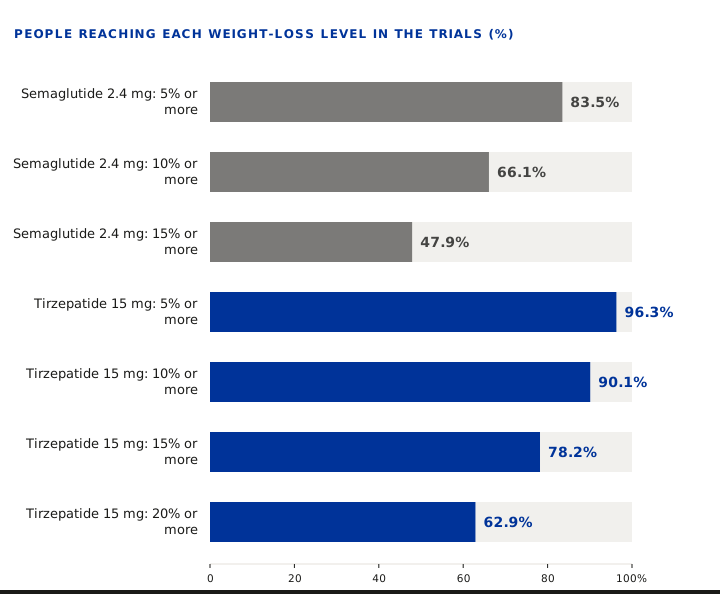
Share of trial participants reaching each weight-loss level. The two medicines were tested in different trials of different lengths, so this is not a head-to-head comparison. Sources: European Medicines Agency, Wegovy and Mounjaro product information, section 5.1.
Placebo groups lost weight too, because they were also dieting and exercising. The gap between the columns is the effect of the medicine.
What happens in the first months?
The dose starts low and rises in steps, so the body can adjust.
- Wegovy: 0.25 mg a week for weeks 1 to 4, then 0.5 mg, 1 mg and 1.7 mg, each for 4 weeks. The 2.4 mg maintenance dose starts in week 17.1
- Mounjaro: 2.5 mg a week for 4 weeks, then up by 2.5 mg every 4 weeks until the target dose. The top dose of 15 mg is reached in week 20.2
Weight loss starts during this phase. The Wegovy label says weight loss “occurred early and continued throughout the trial”.1
This is also when side effects are most common. On Wegovy, nausea affected 43.9% of people in the trials (16.1% on placebo), diarrhoea 29.7% (15.9%), vomiting 24.5% (6.3%) and constipation 24.2% (11.1%).1 Both labels say these effects came mainly while the dose was being increased. Most were mild or moderate.12
A typical episode is short. The Wegovy label gives a median of 8 days for nausea, 3 days for diarrhoea and 2 days for vomiting. Constipation lasts longer, with a median of 47 days.1 We cover these one by one in our pages on nausea, diarrhea and constipation.
Tiredness is common too. Fatigue is listed as very common on Wegovy, mainly during dose escalation, and as common on Mounjaro.12 Our page on GLP-1 fatigue covers what is known.
Side effects did not decide who lost weight. The Wegovy label says the weight loss “occurred irrespective of the presence of gastrointestinal symptoms such as nausea, vomiting or diarrhoea”.1
If the side effects are hard to bear, the label lets prescribers delay the next dose step or go back to the previous dose until they improve.1 That is a decision for your prescriber.
On Wegovy, 4.3% of people stopped the medicine for good because of gastrointestinal side effects.1
What happens once you are on the full dose?
Weight keeps coming off, more slowly, for many months. Then it levels off.
In an analysis of the tirzepatide trials, a plateau was defined as less than 5% weight change over 12 weeks and every 12 weeks after that. The median time to reach it was 24.3 weeks for people who started overweight, 26.0 weeks for class I obesity and 36.1 weeks for class II and III obesity. By week 72, 87.6% to 90.2% had reached it.3 Higher doses, younger age and being female were linked to a later plateau.
For semaglutide, a two-year trial (STEP 5) found that average weight fell until week 68 and then plateaued.1
A plateau is the expected shape of the curve. It does not mean the medicine has stopped working. Our page on the GLP-1 weight-loss plateau explains why the body settles.
What other changes happen as weight comes off?
Fat and muscle. Both labels report body-scan sub-studies in which people lost more fat than lean mass, including visceral fat around the organs. The labels conclude that most of the weight lost was fat tissue.12 Some lean mass is still lost. See our page on muscle loss on GLP-1.
Hair loss. On Wegovy, hair loss was reported by 2.5% of people against 1.0% on placebo. It was more common in people who lost 20% or more, was mostly mild, and most people recovered while staying on the medicine.1
Gallstones. Gallstones were reported in 1.6% of people on Wegovy against 1.1% on placebo.1
Red flags. Severe stomach pain that does not go away, especially if it spreads to the back, can be a sign of pancreatitis and needs prompt medical attention. Diarrhoea or vomiting you cannot keep up with can dehydrate you and harm the kidneys.12
How long does the weight loss last?
As long as the medicine continues, in the trials. In a three-year follow-up of SURMOUNT-1 in people with prediabetes, weight was still 15.4% to 22.9% lower at week 176, depending on dose (2.1% on placebo).2
What happens if you stop?
Three trials tested this.
- STEP 4 (semaglutide). Everyone took semaglutide for 20 weeks. Then half switched to placebo. Over the next 48 weeks, the placebo group regained 6.9% of body weight, while the group that continued lost a further 7.9%.1
- STEP 1 extension. After 68 weeks of treatment, 327 people were followed for a year off the medicine. Weight rose in both groups, but the former semaglutide group ended 5.6% below where it started.1 The trial’s authors reported that about two-thirds of the weight lost had come back.4
- SURMOUNT-4 (tirzepatide). Everyone took tirzepatide for 36 weeks. Then half switched to placebo. Over the next 52 weeks the placebo group regained 14.8%, while the group that continued lost a further 6.7%. At the end, 93.4% of those who continued had kept at least 80% of their earlier weight loss, against 13.5% of those who stopped.2
In each trial, the group that stopped still weighed less than at the start. Our page on keeping weight off after stopping covers what helps.
Where does fibre fit?
Fibre does not cause the weight loss on these medicines. It matters for a different reason: eating less food usually means eating less fibre, and constipation is the side effect that lasts longest. Our complete guide to fibre and GLP-1 medications covers that.
On these medicines, the weight comes off over many months, levels off, and stays off while treatment continues.
Footnotes
-
European Medicines Agency, Wegovy (semaglutide) EPAR Product Information, sections 4.2, 4.4, 4.8 and 5.1: dose escalation table; STEP 1 Table 4 (−14.9% vs −2.4% at week 68; ≥5% 83.5% vs 31.1%, ≥10% 66.1% vs 12.0%, ≥15% 47.9% vs 4.8%); STEP 2 −9.6%; STEP 4 Table 7 (−7.9% vs +6.9%, weeks 20–68); STEP 5 plateau after week 68; STEP 1 off-treatment extension (5.6% below baseline at week 120); gastrointestinal adverse reactions, median durations, 4.3% discontinuation; hair loss 2.5% vs 1.0%; cholelithiasis 1.6% vs 1.1%; DEXA body-composition sub-study. https://www.ema.europa.eu/en/documents/product-information/wegovy-epar-product-information_en.pdf ↩ ↩2 ↩3 ↩4 ↩5 ↩6 ↩7 ↩8 ↩9 ↩10 ↩11 ↩12 ↩13 ↩14 ↩15 ↩16 ↩17 ↩18 ↩19 ↩20 ↩21 ↩22
-
European Medicines Agency, Mounjaro (tirzepatide) EPAR Product Information, sections 4.8 and 5.1: dose escalation (2.5 mg for 4 weeks, then 2.5 mg increments every 4 weeks); SURMOUNT-1 results at week 72 (−16.0%, −21.4%, −22.5% vs −2.4%; milestone shares) and at week 176 (−15.4%, −19.9%, −22.9% vs −2.1%, patients with prediabetes); SURMOUNT-4 Table 12 (−6.7% vs +14.8%; 93.4% vs 13.5% kept ≥80% of lead-in loss); DEXA sub-study. https://www.ema.europa.eu/en/documents/product-information/mounjaro-epar-product-information_en.pdf ↩ ↩2 ↩3 ↩4 ↩5 ↩6 ↩7 ↩8 ↩9 ↩10 ↩11
-
Horn DB, et al. “Time to weight plateau with tirzepatide treatment in the SURMOUNT-1 and SURMOUNT-4 clinical trials.” Clinical Obesity 2025. PMID 39800653. A post-hoc analysis. ↩
-
Wilding JPH, et al. STEP 1 trial extension (off-treatment follow-up). Diabetes, Obesity and Metabolism 2022. ↩