
Yes, and it is on the label. European product information lists fatigue as an adverse reaction for both semaglutide and tirzepatide. On the Wegovy label it sits in the highest frequency band, very common, meaning at least 1 in 10. On the Mounjaro label it is common, at least 1 in 100.12
If you are on a GLP-1 and feeling flattened in a way you did not expect, that is the first useful thing to know. You did not invent it, and you are not failing at the medicine.
It is worth dwelling on, because tiredness is the GLP-1 side effect people are most often told is in their head. It also sits furthest from the gastrointestinal story that our complete guide to fibre and GLP-1 medications covers, which may be part of why it gets so little useful attention.
Where each label puts fatigue
Both product informations list adverse reactions in a table sorted into frequency bands, and both define those bands in the same document. Very common means at least 1 in 10. Common means at least 1 in 100 and fewer than 1 in 10.12
Fatigue appears in both, under the system organ class “General disorders and administration site conditions”.12 What differs is the band.
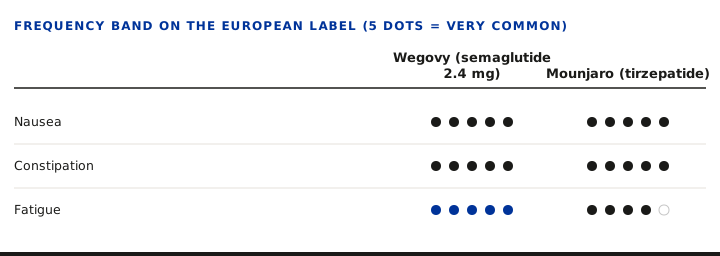
Where each European label places fatigue, compared with the two side effects people expect. Five dots is the very common band, defined as at least 1 in 10; four dots is common, at least 1 in 100 to fewer than 1 in 10. Mounjaro rows are read at the weight-management indication where its label reports frequencies separately by indication; its fatigue entry carries no such split, so common applies to both. Sources: European Medicines Agency, Wegovy product information section 4.8; Mounjaro summary of product characteristics section 4.8.
On the Wegovy label, fatigue sits in the same top band as nausea, diarrhoea, vomiting and constipation. It is not a footnote to the gastrointestinal story. It is filed alongside it.
Two things “very common” does not mean
This is where most writing on the topic goes wrong, so it is worth being careful.
It is not a percentage. A frequency band is a regulatory category, not a measured incidence. The Wegovy label gives you exact figures for the gastrointestinal effects, nausea at 43.9% against 16.1% on placebo, constipation at 24.2% against 11.1%.3 It gives no such figure for fatigue. So if you see “fatigue affects X% of GLP-1 users” quoted with confidence, that number is not coming from the label, and we could not find a source that supports one.
It is not one symptom. Both labels flag their fatigue entry as a grouped term. The Mounjaro footnote spells out the grouping: “Fatigue includes the terms fatigue, asthenia, malaise, and lethargy.”2 The Wegovy entry carries a footnote reading simply “Grouped preferred terms”.1 So the band covers a cluster of related experiences, from physical weakness to a general sense of being unwell, not a single clean thing called tiredness.
Both caveats cut the same way. The label tells you fatigue is real and frequent. It does not tell you how likely it is for you, or exactly what it will feel like.
When it tends to show up
The Wegovy label attaches a second footnote to its fatigue entry: “Mainly seen in the dose-escalation period.”1
For the 2.4 mg regimen, that period is the first 16 weeks or so. The label’s own schedule steps through 0.25 mg for weeks 1 to 4, 0.5 mg for weeks 5 to 8, 1 mg for weeks 9 to 12, and 1.7 mg for weeks 13 to 16 before the 2.4 mg maintenance dose.1 If you go on to the 7.2 mg dose, which the current label permits after at least 4 further weeks at 2.4 mg, escalation runs longer still.1
This mirrors what both labels already say about the gastrointestinal effects clustering in the climb rather than the plateau.4
One limit we want to be honest about. The footnote says where fatigue was seen. It does not say it goes away. For nausea we can point you to a hard number, a median episode of 8 days in the same document.3 For fatigue there is no equivalent published figure, and we are not going to invent the reassurance.
What people actually report
When researchers analysed 410,198 posts from GLP-1 communities covering 67,008 self-reported users, fatigue was the second most discussed side effect at 16.7%, behind nausea at 36.9% and ahead of vomiting, constipation and diarrhoea.5
That figure is a share of conversation, not an incidence rate, and the study’s own authors describe the fatigue signal as hypothesis-generating. It tells you people talk about this a great deal. It cannot tell you how many people get it, and it certainly cannot tell you why.
Read alongside the label, though, the two point the same direction. Fatigue is not a fringe complaint. It is a top-tier one in both the regulatory data and the lived experience, and it is the one people get the least useful information about.
Why does the fatigue happen?
We could not find out, and we think you should know that rather than be handed a story.
We ran a structured research pass on the mechanism, with adversarial verification on every claim, and every single mechanistic explanation we tested failed. That includes all the ones you will have read elsewhere: that it is simply the calorie deficit, that it is dehydration from gastrointestinal losses, that it is inadequate protein intake, that it is loss of lean muscle mass, that it is micronutrient deficiency. Not one of them met our evidence bar, and the specific figures attached to them did not survive checking either.
One finding is worth naming directly, because it shows how this topic gets polluted. The most confident explanation we encountered, a tidy three-part account combining calorie insufficiency, iron deficiency and a direct drug effect, traces back to a single medical-education blog post. It reads exactly like settled consensus. It failed verification outright. If a mechanism is repeated often enough across enough pages, it starts to sound established, and this one is not.
To be clear about what we are and are not saying: absence of evidence is not evidence of absence. Any of those mechanisms may turn out to be right. Some of them are biologically plausible. They are simply not established today, and a page that tells you otherwise is telling you something it cannot support.
What the labels do carry is a general warning that gastrointestinal effects can cause fluid loss. The Wegovy product information notes that “nausea, vomiting, and diarrhoea may cause dehydration, which in rare cases can lead to a deterioration of renal function”, and advises patients to take precautions to avoid fluid depletion.6 That is a real warning worth knowing. It is not an explanation for feeling tired, and we are not going to present it as one.
Where fibre fits, and where it does not
We are a fibre company, so we will be as direct here as we were about nausea: fibre is not a fatigue remedy.
Our research pass surfaced no study linking fibre intake to fatigue or energy levels in people on GLP-1 medications, in either direction. That is a weaker statement than “it has been tested and does not work”. The question appears not to have been properly asked. Either way, we have nothing to sell you here and no evidence that would let us.
Where fibre does earn its place is the constipation side of GLP-1 side effects, which is well evidenced and which the same labels put in the very common band. We make that case at length in our guide to fibre and GLP-1 medications, and in the drug-specific pieces on semaglutide constipation and tirzepatide constipation. If you are weighing up the other side effect that dominates the early weeks, GLP-1 nausea and how long it lasts covers that one.
Raising it with your prescriber
Because there is no established mechanism, there is no evidence-based self-management protocol we can responsibly give you. What we can say is that a documented, labelled adverse reaction is a legitimate thing to raise, not something to absorb quietly.
Tiredness that is new, that is severe, or that is not following the pattern the label describes, meaning it is not easing as your dose stabilises, is worth a conversation with the clinician who prescribed it. So is tiredness alongside symptoms that are making it hard to keep fluids down. Fatigue is a broad symptom with many causes that have nothing to do with your medicine, and sorting that out is a clinical job rather than a reading job.
The short version
Fatigue on a GLP-1 is documented, not imagined. The European labels list it for both semaglutide and tirzepatide, very common on the Wegovy label and common on the Mounjaro one, and both treat it as a cluster of related experiences rather than one symptom. It clusters in the dose-escalation weeks, at least on the semaglutide label, though nothing published tells us how long it lasts. It is the second most discussed side effect in the largest real-world dataset we have. And after a full research pass, nobody can yet tell you why it happens, including us.
This article is general information about a medicine’s documented side effects, not medical advice. Decisions about your dose or your treatment belong with the clinician who prescribed it.
Footnotes
-
European Medicines Agency, Wegovy (semaglutide) EPAR Product Information, sections 4.2 and 4.8. Table 3 places “Fatigue” in the “Very common” column under the system organ class “General disorders and administration site conditions”, with footnotes “b) Mainly seen in the dose-escalation period” and “c) Grouped preferred terms”. Frequency key as given in the same section: “Very common (≥1/10); common (≥1/100 to <1/10); uncommon (≥1/1 000 to <1/100); rare (≥1/10 000 to <1/1 000); very rare (<1/10 000)”. Dose escalation schedule from section 4.2, Table 2: “Week 1–4 0.25 mg / Week 5–8 0.5 mg / Week 9–12 1 mg / Week 13–16 1.7 mg / Maintenance dose 2.4 mg”, with 7.2 mg permitted “after a minimum of 4 weeks on the 2.4 mg dose”. Verified by direct download and cell-level table extraction, 2026-07-28, and independently against the MHRA/emc Wegovy 2.4 mg FlexTouch SmPC, product 13803. https://www.ema.europa.eu/en/documents/product-information/wegovy-epar-product-information_en.pdf ↩ ↩2 ↩3 ↩4 ↩5 ↩6 ↩7
-
Mounjaro (tirzepatide) KwikPen Summary of Product Characteristics, section 4.8, MHRA/emc product 15481. Table 1 places “Fatigue†” in the “Common” column under “General disorders and administration site conditions”, with the Very common cell for that class empty. Footnote: “Fatigue includes the terms fatigue, asthenia, malaise, and lethargy.” Frequency key: “very common: ≥ 1/10; common: ≥ 1/100 to < 1/10; uncommon: ≥ 1/1 000 to < 1/100; rare: ≥ 1/10 000 to < 1/1 000; very rare: < 1/10 000”. The fatigue entry carries no indication superscript, unlike rows split by footnotes “1 Frequency reported in clinical trials supporting the type 2 diabetes indication” and “2 Frequency reported in clinical trials supporting the weight management indication”. Verified by direct fetch and cell-level parse, 2026-07-28. https://www.medicines.org.uk/emc/product/15481/smpc ↩ ↩2 ↩3 ↩4
-
European Medicines Agency, Wegovy (semaglutide) EPAR Product Information, section 4.8: over the 68-week trial period nausea occurred in 43.9% of patients (16.1% for placebo) and constipation in 24.2% (11.1% for placebo); “median duration of nausea was 8 days, vomiting 2 days, diarrhoea 3 days, and constipation 47 days”. https://www.ema.europa.eu/en/documents/product-information/wegovy-epar-product-information_en.pdf ↩ ↩2
-
Mounjaro (tirzepatide) Summary of Product Characteristics, section 4.4, MHRA/emc: “The incidence of nausea, diarrhoea and vomiting occurred primarily during dose escalation and decreased over time.” https://www.medicines.org.uk/emc/product/15481/smpc ↩
-
Sehgal N, et al. Self-reported side effects of semaglutide and tirzepatide in online communities. Nature Health, 10 April 2026. University of Pennsylvania. 410,198 posts analysed from May 2019 to June 2025, identifying 67,008 self-reported GLP-1 users. Fatigue was the second most discussed side effect at 16.7%, behind nausea at 36.9%. The authors describe the fatigue signal as hypothesis-generating and underrepresented in trial reporting. ↩
-
European Medicines Agency, Wegovy (semaglutide) EPAR Product Information, section 4.4, “Gastrointestinal effects and Dehydration”: “nausea, vomiting, and diarrhoea may cause dehydration, which in rare cases can lead to a deterioration of renal function… Patients treated with semaglutide should be advised of the potential risk of dehydration in relation to gastrointestinal side effects and take precautions to avoid fluid depletion.” https://www.ema.europa.eu/en/documents/product-information/wegovy-epar-product-information_en.pdf ↩