Your weight loss on a GLP-1 has slowed or stopped. That is a plateau, and it is normal. The trials that got these drugs approved show the same shape: fast loss at first, then slower, then a settle. A plateau is not the drug failing.
If your weight has stalled on Wegovy, Ozempic or Mounjaro, you did not do anything wrong. The curve was always going to flatten.
This part catches people off guard, because most of the talk is about the dramatic first months. Below is when a plateau tends to arrive, why your body settles, and where fibre does and does not help. For the wider picture, see our complete guide to fibre and GLP-1 medications.
When a plateau happens
Researchers measured this in the SURMOUNT-1 tirzepatide trial. They counted a plateau once weight changed by less than 5 percent over 12 weeks, and stayed that way.1
The heavier someone started, the longer it took. The median time to a plateau was about 24 weeks in the overweight group, 26 weeks with class I obesity, and 36 weeks with class II and III obesity.1
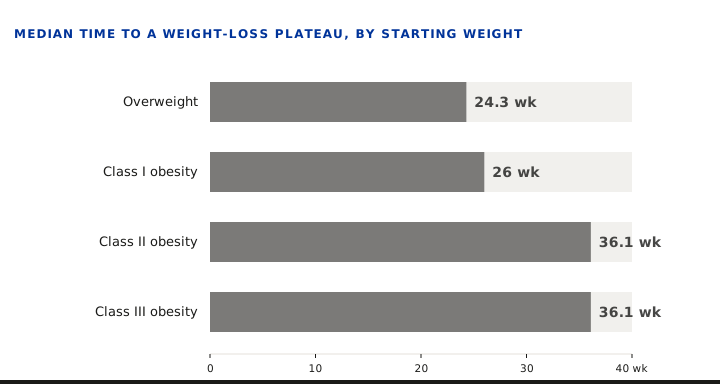
Median time to a weight-loss plateau in the SURMOUNT-1 tirzepatide trial, by starting body-mass-index category. A plateau was defined as less than 5 percent weight change over a 12-week interval and every interval after. By week 72, between 87.6 and 90.2 percent of participants across these categories had reached one. Source: Horn et al., Time to weight plateau with tirzepatide treatment in the SURMOUNT-1 and SURMOUNT-4 clinical trials, Clinical Obesity, 2025.
By week 72, nearly 9 in 10 people had reached a plateau. Weight held steady there. It did not climb back.1
One result surprised the researchers: higher doses, younger age and being female were each linked to a later plateau, not an earlier one.1
A plateau also shows up well inside the trials, not at the finish line. SURMOUNT-1 ran 72 weeks, and average weight was still edging down at the end, reaching 20.9 percent at the top dose.2 The semaglutide STEP 1 trial ran 68 weeks, averaging 17.3 percent.3 Slowing after several months is just how these curves are shaped.
Why your body settles
When you lose weight, your body pushes back. Lose about 10 percent of your weight and your resting metabolism drops by more than 10 percent. You burn fewer calories than your smaller size alone would explain.4
You might hope a GLP-1 turns that off. It does not. In a 2026 human study, tirzepatide had no effect on this metabolic slowdown, even while it cut appetite and raised fat burning.5
So two things happen at once. The drug holds your appetite down. Your body keeps lowering how much energy it needs. Early on, you eat far less than you burn, and weight drops fast. As you get lighter, that gap closes. Eventually what you eat and what you burn meet again, at a new, lower weight. That is the plateau. It means the drug carried you somewhere new, not that it quit.
”It stopped working” often means “not at full dose yet”
Check one thing first. These drugs start low and step up slowly. Semaglutide takes about 16 weeks to reach its 2.4 mg maintenance dose. Tirzepatide takes about 20 weeks to reach 15 mg.2 Higher doses do more: in SURMOUNT-1, average weight change was 15.0 percent at 5 mg, 19.5 percent at 10 mg, and 20.9 percent at 15 mg.2
If your loss slowed while you are still stepping up, you may not be at full strength yet. That is different from a plateau at the top dose, and it is a question for your prescriber, who may keep the planned increase going. Do not change your dose on your own. This article is not medical advice.
What helps, and what does not
No supplement breaks a plateau. There is no good evidence that extra fibre pushes more weight off once your weight has settled. Anyone who promises that is selling you something.
The honest goal shifts. Your weight has stabilised, so the aim becomes eating well at your new weight. Nutrition groups that advise on GLP-1 care point to the same basics: enough protein to protect muscle, enough fibre, and enough vitamins and minerals, all on a smaller appetite.6
Fibre helps with two of those. It adds fullness to a meal, which is well studied.7 And it is the go-to fix for GLP-1 constipation, which often shows up around the same time. Fibre is part of eating well on a GLP-1. It is not a lever for the scale.
If your real worry is what happens after you stop the drug, that is a different question, and we cover it in what happens to your weight after stopping a GLP-1. For fibre and weight more broadly, see our guide to fibre and weight loss.
A plateau is the drug having worked, and your body arriving somewhere new. That is worth knowing.
Frequently asked questions
Why has my weight loss plateaued on a GLP-1? Because a plateau is normal, and the trials show it. In the SURMOUNT-1 tirzepatide trial, most people reached a plateau between about 24 weeks, if they started in the overweight range, and about 36 weeks, if they started with class II or III obesity, and nearly 9 in 10 by week 72.1 The trial counted a plateau once weight changed by less than 5 percent over 12 weeks and stayed there. The reason is physiology: the drug lowers your appetite, but as you lose weight your body needs fewer calories, so what you eat and what you burn settle at a new, lower weight.
Does a weight-loss plateau mean my Wegovy or Mounjaro has stopped working? Usually not. A plateau is where your weight settles, not where the drug quits. In SURMOUNT-1 most people plateaued while still on treatment, and their weight held steady rather than climbing back.1 Check one thing first: these drugs step up slowly, so semaglutide reaches its 2.4 mg maintenance dose around week 16 and tirzepatide reaches 15 mg over about 20 weeks.2 If you are still stepping up, you may not be at full strength yet. That is a question for your prescriber, and no one should change a dose on their own.
When does a GLP-1 weight-loss plateau usually happen? In months, not weeks, and it depends on where you started. In the SURMOUNT-1 tirzepatide trial the median time to a plateau was about 24 weeks starting from the overweight range, 26 weeks with class I obesity, and 36 weeks with class II and III obesity.1 Higher doses, younger age and being female were linked to a later plateau. The trials ran 68 weeks for semaglutide and 72 for tirzepatide, with average weight still edging down at the end, so a plateau is the curve flattening, not a hard stop.23
Can fibre help with a GLP-1 weight-loss plateau? Not as a way to break one. There is no good evidence that extra fibre pushes more weight off once your weight has settled. What fibre does help with is fullness from a meal, which is well studied,7 and GLP-1 constipation, which often shows up around the same time. It also counts toward the good nutrition that clinical groups recommend during treatment, alongside enough protein.6 So fibre is part of eating well on a GLP-1, not a lever for the scale.
Footnotes
-
Horn DB, et al. Time to weight plateau with tirzepatide treatment in the SURMOUNT-1 and SURMOUNT-4 clinical trials. Clinical Obesity (2025). PMID 39800653. Post-hoc analysis; plateau defined as weight change less than 5% over a 12-week interval and all subsequent intervals. Median time to plateau in SURMOUNT-1 by BMI category: 24.3, 26.0, 36.1 and 36.1 weeks (overweight, class I, II, III); 87.6 to 90.2 percent reached a plateau by week 72; higher doses, younger age and female sex associated with a longer time to plateau. ↩ ↩2 ↩3 ↩4 ↩5 ↩6 ↩7
-
Jastreboff AM, et al. Tirzepatide Once Weekly for the Treatment of Obesity (SURMOUNT-1). New England Journal of Medicine (2022). PMID 35658024. 2,539 adults, 72-week trial including a 20-week dose-escalation period; mean weight change at week 72: 15.0% (5 mg), 19.5% (10 mg), 20.9% (15 mg), 3.1% (placebo). ↩ ↩2 ↩3 ↩4 ↩5
-
Wilding JPH, et al. Once-Weekly Semaglutide in Adults with Overweight or Obesity (STEP 1), and the STEP 1 trial extension. New England Journal of Medicine (2021) / Diabetes, Obesity and Metabolism (2022). Semaglutide 2.4 mg, 68-week treatment, on-treatment mean weight loss 17.3%; titrated weekly from 0.25 mg to the 2.4 mg maintenance dose. ↩ ↩2
-
Rosenbaum M, Leibel RL. Adaptive thermogenesis in humans. International Journal of Obesity (2010). A reduction in body weight is accompanied by a decline in energy expenditure greater than predicted by the change in body mass. ↩
-
Tirzepatide did not impact metabolic adaptation in people with obesity, but increased fat oxidation. Cell Metabolism (2026). PMID 40203836. DOI: 10.1016/j.cmet.2025.03.011. Phase-1 clinical trial (NCT04081337); in the human study tirzepatide had no impact on metabolic adaptation while increasing fat oxidation and reducing appetite and calorie intake versus placebo. ↩
-
Nutritional priorities to support GLP-1 therapy for obesity: a joint Advisory from the American College of Lifestyle Medicine, the American Society for Nutrition, the Obesity Medicine Association, and The Obesity Society. American Journal of Clinical Nutrition (2025). ↩ ↩2
-
Soluble dietary fibre supplementation: effects on energy intake and perceived satiety. Systematic review and meta-analysis of RCTs. Foods / MDPI (2019). ↩ ↩2