Diarrhea on a GLP-1 medicine is common and usually short. On Wegovy, about 3 in 10 people had it in the trials,1 and the European label puts a typical episode at 3 days. It comes mostly while the dose is being stepped up. The main risk is losing too much fluid. For fiber on these medicines in general, see our complete guide to fiber and GLP-1 medications.
How common is diarrhea on a GLP-1?
The numbers depend on the medicine and the dose, so each one needs its source next to it.
| Medicine and dose | Diarrhea | Placebo |
|---|---|---|
| Semaglutide 2.4 mg (Wegovy), 68 weeks | 29.7% | 15.9% |
| Semaglutide 1 mg (Ozempic), type 2 diabetes | 13.3% | not reported |
| Semaglutide 0.5 mg (Ozempic), type 2 diabetes | 12.2% | not reported |
| Tirzepatide 15 mg (Mounjaro), weight management | 23.0% | 7.3% |
| Tirzepatide 10 mg (Mounjaro), weight management | 21.2% | 7.3% |
| Tirzepatide 5 mg (Mounjaro), weight management | 18.7% | 7.3% |
Sources: EMA Wegovy and Mounjaro product information, Ozempic summary of product characteristics.123
The placebo column matters. On Wegovy, 15.9% of people taking a dummy injection1 also reported diarrhea, so part of what people notice would have happened anyway. The extra share caused by the medicine is the gap between the two columns.
The labels describe most cases as mild or moderate. On Wegovy, 4.3% of people stopped the medicine permanently because of gastrointestinal side effects of any kind.1
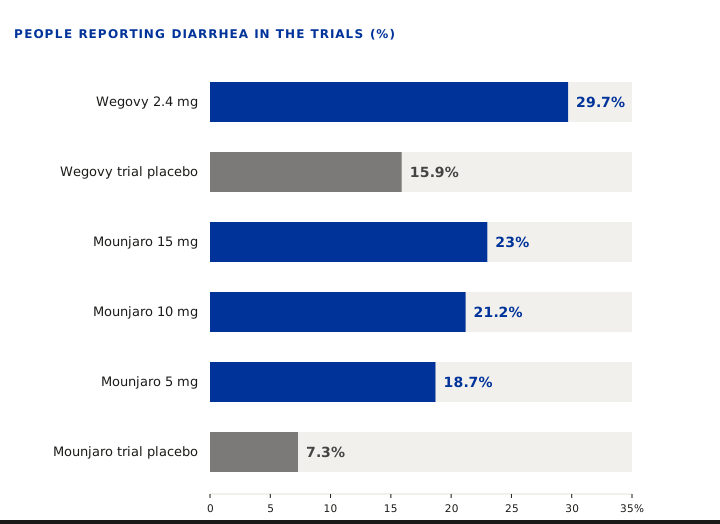
Share of people who reported diarrhea in the trials. Wegovy and Mounjaro were tested in different trials, so the bars should not be read as a head-to-head comparison. Sources: European Medicines Agency, Wegovy and Mounjaro product information, section 4.8.
How long does GLP-1 diarrhea last?
The European Wegovy label gives the median duration of a diarrhea episode on semaglutide 2.4 mg as 3 days. In the same passage, nausea lasts 8 days and constipation 47 days.1
A median is the middle value: half of the episodes were shorter and half were longer. It counts single episodes rather than the whole course of treatment.
Both labels describe the same timing. For Mounjaro, diarrhea “was higher during the dose escalation period and decreased over time”.2 For Wegovy, gastrointestinal events were most often reported during dose escalation.1 Wegovy starts at 0.25 mg and rises every 4 weeks to 2.4 mg at week 17.1 Each step can bring a new episode.
Why does a GLP-1 cause diarrhea?
Nobody has fully explained it. These medicines slow how fast the stomach empties, which is part of why people feel full sooner. A 2024 review of dietary management points out that slower emptying does not fully account for diarrhea or constipation, and that the two are likely driven by different mechanisms.4
The timing is well described. The labels show that diarrhea follows the dose steps, and that is the part you can discuss with your prescriber.
What helps with GLP-1 diarrhea?
Drink enough. This is the point the labels themselves make. The Wegovy label warns that nausea, vomiting and diarrhoea “may cause dehydration, which in rare cases can lead to a deterioration of renal function”, and tells patients to “take precautions to avoid fluid depletion”.1 Sip water through the day, and drink more on days with loose stools.
Eat smaller, simpler meals. The same 2024 review recommends small, frequent meals, simple cooking such as steaming, baking or boiling instead of frying, and avoiding spicy food and alcohol.4 Other reviews add avoiding high-fat and very large meals.5 These are commonly recommended but untested. No trial has measured an eating pattern against GLP-1 diarrhea.
Talk to your prescriber about the dose steps. The Wegovy label tells prescribers: “In case of significant gastrointestinal symptoms, consider delaying dose escalation or lowering to the previous dose until symptoms have improved.”1 That decision belongs to the prescriber. But it means a slower climb is a normal thing to ask about.
For the other two common gut effects, see how long GLP-1 nausea lasts and constipation on semaglutide.
Does fiber help with diarrhea on a GLP-1?
Nobody has tested it in people on GLP-1 medicines, so there is no direct answer.
What exists is evidence about fibre types in general. A 2015 review describes psyllium, a fibre that forms a thick gel and is hardly fermented in the colon, as “stool-normalizing”: it softens hard stool and firms loose or liquid stool.6 The same review says wheat bran, an insoluble fibre, “can exacerbate diarrhea”. Fibres that gut bacteria ferment quickly lose their gel and, in the review’s words, leave “no retained gel to attenuate diarrhea”. The review’s author worked as a scientist for Procter & Gamble, which makes the psyllium product Metamucil.
Fermentation also makes gas. In a small study of 19 people with irritable bowel syndrome, inulin produced a large rise in colonic gas and psyllium produced almost none.7
PHGG (partially hydrolysed guar gum) is another option that has been studied in people with IBS. It is a soluble fibre that stays thin in water instead of forming a gel, and Monash University, which runs the FODMAP research programme, classifies it as low FODMAP.8 In a 12-week trial in 108 people with IBS, PHGG at 3 grams a day for a week and then 6 grams a day reduced bloating more than placebo. It did not beat placebo on abdominal pain or on how often people went.9 A second trial gave 5 grams a day to 44 healthy volunteers who tended to have loose stools. Their stools became more formed over 12 weeks, though the number of bowel movements did not change. That trial was funded by the maker of the PHGG it used.10 Monash dietitians describe PHGG as likely well tolerated in both constipation-type and diarrhea-type IBS, and say more studies are needed.8 None of these trials included people taking a GLP-1. Our guide to PHGG covers the full evidence.
If you try psyllium, the European herbal monograph sets the rules: about 30 ml of water for every gram, and a gap of half an hour to an hour from other medicines.11 Taken with too little fluid it can block the throat or gut. The monograph lists constipation and soft-stool conditions as uses. Diarrhea is not on that list. No fibre has an authorised EU health claim for diarrhea. Our guide to psyllium husk dosage covers the amounts, and can you take fiber with a GLP-1 covers timing around the injection.
When does diarrhea on a GLP-1 need a doctor?
Most cases are mild and pass. Call your prescriber in these cases.
You cannot keep up with fluids. The Mounjaro label says fluid loss “could lead to a deterioration in renal function including acute renal failure”, and that older people may be more at risk.2 People with existing kidney problems should call early.
Severe stomach pain that does not go away, especially if it spreads to the back. This can be a sign of acute pancreatitis. The labels say the medicine is stopped if pancreatitis is suspected.1 Get medical help promptly.
Diarrhea that does not ease at a stable dose. If you are taking psyllium, the monograph says not to use it when a change in bowel habit has lasted more than 2 weeks, or with unexplained rectal bleeding, until a doctor has checked it.11
On a stable dose, diarrhea usually settles. Fluids come first, and the pace of the dose steps is worth raising with your prescriber.
Footnotes
-
European Medicines Agency, Wegovy (semaglutide) EPAR Product Information, sections 4.2, 4.4 and 4.8. Over 68 weeks, “diarrhoea in 29.7% (15.9% for placebo)”; “median duration of nausea was 8 days, vomiting 2 days, diarrhoea 3 days, and constipation 47 days”; gastrointestinal events led to permanent discontinuation in 4.3% of patients. https://www.ema.europa.eu/en/documents/product-information/wegovy-epar-product-information_en.pdf ↩ ↩2 ↩3 ↩4 ↩5 ↩6 ↩7 ↩8 ↩9 ↩10
-
European Medicines Agency, Mounjaro (tirzepatide) EPAR Product Information, section 4.8: in a placebo-controlled weight management study in patients without type 2 diabetes, diarrhoea occurred in 18.7%, 21.2% and 23.0% versus 7.3% for tirzepatide 5 mg, 10 mg and 15 mg versus placebo; “The incidence of nausea, diarrhoea and vomiting was higher during the dose escalation period and decreased over time.” Dehydration wording from the Mounjaro summary of product characteristics, section 4.4, MHRA/emc. https://www.ema.europa.eu/en/documents/product-information/mounjaro-epar-product-information_en.pdf ↩ ↩2 ↩3
-
Ozempic (semaglutide) 0.5 mg Summary of Product Characteristics, section 4.8, MHRA/emc: diarrhoea in 12.2% and 13.3% at 0.5 mg and 1 mg. https://www.medicines.org.uk/emc/product/9750/smpc ↩
-
“Dietary Recommendations for the Management of Gastrointestinal Symptoms in Patients Treated with GLP-1 Receptor Agonist.” Diabetes, Metabolic Syndrome and Obesity, December 2024. A narrative review. https://pmc.ncbi.nlm.nih.gov/articles/PMC11668918/ ↩ ↩2
-
“Do no harm: managing nausea and vomiting in GLP-1 based obesity therapies.” Frontiers in Endocrinology, 2026. https://pmc.ncbi.nlm.nih.gov/articles/PMC12992036/ ↩
-
McRorie JW Jr. “Evidence-Based Approach to Fiber Supplements and Clinically Meaningful Health Benefits, Part 1.” Nutrition Today 2015;50(2):82-89. A narrative review; the author was a scientist at Procter & Gamble (Metamucil). https://pmc.ncbi.nlm.nih.gov/articles/PMC4415962/ ↩
-
Gunn et al. Gut 2022;71(5):919-927. MRI and breath-hydrogen crossover study in 19 patients with irritable bowel syndrome. ↩
-
Monash University FODMAP programme, monashfodmap.com, 26 March 2025, on PHGG’s low FODMAP status; and “Fibre supplements and IBS”, Lyndal Collins and Dr Marina Iacovou, research dietitians, 10 November 2017. ↩ ↩2
-
Niv E, Halak A, Tiommny E, et al. “Randomized clinical study: partially hydrolyzed guar gum (PHGG) versus placebo in the treatment of patients with irritable bowel syndrome.” Nutrition & Metabolism (London) 2016;13:10. PMID 26855665. ↩
-
Yasukawa Z, Inoue R, Ozeki M, et al. “Effect of Repeated Consumption of Partially Hydrolyzed Guar Gum on Fecal Characteristics and Gut Microbiota.” Nutrients 2019. PMID 31509971. Funded by Taiyo Kagaku, maker of the PHGG studied. ↩
-
European Medicines Agency, Committee on Herbal Medicinal Products. Community herbal monograph on Plantago ovata Forssk., seminis tegumentum (ispaghula husk), EMA/HMPC/199774/2012, adopted 14 May 2013. https://www.ema.europa.eu/en/documents/herbal-monograph/final-community-herbal-monograph-plantago-ovata-forssk-seminis-tegumentum_en.pdf ↩ ↩2