
If you are five weeks into a GLP-1 and wondering whether feeling this queasy is normal, and how much longer it goes on: it is normal, it is the single most common effect of these medicines, and of all the gastrointestinal side effects it is the one that passes fastest.
That last part is the piece most people never get told, and it is worth putting a number on.
How long does GLP-1 nausea last?
European product information for semaglutide 2.4 mg, the Wegovy weight-management dose, records the median duration of nausea as 8 days. The same passage gives 2 days for vomiting, 3 days for diarrhoea, and 47 days for constipation.1
Read those four numbers together, because the contrast is the useful part. Nausea is loud and miserable and short. Constipation is quiet and roughly six times more persistent. The symptom that dominates how you feel is not the symptom that lingers. For the one that does linger, our complete guide to fiber on a GLP-1 covers what fiber can and cannot do.
Two honest caveats. This is a median for individual episodes across a trial population, so half of episodes ran longer, and it is not a forecast for any one person. And a median episode length is not the same as “your nausea is over in 8 days”, because a new dose step can bring a new episode.
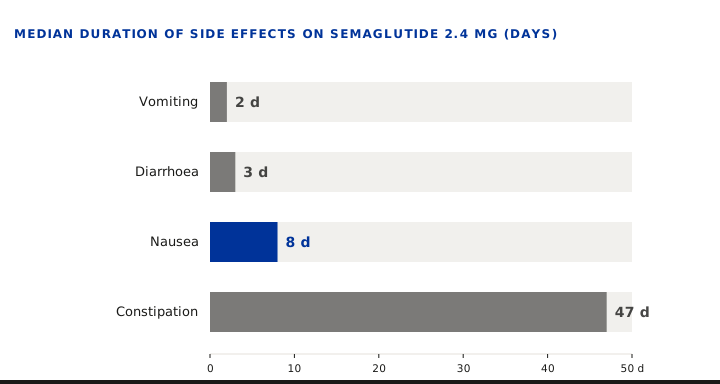
Median duration of gastrointestinal side effects on semaglutide 2.4 mg: nausea 8 days, vomiting 2 days, diarrhoea 3 days, constipation 47 days. These are medians for individual episodes, not time to permanent resolution. Source: European Medicines Agency, Wegovy product information, section 4.8.
Why nausea tracks your dose, not the calendar
Both drug families tell the same story in their own labels.
For tirzepatide (Mounjaro), the product information states that the incidence of nausea, diarrhoea and vomiting “occurred primarily during dose escalation and decreased over time”.2 For semaglutide at the diabetes doses, events “were most frequently reported during the first months on treatment”.3 At the weight-management dose, they were “most frequently reported during dose escalation”.1
GLP-1 medicines are started low and stepped up deliberately: for Wegovy, 0.25 mg for weeks 1 to 4, then 0.5 mg, 1 mg, 1.7 mg, reaching the 2.4 mg maintenance dose at week 16.1 Each step is a fresh adjustment, and the nausea tends to track the steps rather than the calendar. Once you are at a stable dose, the pattern in the trial data is that it settles.
The mechanism is the same one doing the useful work. These medicines slow how quickly the stomach empties, which is a large part of why you feel full sooner and eat less. A stomach that empties slowly is also a stomach that feels full, heavy and queasy when you put too much into it at once.
How common is it, and why the numbers disagree
You will see wildly different percentages quoted for GLP-1 nausea. They are mostly all correct, and they are describing different things.
| Medicine and dose | Indication | Nausea | Placebo |
|---|---|---|---|
| Semaglutide 2.4 mg (Wegovy), 68 weeks | Weight management | 43.9% | 16.1% |
| Semaglutide 1 mg (Ozempic) | Type 2 diabetes | 19.9% | not reported |
| Semaglutide 0.5 mg (Ozempic) | Type 2 diabetes | 17% | not reported |
Sources: EMA Wegovy product information and the Ozempic summary of product characteristics.13
The weight-management figure is more than double the diabetes-dose figure. Both come from the same molecule. So when someone quotes “about 1 in 5 people get nausea” and someone else says “more like half”, the difference is dose and indication, not disagreement.
A dose-response analysis across 39 randomised trials and 33,354 participants found that nausea risk rose fastest across the lowest doses, then showed “a tendency to plateauing at highest dosages”.4 Which is the quantitative case for slow titration: most of the nausea cost is paid early, in the climb.
For scale on the human side, when researchers analysed 410,198 posts from GLP-1 communities covering 67,008 self-reported users, nausea was the single most discussed side effect at 36.9%, ahead of fatigue at 16.7% and constipation at 15.3%.5 It dominates the conversation because it dominates the early experience.
What actually helps
Three independent clinical reviews published between 2024 and 2026 converge on the same short list.678 Eat smaller meals, more often. Eat slowly, and stop at the first sign of fullness rather than at the end of the plate. Avoid high-fat and large-volume meals. Keep fluids separate from meal volume, sipping through the day rather than drinking a large glass with food. Do not lie down straight after eating.
An important qualifier, because you deserve the evidence tier along with the advice: these are commonly recommended, not trial-proven. All three sources are expert reviews, one of them openly extrapolating from post-bariatric-surgery practice, and no study has tested an eating pattern against a measured nausea endpoint. The 2026 review is blunt that diet is secondary, noting these measures are “substantially less effective if dose titration is not actively and thoughtfully managed”.8
Which points at the one intervention with real authority behind it. The product information itself tells prescribers: “In case of significant gastrointestinal symptoms, consider delaying dose escalation or lowering to the previous dose until symptoms have improved.”1 That is a prescriber’s decision and not something to do on your own. But it does mean that if you are struggling, the pace of your titration is a legitimate conversation to have, not a sign you are failing at the medicine.
Where fibre fits, and where it does not
Fibre is not a nausea remedy.
Fibre earns its place on the constipation side of GLP-1 side effects, which, as the 47-day median above shows, is the side that lasts. That case is a good one and we make it at length in our guide to fibre and GLP-1 medications and in the drug-specific pieces on semaglutide constipation and tirzepatide constipation.
During active nausea, published dietary guidance runs the other way. One of the reviews above notes that high fibre consumption “can slow down the rate at which the stomach empties”, and recommends lower-fibre vegetables, avoiding peels and seeds, with modest portion sizes.6 Mechanistically that follows: bulking and viscous fibres slow gastric emptying, and a GLP-1 is already slowing it.
So the sequencing is the practical answer. A bad nausea week is not the week to start a fibre supplement or push a high-fibre plate. When nausea settles at a stable dose and the slower-moving constipation problem surfaces, that is when fibre becomes the right tool, introduced gradually. If you are starting one, how to begin without bloating covers the ramp.
One point of caution that is genuinely unresolved: the published guidance treats “fibre” as a single undifferentiated category, when soluble non-viscous fibres behave quite differently from bulking ones. Nobody has tested whether that distinction matters for nausea. We would rather say that plainly than imply an answer that the evidence does not support.
Red flags: when nausea needs medical attention
Most GLP-1 nausea is mild to moderate and self-limiting. A few situations are not, and they are worth recognising early.
Dehydration. European product information carries an explicit warning that nausea, vomiting and diarrhoea “may cause dehydration, which in rare cases can lead to a deterioration of renal function”.1 The tirzepatide label goes further, naming “acute renal failure” and flagging that older people may be more susceptible.2 If you cannot keep fluids down, that is a call to your prescriber, not something to wait out.
Severe, persistent stomach pain, especially radiating to the back. This is the characteristic presentation of acute pancreatitis. The labels instruct that if pancreatitis is suspected, the medicine is stopped, and if confirmed, not restarted.1 It needs prompt medical attention. In the UK, NHS guidance lists it among the serious side effects of semaglutide and directs people to call NHS 111 if they think they may be experiencing one.9
Nausea that is not following the expected pattern. If it is not easing at a stable dose, or it is getting worse rather than better, that is worth raising rather than absorbing.
Existing kidney problems, and being older, both raise the stakes on fluid loss. None of this is a reason for alarm about a very common and usually short-lived effect. It is a reason to know which version of it is different.
The short version
Nausea is the most common thing these medicines do to you, and among the gastrointestinal effects it is the one that resolves fastest, at a median of 8 days per episode against 47 for constipation. It clusters in the dose-escalation weeks and settles as the dose stabilises. Smaller and slower meals are the sensible response, titration pace is the powerful one, and fibre belongs to the problem that comes after this one, not to this one.
This article is general information about a medicine’s documented side effects, not medical advice. Decisions about your dose or your treatment belong with the clinician who prescribed it.
Footnotes
-
European Medicines Agency, Wegovy (semaglutide) EPAR Product Information, sections 4.2, 4.4 and 4.8. “In patients treated with semaglutide, median duration of nausea was 8 days, vomiting 2 days, diarrhoea 3 days, and constipation 47 days.” Over the 68-week trial period nausea occurred in 43.9% of patients (16.1% placebo). Dose escalation schedule and the instruction to consider delaying escalation are from section 4.2; the dehydration and pancreatitis warnings from section 4.4. https://www.ema.europa.eu/en/documents/product-information/wegovy-epar-product-information_en.pdf ↩ ↩2 ↩3 ↩4 ↩5 ↩6 ↩7
-
Mounjaro (tirzepatide) KwikPen Summary of Product Characteristics, sections 4.4 and 4.8, MHRA/emc: “The incidence of nausea, diarrhoea and vomiting occurred primarily during dose escalation and decreased over time.” https://www.medicines.org.uk/emc/product/15481/smpc ↩ ↩2
-
Ozempic (semaglutide) 0.5 mg Summary of Product Characteristics, section 4.8, MHRA/emc: “Nausea occurred in 17% and 19.9% of patients when treated with semaglutide 0.5 mg and 1 mg, respectively… Most events were mild to moderate in severity and of short duration. The events were most frequently reported during the first months on treatment.” https://www.medicines.org.uk/emc/product/9750/smpc ↩ ↩2
-
Ismaiel A, Scarlata GGM, Boitos I, et al. Dose-response network meta-analysis of gastrointestinal adverse events with GLP-1 receptor agonists, 39 randomised trials and 33,354 non-diabetic participants with overweight or obesity. International Journal of Obesity. 2025;49:1946-1957. https://www.ncbi.nlm.nih.gov/pmc/articles/PMC12532569/ ↩
-
Sehgal N, et al. Self-reported side effects of semaglutide and tirzepatide in online communities. Nature Health, 10 April 2026. University of Pennsylvania. 410,198 posts analysed from May 2019 to June 2025, identifying 67,008 self-reported GLP-1 users. ↩
-
Dietary Recommendations for the Management of Gastrointestinal Symptoms in Patients Treated with GLP-1 Receptor Agonist. Diabetes, Metabolic Syndrome and Obesity, December 2024. https://pmc.ncbi.nlm.nih.gov/articles/PMC11668918/ ↩ ↩2
-
Bridging the nutrition guidance gap for GLP-1 receptor agonist therapy assisted weight loss: lessons from bariatric surgery. International Journal of Obesity, 2025. Note that this source extrapolates from post-bariatric-surgery protocols and hedges its recommendations as measures that “may help mitigate” symptoms. https://www.ncbi.nlm.nih.gov/pmc/articles/PMC12913018/ ↩
-
Do no harm: managing nausea and vomiting in GLP-1 based obesity therapies. Frontiers in Endocrinology, 2026. https://pmc.ncbi.nlm.nih.gov/articles/PMC12992036/ ↩ ↩2
-
NHS, Semaglutide medicines information: serious side effects include “an inflamed pancreas (acute pancreatitis), which can cause severe pain in your stomach or back, which does not go away”. https://www.nhs.uk/medicines/semaglutide/ ↩