
Inulin ferments fast in the gut and holds an authorised EU claim for bowel function, at 12 grams a day. PHGG ferments slowly, is classed low FODMAP, and holds no EU claim. Neither one has been tested against the other in a trial of gas or regularity.
Both are powders that stay thin in water and that gut bacteria break down. They are different molecules from different plants, and the trials on each measured different things. Our guide to the types of fiber supplements places both next to psyllium, acacia and the rest.
What is the difference between inulin and PHGG?
They come from different plants and break down at different speeds.
Inulin is a fructan, a chain of fructose that plants store as energy. Supplements usually take it from chicory root, and it also occurs in onion, garlic, leeks, bananas and wheat. More than 85% of it reaches the colon intact, where bacteria ferment it quickly and make gas and short-chain fatty acids.1
PHGG, partially hydrolyzed guar gum, starts as guar gum from the guar bean. An enzyme cuts its chains to less than a tenth of their length, which removes the thickness: a 5% PHGG solution measures under 10 mPa·s, against 2,000 to 3,000 for guar gum at 1%.2 Those figures come from researchers at Taiyo Kagaku, which makes the branded PHGG Sunfiber. Bacteria ferment PHGG slowly. Our PHGG explainer covers how it is made.
| Chicory inulin | PHGG | |
|---|---|---|
| Source | Chicory root | Guar bean, enzyme-cut |
| Thickness in a drink | Thin | Thin |
| Fermented by gut bacteria | Yes, quickly | Yes, slowly |
| FODMAP status | A FODMAP (fructan) | Low FODMAP (Monash) |
| Authorised EU health claim | Bowel function, 12 g a day | None |
| Daily amount in the evidence | 12 g (EU claim condition) | 5 to 6 g (three trials) |
Does inulin cause more gas than PHGG?
Nobody has measured that in people. Each fiber has been studied on its own.
Inulin. Inulin-type fructans are FODMAPs, and they can worsen symptoms in people with IBS, more so at higher doses. In an MRI study of 19 people with IBS, a 20 gram drink of inulin produced the largest rise in colonic gas of the four drinks tested.1
PHGG. Monash University classes PHGG as low FODMAP.3 That describes what is in the powder. It does not predict how a given person will feel. In a four-week trial of 5 grams a day in care-home residents, 8 of 26 people reported more flatulence on PHGG and 3 of 26 on placebo. The gap was not statistically significant, and the trial was too small to rule a difference in or out.4
You will often read that PHGG makes less gas than inulin. That ranking comes from laboratory fermentation in sealed vessels. No trial in people has tested it.5
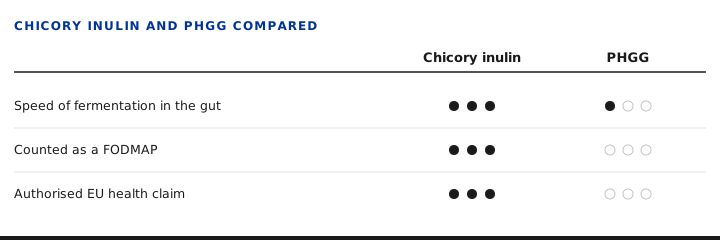
More filled dots mean more of the property named, not a better fiber. Sources: Gunn et al., Gut 2022 (inulin fermentation and FODMAP status); Yoon, Chu and Juneja 2008 (PHGG fermentation); Monash University FODMAP programme, 26 March 2025 (PHGG low FODMAP); Commission Regulation (EU) 2015/2314 (inulin claim), retrieved 12 November 2026; EU Register of nutrition and health claims (13 PHGG entries, all non-authorised), retrieved 23 September 2026.
Which has better evidence for regularity?
Chicory inulin. It holds an authorised EU claim for bowel function, and PHGG does not.
The approved wording is: “Chicory inulin contributes to normal bowel function by increasing stool frequency.” It applies to foods that provide at least 12 grams a day of native chicory inulin.6 EFSA based it on six studies with 86 adults who had fewer than three bowel movements a week. The effect was about one extra bowel movement a week.7
For its first five years, from 1 January 2016, only the applicant, BENEO-Orafti, could use the claim. That period has ended, and any food business may now use it on a product that meets the conditions.6
PHGG holds no EU claim. It has 13 entries in the EU register, covering bowel function, gut comfort, blood sugar, weight and more, and all 13 were refused.8 A refusal means the evidence sent to EFSA did not meet its standard. It does not prove the fiber does nothing.
PHGG’s own trials are small: three of them, about 200 people in total, at 5 to 6 grams a day.9 In people with loose stools, stool form moved toward normal. In one IBS trial, bloating fell more than on placebo, with no change in pain. In the two trials that measured stool frequency, PHGG made no difference.9
Has anyone compared inulin and PHGG directly?
Once, in a trial that measured how fast food moved through the gut. It did not measure symptoms.
A Brazilian crossover trial gave healthy adults a meal with 20 grams of FOS, a shorter relative of inulin, 20 grams of PHGG, or a placebo. Within two hours the stomach had emptied 84% of the FOS meal, 74% of the PHGG meal and 78% of the placebo meal. Both fibers slowed movement through the small intestine compared with placebo. Neither changed hunger or the gut hormones measured.10
The one trial of the two fibers together found no benefit over placebo. Sixty constipated women took 15 grams a day of an inulin and PHGG mixture, or a placebo, for three weeks. Bowel movements rose in both groups, with no difference between them.11
Which should you choose?
Choose by the job you need done.
For more frequent bowel movements, chicory inulin at 12 grams a day is the dose behind the EU claim. Build up slowly, since inulin ferments fast. Our guide on how to start a fiber supplement without bloating covers the build-up.
If FODMAPs bother you, PHGG is classed low FODMAP and inulin is not. The trials used 5 to 6 grams a day.
For hard, dry stools, neither is the strongest choice. Psyllium has more trial evidence, as our inulin vs psyllium comparison shows.
Whichever you pick, start with one fiber at a time and take it with a full glass of water.
Frequently asked questions
What is the difference between inulin and PHGG? Inulin is a fructan, usually taken from chicory root, that gut bacteria ferment quickly. PHGG is guar gum cut by an enzyme into short chains, which bacteria ferment slowly. Inulin is a FODMAP and holds an authorised EU claim for bowel function at 12 grams a day. PHGG is classed low FODMAP by Monash University and holds no EU claim.
Is PHGG gentler than inulin? No trial in people has compared them for gas or bloating. What is documented: inulin is a FODMAP and produced the most colonic gas in an MRI study of 19 people with IBS, and Monash University classes PHGG as low FODMAP. The claim that PHGG makes less gas than inulin comes from laboratory fermentation in sealed vessels.
Which is better for constipation, inulin or PHGG? Chicory inulin is the one with an authorised EU claim: it contributes to normal bowel function by increasing stool frequency, at 12 grams a day. In EFSA’s assessment that meant about one extra bowel movement a week in adults who had fewer than three. PHGG has no claim, and in the two trials that measured it, PHGG did not change stool frequency.
Can you take inulin and PHGG together? They have been taken together in one trial. In it, 60 constipated women took 15 grams a day of a mixture for three weeks. Bowel movements rose in both the fiber and the placebo groups, with no difference between them.
Sources
Footnotes
-
Gunn D, Abbas Z, Harris HC, et al. “Psyllium reduces inulin-induced colonic gas production in IBS: MRI and in vitro fermentation studies.” Gut 2022;71(5):919-927. PMC8995815. Randomised four-treatment crossover in 19 people with IBS, 20 g test drinks; inulin reached the colon largely intact, was fermented quickly and produced the largest rise in colonic gas; inulin-type fructans are FODMAPs that worsen IBS symptoms, especially at higher doses. ↩ ↩2
-
Yoon S-J, Chu D-C, Juneja LR. “Chemical and Physical Properties, Safety and Application of Partially Hydrolized Guar Gum as Dietary Fiber.” Journal of Clinical Biochemistry and Nutrition 2008;42:1-7. PMID 18231623. All three authors work for Taiyo Kagaku, the manufacturer of Sunfiber. ↩
-
Monash University FODMAP programme, monashfodmap.com, 26 March 2025: PHGG is low FODMAP. ↩
-
Chan TC, Yu VMW, Luk JKH, et al. “Effectiveness of Partially Hydrolyzed Guar Gum in Reducing Constipation in Long Term Care Facility Residents.” Journal of Nutrition, Health and Aging 2022. PMID 35297467. 52 residents, 5 g a day for 4 weeks; increased flatulence 8 vs 3 (p=0.173). ↩
-
Noack J, Timm D, Hospattankar A, Slavin J. “Fermentation profiles of wheat dextrin, inulin and partially hydrolyzed guar gum using an in vitro digestion pretreatment and in vitro batch fermentation system model.” Nutrients 2013. PMID 23645025. Laboratory model, no human participants. ↩
-
Commission Regulation (EU) 2015/2314 of 7 December 2015, amending Regulation (EU) No 432/2012, Article 1 and Annex. Condition of use: at least 12 g a day of native chicory inulin. Use restricted to BENEO-Orafti S.A. for five years from 1 January 2016, after which any food business operator may use the claim under the same conditions. EUR-Lex CELEX 32015R2314, retrieved 12 November 2026. ↩ ↩2
-
EFSA Panel on Dietetic Products, Nutrition and Allergies. Scientific opinion on native chicory inulin and maintenance of normal defecation by increasing stool frequency. EFSA Journal 2015;13(1):3951. Six human intervention studies, 86 subjects with fewer than three bowel movements a week. ↩
-
European Commission, EU Register of nutrition and health claims, entries under “Guar gum partially hydrolyzed”, “Hydrolised guar gum” and “Partially Hydrolysed Guar Gum (PHGG)”: 13 entries, all non-authorised. Retrieved 23 September 2026. ↩
-
Niv E, Halak A, Tiommny E, et al. Nutrition & Metabolism 2016;13:10 (IBS, 108 analysed, 12 weeks, 3 g a day for one week then 6 g; bloating P=0.03, pain P=0.334, stool frequency P=0.713). Yasukawa Z, Inoue R, Ozeki M, et al. Nutrients 2019, PMID 31509971 (44 volunteers with loose stools, 5 g a day for 12 weeks; stool form toward Bristol type 4; no difference in stool frequency; funded by Taiyo Kagaku). Chan 2022, as note 4. ↩ ↩2
-
da Silva MVT, Nunes SS, Costa WC, et al. “Acute intake of fructooligosaccharide and partially hydrolyzed guar gum on gastrointestinal transit: A randomized crossover clinical trial.” Nutrition 2022;102:111737. PMID 35843106. Gastric emptying at 2 hours: FOS 84.2%, PHGG 74%, placebo 78%; small-intestinal transit reduced after both fibers; no change in active GLP-1, pancreatic polypeptide, GIP, hunger or satiety. ↩
-
Linetzky Waitzberg D, Alves Pereira CC, Logullo L, et al. “Microbiota benefits after inulin and partially hydrolized guar gum supplementation: a randomized clinical trial in constipated women.” Nutrición Hospitalaria 2012;27(1):123-9. PMID 22566311. ↩