A food gum is a large carbohydrate from a plant or a microbe that thickens or gels water at small amounts. The technical word is hydrocolloid. Gums come from tree resins, ground seeds and bacteria, and none of them is digested in the small intestine.
Some gums sit on ingredient lists as thickeners. A few are sold on their own as fibre supplements. Our guide to the types of fiber supplements compares the gums sold as fibre with psyllium, inulin and the rest.
What do all gums have in common?
Every gum on the EU list of food additives is a polysaccharide: a long chain of sugar units, with a molecular weight in the hundreds of thousands or millions.1 The EU specifications describe guar gum and locust bean gum as made “mainly of a high molecular weight hydrocolloidal polysaccharide”.1
Beyond that, gums differ a great deal. They are built from different sugars, they come from trees, seeds or bacteria, and they behave differently in water and in the gut. What they share is their job: a little of one makes a liquid thicker or turns it into a gel.
Our digestive enzymes cannot break any of them down. EFSA, the EU food safety authority, re-evaluated six common gums between 2017 and 2018 and found that none is absorbed intact.2 3 4 5 6 7 They reach the large intestine, where gut bacteria ferment some of them and leave others alone.
Where do gums come from?
There are three main sources.
Tree resins (exudates). Some plants seep a sap from their stems and branches that dries hard. Gum arabic, also called acacia gum (E 414), comes from Acacia senegal and related acacia trees. Tragacanth (E 413) comes from Asian species of Astragalus, and karaya gum (E 416) mainly from Sterculia species.1
Seeds. Guar gum (E 412), locust bean gum (E 410, also called carob bean gum) and tara gum (E 417) are made by grinding the endosperm, the inner part of the seed. Guar comes from the guar bean, locust bean gum from the seeds of the carob tree, tara from the seeds of Caesalpinia spinosa. All three plants are legumes.1
Bacteria. Xanthan gum (E 415) is made by growing the bacterium Xanthomonas campestris on a carbohydrate, then recovering the gum with alcohol, drying it and milling it. Gellan gum (E 418) is made the same way by Pseudomonas elodea.1
A fourth source is a tuber. Konjac gum and konjac glucomannan (E 425) come from the root-like tuber of the konjac plant.8 Our glucomannan explainer covers it.
Why do guar, tara and locust bean gum behave differently?
The three seed gums are the same kind of molecule. Each is a galactomannan: a backbone of mannose sugars with single galactose sugars attached along it. They differ in how many galactose side groups they carry.
The EU specification gives the ratio of mannose to galactose as 2 to 1 in guar gum, 3 to 1 in tara gum and 4 to 1 in locust bean gum.1 So guar has the most side groups and locust bean gum the fewest.
The same specifications list how each dissolves. Guar gum is “soluble in cold water”. Locust bean gum is “soluble in hot water”.1 EFSA adds that locust bean gum swells in cold water, but heating is necessary for it to dissolve fully.2 Tara, in the middle, is listed as soluble in water.1
How do gums differ in water?
Gums differ in how thick they make a liquid and in how they behave together.
Thickness. Gum arabic is unusual: one gram dissolves in 2 millilitres of cold water and the solution “flows readily”.1 Tragacanth does the opposite. One gram in 50 millilitres of water swells into a smooth, stiff mucilage.1 Xanthan gum makes a very thick solution that thins out when it is stirred or poured and thickens again at rest.4
Gums together. Some gums thicken more when combined. EFSA notes that adding locust bean gum, guar gum or konjac glucomannan to xanthan gum gives a thicker solution than the gums give alone.4 Locust bean gum also strengthens gels made with carrageenan or agar. Food makers use these pairings in sauces, dressings and ice cream.2
Chain length. A gum can be cut into shorter chains. PHGG (partially hydrolysed guar gum) is guar gum cut by an enzyme to under a tenth of its length. A 1 percent solution of guar gum measures 2,000 to 3,000 mPa·s. A 5 percent solution of PHGG measures about 10, close to water.9
What happens to gums in the gut?
Gut bacteria in the large intestine ferment some gums well and others hardly at all. EFSA’s re-evaluations give the picture for six common gums.
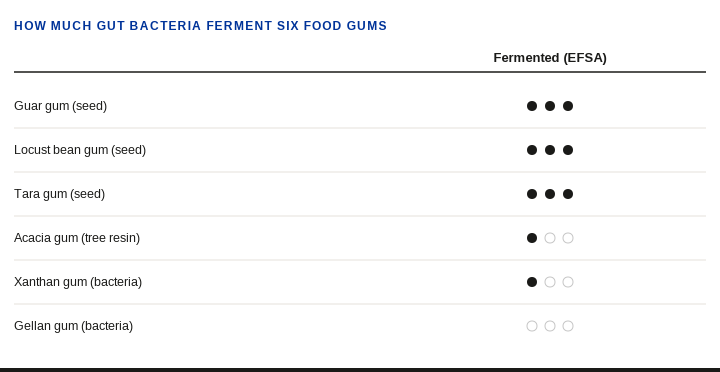
How much gut bacteria ferment each gum, in EFSA’s words. Sources: EFSA ANS Panel re-evaluations of guar gum (2017), locust bean gum (2017), tara gum (2017), acacia gum (2017), xanthan gum (2017) and gellan gum (2018).
| Gum | Source | Fermented by gut bacteria (EFSA) |
|---|---|---|
| Guar gum, E 412 | Seed | Significantly6 |
| Locust bean gum, E 410 | Seed | Significantly2 |
| Tara gum, E 417 | Seed | Significantly, by analogy with the other seed gums3 |
| Acacia gum, E 414 | Tree resin | Slightly7 |
| Xanthan gum, E 415 | Bacteria | Partially or slightly4 |
| Gellan gum, E 418 | Bacteria | Not fermented5 |
The seed gums ferment the most. For tara, EFSA found no convincing human study and reasoned from the other galactomannans.3
How much people tolerate. Adults tolerated 9 to 30 grams of guar gum a day, with abdominal discomfort in some from around 15 grams.6 They tolerated up to 30 grams of acacia gum a day, with flatulence in some.7 Xanthan gum at up to 15 grams a day for at least ten days was tolerated, with abdominal discomfort in some people.4 EFSA judged that discomfort unpleasant but not harmful. For all six gums it found no safety concern for the general population at their uses as food additives, and no need for a numerical limit on daily intake.2 3 4 5 6 7
Is a gum on an ingredient list a fibre?
Under EU law, a gum in a recipe is named by its job. The label rules say additives in categories such as thickener, gelling agent, stabiliser and emulsifier are listed by that category, followed by their name or E number, so “thickener (xanthan gum)” or “stabiliser: E 410”.10 If an additive does two jobs, the label names the main one in that food.
For fibre, the EU defines fibre as carbohydrate polymers of three or more units that are “neither digested nor absorbed in the human small intestine”.10 Gums meet that part. For a carbohydrate extracted from a raw material, the definition adds a second condition: a beneficial physiological effect shown by generally accepted scientific evidence.10
Some gums are sold for their fibre. Gum arabic is sold as acacia fiber, guar gum both whole and as PHGG, and konjac as glucomannan. Two of them hold an authorised EU health claim. “Guar gum contributes to the maintenance of normal blood cholesterol levels” applies at 10 grams of guar gum a day. Glucomannan holds the same cholesterol claim at 4 grams a day.11 Acacia gum and PHGG hold none: 12 acacia submissions and 13 PHGG submissions are all listed as non-authorised.12
Guar gum and konjac glucomannan are the two gums that appear both as thickeners on ingredient lists and as fibres with an authorised EU health claim.
Sources
Footnotes
-
Commission Regulation (EU) No 231/2012 laying down specifications for food additives, entries E 410 Locust bean gum, E 412 Guar gum, E 413 Tragacanth, E 414 Acacia gum, E 415 Xanthan gum, E 416 Karaya gum, E 417 Tara gum and E 418 Gellan gum: definitions, molecular weights, solubility and the mannose to galactose ratios (E 417 entry). ↩ ↩2 ↩3 ↩4 ↩5 ↩6 ↩7 ↩8 ↩9 ↩10
-
EFSA Panel on Food Additives and Nutrient Sources added to Food (ANS). “Re-evaluation of locust bean gum (E 410) as a food additive.” EFSA Journal 2017;15(1):4646. doi:10.2903/j.efsa.2017.4646. ↩ ↩2 ↩3 ↩4 ↩5
-
EFSA ANS Panel. “Re-evaluation of tara gum (E 417) as a food additive.” EFSA Journal 2017;15(6):4863. doi:10.2903/j.efsa.2017.4863. ↩ ↩2 ↩3 ↩4
-
EFSA ANS Panel. “Re-evaluation of xanthan gum (E 415) as a food additive.” EFSA Journal 2017;15(7):4909. doi:10.2903/j.efsa.2017.4909. ↩ ↩2 ↩3 ↩4 ↩5 ↩6
-
EFSA ANS Panel. “Re-evaluation of gellan gum (E 418) as food additive.” EFSA Journal 2018;16(6):5296. doi:10.2903/j.efsa.2018.5296. ↩ ↩2 ↩3
-
EFSA ANS Panel. “Re-evaluation of guar gum (E 412) as a food additive.” EFSA Journal 2017;15(2):4669. doi:10.2903/j.efsa.2017.4669. ↩ ↩2 ↩3 ↩4
-
EFSA ANS Panel. “Re-evaluation of acacia gum (E 414) as a food additive.” EFSA Journal 2017;15(4):4741. doi:10.2903/j.efsa.2017.4741. ↩ ↩2 ↩3 ↩4
-
EFSA ANS Panel. “Re-evaluation of konjac gum (E 425 i) and konjac glucomannan (E 425 ii) as food additives.” EFSA Journal 2017;15(6):4864. doi:10.2903/j.efsa.2017.4864. ↩
-
Yoon S-J, Chu D-C, Juneja LR. “Chemical and Physical Properties, Safety and Application of Partially Hydrolized Guar Gum as Dietary Fiber.” Journal of Clinical Biochemistry and Nutrition 2008;42:1-7. PMID 18231623. All three authors worked for Taiyo Kagaku Co., Ltd., which makes the PHGG brand Sunfiber. ↩
-
Regulation (EU) No 1169/2011 on the provision of food information to consumers, consolidated text: Annex I point 12 (definition of fibre) and Annex VII Part C (designation of additives by category name followed by specific name or E number). ↩ ↩2 ↩3
-
Commission Regulation (EU) No 432/2012 establishing a list of permitted health claims made on foods, consolidated text, Annex entries for Guar gum and for Glucomannan (blood cholesterol). ↩
-
European Commission, Food and Feed Information Portal, EU Register of nutrition and health claims: entries for acacia gum (gum arabic), arabino-galactans (gum acacia) and partially hydrolysed guar gum under three spellings, retrieved 23 September 2026. ↩