Digestion is how your body turns a meal into molecules small enough to absorb. Proteins become amino acids, fats become fatty acids and glycerol, and carbohydrates become simple sugars.1 It happens along a tube about 5 metres long, from mouth to anus, with help from the liver, gallbladder and pancreas.2
If you take a GLP-1 medicine, this system is where many of its effects show up, including its side effects. And if you eat more fiber, this is where fiber goes. For the practical side, see our guide to fiber on a GLP-1.
What is the digestive system made of?
The digestive system has two kinds of organs. The hollow organs form one long, twisting tube: mouth, esophagus, stomach, small intestine, large intestine and anus. Food passes through all of them. The solid organs are the liver, pancreas and gallbladder. Food never enters them. They make or store digestive juices and send them into the tube.1
The small intestine has three parts: the duodenum first, then the jejunum, then the ileum. The large intestine includes the cecum, the appendix, the colon and the rectum.1
Other systems help. Nerves and hormones decide when juices flow and how fast food moves. Bacteria in the gut break down food we cannot. The blood carries away what is absorbed.1
How does food move through the gut?
By a wave of muscle called peristalsis. The muscle behind the food squeezes while the muscle in front relaxes, so the food is pushed forward and mixed at the same time.1
When you swallow, a flap of tissue called the epiglottis folds over your windpipe so food goes down the esophagus. From that point the process runs on its own. At the bottom of the esophagus, a ring of muscle opens to let food into the stomach and then closes again to keep stomach contents from flowing back up.1
The gut has its own network of nerves in its walls, the enteric nervous system. When food stretches the wall, these nerves speed up or slow down the movement of food and the release of digestive juices.1
What happens in each organ?
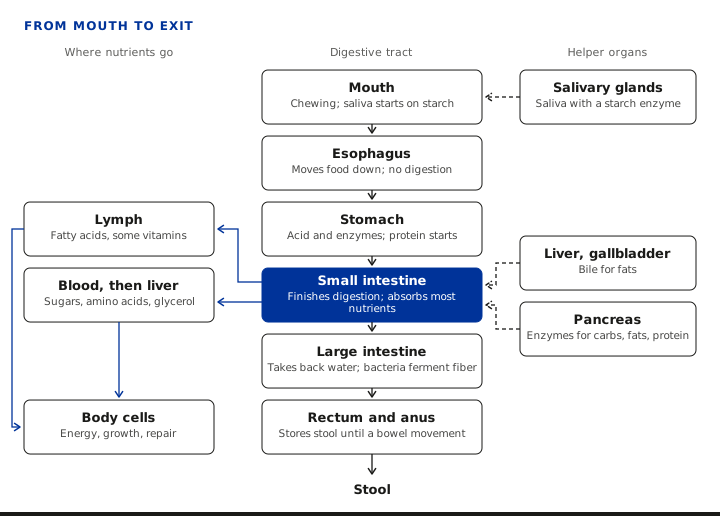
The digestive system from mouth to exit: the tract in the middle, the organs that feed juices into it on the right, and where absorbed nutrients go on the left. Sources: NIDDK, “Your Digestive System & How it Works”; Holscher, Gut Microbes 2017.
| Organ | Juices added | What is broken down |
|---|---|---|
| Mouth | Saliva | Starches |
| Esophagus | None | None |
| Stomach | Stomach acid and enzymes | Proteins |
| Small intestine | Small intestine juice | Starches, proteins, carbohydrates |
| Pancreas | Pancreatic juice | Carbohydrates, fats, proteins |
| Liver | Bile | Fats |
| Large intestine | None | Bacteria break down what is left |
Mouth. Chewing breaks food into smaller pieces. Saliva moistens it so it slides down, and it contains an enzyme that starts breaking down starch.1
Esophagus. Moves food to the stomach. No digestion happens here.1
Stomach. Glands in the lining make acid and enzymes, and the stomach muscles mix food with them. Protein breakdown starts here. The stomach then empties its contents, now a thick liquid called chyme, slowly into the small intestine.1
Pancreas. Sends a juice into the small intestine through small ducts. Its enzymes break down carbohydrates, fats and proteins.1
Liver and gallbladder. The liver makes bile, which helps digest fats and some vitamins. The gallbladder stores bile between meals and squeezes it into the small intestine when you eat.1
Small intestine. Its own juice mixes with bile and pancreatic juice and finishes breaking down proteins, carbohydrates and fats. It also absorbs water along with the nutrients.1
Large intestine. Takes water back into the blood. Its bacteria break down what is left and make vitamin K. The waste becomes stool, which the rectum stores until a bowel movement.1
Where are nutrients absorbed?
Mostly in the small intestine.1 It is about two thirds of the gut’s length, and its lining is folded, then covered in finger-like villi, which are covered in microvilli. The folds enlarge the surface about 1.6 times, and the villi and microvilli another 60 to 120 times.2
The whole lining of the digestive tract averages about 32 square metres, roughly half a badminton court. Only about 2 square metres of that is in the large intestine. Older textbooks gave 260 to 300 square metres, about a tennis court; a 2014 review recalculated it from biopsy measurements.2
Once absorbed, nutrients take two routes. The blood carries simple sugars, amino acids, glycerol and some vitamins and salts to the liver, which stores, processes and sends them on to the rest of the body. Fatty acids and some vitamins go into the lymph system instead.1
How long does digestion take?
It varies widely between people. In a study of 125 healthy adults, a swallowed tracking capsule left the stomach after a median of 2.7 hours. In 89% of them it had left within 6 hours, and the full range ran from a few minutes to 21 hours.3 A capsule does not break down like food, so a real meal may take a different time.
Time through the colon, and through the whole gut, differs by person. In 215 healthy volunteers, women had longer stomach emptying, colon transit and whole-gut transit than men.4 Age and body mass index (BMI) also changed transit times. In both studies, whole-gut times bunched at roughly 24-hour intervals.45
How often you go varies too. Constipation is usually described as fewer than three bowel movements a week, or stools that are hard, painful or hard to pass. The US National Institutes of Health adds that “only you know what’s normal for you.”6
What do GLP-1 medicines change in the gut?
GLP-1 is first a hormone your own gut makes. It comes mainly from cells in the last part of the small intestine and in the colon, and it is released after you eat. It helps you feel full and helps regulate blood sugar. Your body breaks it down within about a minute and a half.7
GLP-1 medicines copy that signal and last far longer. Semaglutide (Ozempic, Wegovy) has a half-life of about a week.8 Their effects on digestion, in the words of the European labels:
- Slower stomach emptying. Semaglutide causes “a minor delay in gastric emptying in the early postprandial phase”, meaning after a meal.8 Tirzepatide (Mounjaro) “delays gastric emptying”.9
- Less hunger, more fullness. Semaglutide “reduces feelings of hunger” and increases “feelings of satiety, fullness and control of eating”.8
- Gut side effects. Nausea, vomiting, diarrhoea, constipation and abdominal pain are listed as very common for both medicines. At the Wegovy weight-management dose over 68 weeks, nausea affected 43.9% of people (16.1% on placebo) and constipation 24.2% (11.1% on placebo). Most cases were mild to moderate.89
These effects are highest while the dose is being raised and decrease over time.89 On semaglutide, a typical episode of nausea lasted a median of 8 days, diarrhoea 3 days and constipation 47 days.8 We cover each in how long GLP-1 nausea lasts and GLP-1 constipation.
Slower emptying does not explain everything. A 2024 review notes that the effect on the stomach does “not fully account for” diarrhoea or constipation, which probably have other causes.7
Three things to tell your care team. Food can stay in the stomach longer than usual, and aspiration has been reported during general anaesthesia and deep sedation, so tell the team before a procedure that you take a GLP-1.89 Tirzepatide’s slower emptying can change how some oral medicines are absorbed, and the label advises monitoring drugs such as warfarin.9 And vomiting or diarrhoea can dehydrate you, which in rare cases can affect the kidneys, so drink enough and contact your prescriber if you cannot keep fluids down.8
What happens to fiber in the gut?
Fiber is the part of food our own enzymes cannot break down. EU law defines it by exactly that: carbohydrate that is “neither digested nor absorbed in the human small intestine”.10 So fiber passes the stomach and small intestine intact and arrives in the large intestine. For the full definition and the different types, see what dietary fiber is.
In the large intestine, bacteria do what we cannot. They ferment fiber into short-chain fatty acids, mainly acetate, propionate and butyrate. Butyrate is the main energy source for the cells lining the colon.11 How much of a fiber gets fermented depends on the type. Inulin is readily fermented. Psyllium is soluble and forms a gel but is only partly fermented. Cellulose is poorly fermented. Some fibres, such as methylcellulose, are not fermented at all and leave in the stool.1112
Why fiber can cause gas. Fermentation makes gases, mainly hydrogen and carbon dioxide, along with the fatty acids.11 In a study of 19 people with irritable bowel syndrome, inulin produced the most gas in the colon and psyllium very little.13 Some gas is normal for everyone; it leaves by burping or through the anus.14 Starting with a small amount, around 5 g a day, and building up slowly is the usual advice.15 Our guide on starting fiber without bloating goes step by step.
Why gel-forming fiber needs water. Psyllium holds up to 40 times its weight in water, and the European medicine monograph says to take about 30 ml of water per gram.16 Taken dry with too little liquid, gel-forming fibres can cause choking, which is why EU law requires a warning on some of them.1216
What is authorised in the EU. Two fibres hold an approved claim about bowel function. “Chicory inulin contributes to normal bowel function by increasing stool frequency”, at 12 g a day. “Wheat bran fibre contributes to an acceleration of intestinal transit”, at 10 g a day in a high-fibre food.12
How do GLP-1 medicines and fiber fit together?
Fiber fermentation is one of several things that can raise your own GLP-1 a little.7 Human studies are mixed: in one review, oat and barley beta-glucan raised blood GLP-1 in 3 of 9 studies and lowered it in 1.17 Any effect is much smaller and shorter-lived than a medicine’s. Fiber does not do what a GLP-1 medicine does.
The practical overlap is timing and comfort. No interaction between fiber and an injected GLP-1 medicine is documented, since the medicine goes under the skin.18 The spacing rule that exists is for other oral medicines: psyllium medicine labels say to take it half an hour to an hour before or after them.18 With oral semaglutide, the tablet goes first on an empty stomach and fiber comes later in the day. The details are in can you take fiber with a GLP-1.
During a week of bad nausea, a 2024 review suggests gentler, lower-fibre food, because a lot of fiber can slow stomach emptying further.7 Fiber can wait until the nausea settles.
The general target does not change on a GLP-1. EFSA considers 25 g a day adequate for adults, and several countries, including Germany and the UK, set 30 g.19 None of the 21 European countries with survey data reaches its own target on average.20 Eating less on a GLP-1 makes the target harder to reach from the same foods, which our page on how much fiber per day works through.
A GLP-1 medicine acts mainly on the stomach and on appetite, while fiber does its work in the large intestine.
Footnotes
-
US National Institute of Diabetes and Digestive and Kidney Diseases (NIDDK). Your Digestive System & How it Works. Last reviewed December 2017. https://www.niddk.nih.gov/health-information/digestive-diseases/digestive-system-how-it-works ↩ ↩2 ↩3 ↩4 ↩5 ↩6 ↩7 ↩8 ↩9 ↩10 ↩11 ↩12 ↩13 ↩14 ↩15 ↩16
-
Helander HF, Fändriks L. Surface area of the digestive tract, revisited. Scandinavian Journal of Gastroenterology. 2014;49(6):681-689. Oro-anal length about 5 m, two thirds small intestine; mean mucosal surface about 32 m², of which about 2 m² large intestine. https://pubmed.ncbi.nlm.nih.gov/24694282/ ↩ ↩2 ↩3
-
Nandhra GK, et al. Normative values for gastric motility assessed with the 3D-Transit electromagnetic tracking system. Neurogastroenterology & Motility. 2020;32(6):e13829. 125 healthy volunteers analysed; median gastric emptying time 2.7 hours (range 0.1 to 21.2). https://pubmed.ncbi.nlm.nih.gov/32154975/ ↩
-
Wang YT, et al. Regional gastrointestinal transit and pH studied in 215 healthy volunteers using the wireless motility capsule. Alimentary Pharmacology & Therapeutics. 2015;42(6):761-772. https://pubmed.ncbi.nlm.nih.gov/26223837/ ↩ ↩2
-
Nandhra GK, et al. Normative values for region-specific colonic and gastrointestinal transit times in 111 healthy volunteers using the 3D-Transit electromagnet tracking system. Neurogastroenterology & Motility. 2020;32(2):e13734. https://pubmed.ncbi.nlm.nih.gov/31565841/ ↩
-
NIDDK. Definition & Facts for Constipation. Last reviewed May 2018. https://www.niddk.nih.gov/health-information/digestive-diseases/constipation/definition-facts ↩
-
Dietary Recommendations for the Management of Gastrointestinal Symptoms in Patients Treated with GLP-1 Receptor Agonist. Diabetes, Metabolic Syndrome and Obesity. December 2024. A narrative review. https://pmc.ncbi.nlm.nih.gov/articles/PMC11668918/ ↩ ↩2 ↩3 ↩4
-
European Medicines Agency. Wegovy (semaglutide) EPAR Product Information, sections 4.4, 4.8, 5.1 and 5.2. https://www.ema.europa.eu/en/documents/product-information/wegovy-epar-product-information_en.pdf ↩ ↩2 ↩3 ↩4 ↩5 ↩6 ↩7 ↩8
-
European Medicines Agency. Mounjaro (tirzepatide) EPAR Product Information, sections 4.4, 4.5 and 4.8. https://www.ema.europa.eu/en/documents/product-information/mounjaro-epar-product-information_en.pdf ↩ ↩2 ↩3 ↩4 ↩5
-
Regulation (EU) No 1169/2011 on the provision of food information to consumers, Annex I point 12. https://eur-lex.europa.eu/eli/reg/2011/1169/oj ↩
-
Holscher HD. Dietary fiber and prebiotics and the gastrointestinal microbiota. Gut Microbes. 2017;8(2):172-184. https://pubmed.ncbi.nlm.nih.gov/28165863/ ↩ ↩2 ↩3
-
Commission Regulation (EU) No 432/2012, consolidated version, including Regulation (EU) 2015/2314 (chicory inulin). https://eur-lex.europa.eu/legal-content/EN/TXT/?uri=CELEX:02012R0432-20210517 Methylcellulose: EFSA ANS Panel, re-evaluation of celluloses E 460 to E 469, EFSA Journal 2018. ↩ ↩2 ↩3
-
Gunn D, et al. Psyllium reduces inulin-induced colonic gas production in IBS: MRI and in vitro fermentation studies. Gut. 2022;71(5):919-927. ↩
-
NIDDK. Definition & Facts for Gas in the Digestive Tract. Last reviewed June 2021. https://www.niddk.nih.gov/health-information/digestive-diseases/gas-digestive-tract/definition-facts ↩
-
UCSF Health. Increasing fiber intake. https://www.ucsfhealth.org/education/increasing-fiber-intake ↩
-
European Medicines Agency, Committee on Herbal Medicinal Products. Community herbal monograph on Plantago ovata Forssk., seminis tegumentum. EMA/HMPC/199774/2012. https://www.ema.europa.eu/en/documents/herbal-monograph/final-community-herbal-monograph-plantago-ovata-forssk-seminis-tegumentum_en.pdf ↩ ↩2
-
de Jong JCB, et al. Dietary fibers to boost endogenous GLP-1 secretion and satiety: a scoping review. Frontiers in Endocrinology. 2026. https://doi.org/10.3389/fendo.2026.1880500 ↩
-
MHRA/emc. Ispaghula husk Summary of Product Characteristics (Fybogel). https://www.medicines.org.uk/emc/product/1099/smpc ↩ ↩2
-
EFSA Panel on Dietetic Products, Nutrition and Allergies. Scientific Opinion on Dietary Reference Values for carbohydrates and dietary fibre. EFSA Journal 2010;8(3):1462. National targets from the European Fibre Gap Index. ↩
-
The Good Fiber Company. European Fibre Gap Index, data current July 2026. https://goodfibercompany.com/fiber-index/ ↩