Yes. GLP-1 is a peptide. A peptide is a short chain of amino acids, the small building blocks your body also uses to make protein. GLP-1 is a chain of 30 of them, released by your gut after you eat. Most GLP-1 medicines are modified peptides too. The peptides advertised online share the chemistry, but in Europe they lack a marketing authorisation, and nobody has officially checked what is in the vial.
Peptides are heavily advertised on social media for weight loss, muscle and anti-ageing, and regulators in Austria, France and Switzerland all issued warnings in 2026.123 For the medicines themselves, see our complete guide to fibre and GLP-1 medicines.
What are peptides?
Amino acids are small molecules that your body uses as building blocks. There are 20 common kinds. When you eat protein, for example in eggs, meat, beans or cheese, your gut breaks it down into amino acids. Your body then joins them again, one after another, to make the molecules it needs.
Nine of them must come from food, because your body cannot make them. Seven others are usually made by the body, but it may need them from food during illness or stress.4 Each one also has a one-letter code, so scientists can write a peptide as a string of letters.5
| Amino acid | Code | Must come from food? |
|---|---|---|
| Alanine | A | No |
| Arginine | R | Sometimes, in illness or stress |
| Asparagine | N | No |
| Aspartic acid | D | No |
| Cysteine | C | Sometimes, in illness or stress |
| Glutamic acid | E | No |
| Glutamine | Q | Sometimes, in illness or stress |
| Glycine | G | Sometimes, in illness or stress |
| Histidine | H | Yes |
| Isoleucine | I | Yes |
| Leucine | L | Yes |
| Lysine | K | Yes |
| Methionine | M | Yes |
| Phenylalanine | F | Yes |
| Proline | P | Sometimes, in illness or stress |
| Serine | S | Sometimes, in illness or stress |
| Threonine | T | Yes |
| Tryptophan | W | Yes |
| Tyrosine | Y | Sometimes, in illness or stress |
| Valine | V | Yes |
A short chain of amino acids is called a peptide. A long chain is called a protein. Most proteins have hundreds of amino acids. There is no natural cut-off between the two, but US regulation counts anything above 40 amino acids as a protein.6
The order of the amino acids decides what a peptide does. Swap a few of them and you get a different molecule with a different effect. That is how drug makers built semaglutide from natural GLP-1, as the table below shows.
Many peptides in your body work as messengers. One organ releases them, and they carry a signal through the blood to another. Insulin is one: it tells your cells to take up sugar. GLP-1 is another. Doctors have used peptides as medicines for decades, for example in diabetes, hormonal disorders and some cancers.1
You may know some of them. Every medicine in this table is a peptide and is licensed in the UK.7
| Medicine | Used for | Amino acids |
|---|---|---|
| Insulin | Diabetes | 51, in two chains8 |
| Glucagon | Severe low blood sugar in people who use insulin | 298 |
| Oxytocin | Starting or strengthening labour, and preventing heavy bleeding after birth | 9, joined in a ring |
| Desmopressin | Bedwetting and one form of diabetes insipidus | 8, plus one building block that is not an amino acid |
| Leuprorelin | Prostate cancer, endometriosis, fibroids and breast cancer | 9 |
| Goserelin | Prostate cancer and breast cancer | 10, one of them modified9 |
| Octreotide | Acromegaly (too much growth hormone) and some hormone-producing tumours | 8 |
| Teriparatide | Osteoporosis with a high risk of fractures | 3410 |
| Ciclosporin | Preventing rejection after an organ transplant | 11, joined in a ring |
The GLP-1 medicines, covered further down, belong on this list too.
The word tells you what a molecule is built from. It says nothing about whether a product is safe or whether it works. Insulin is a peptide hormone, and it is a life-saving medicine at the right dose. It was also what German authorities found in the pens falsely labelled as Ozempic in 2023, which is why those pens were dangerous.11
Is GLP-1 a peptide?
Yes. The name stands for glucagon-like peptide-1. The active form in your body has 30 amino acids.12 Your gut releases it after a meal, and it signals fullness and helps release insulin when blood sugar is high.
It lasts under two minutes in the blood, because an enzyme called DPP-4 cuts it apart.12 Food can raise your own GLP-1 a little and briefly, as we explain in our look at “oatzempic”.
Are GLP-1 medicines peptides?
Most are. Drug makers took the natural peptide and changed it so it survives for days instead of minutes.
| Medicine | What it is | How long it lasts |
|---|---|---|
| Natural GLP-1 | 30 amino acids | Half-life under 2 minutes12 |
| Liraglutide (Saxenda) | Peptide, 97% the same sequence as human GLP-1 | Half-life about 13 hours13 |
| Semaglutide (Ozempic, Wegovy) | Peptide, 94% the same sequence, binds to albumin in the blood | Half-life about 1 week14 |
| Tirzepatide (Mounjaro) | Peptide of 39 amino acids with a fatty acid attached, acts on GLP-1 and GIP receptors | Half-life about 5 days15 |
| Orforglipron (Foundayo) | Small non-peptide molecule | Taken once a day16 |
Peptides are hard to swallow. Stomach acid and enzymes break them down, so most are injected. The Wegovy pill does contain a peptide, but it needs an absorption helper called salcaprozate sodium, and only about 1–2% of the dose reaches the blood.14 That is why the pill comes with a strict fasting rule.
Not every GLP-1 medicine is a peptide. Orforglipron is a small molecule that acts on the same receptor without being a peptide at all.16
Which peptides are advertised online?
They fall into four rough groups. All of the names below appear in regulator warnings or on the anti-doping list.317
- Weight loss: retatrutide, plus products sold as semaglutide or tirzepatide.
- Injury and recovery: BPC-157 and TB-500.
- Muscle and growth hormone: CJC-1295 and ipamorelin.
- Anti-ageing: GHK-Cu. France’s list also includes NAD+, which is not a peptide, so the online label is loose.
What does the evidence look like? BPC-157 is the best-known example. A 2025 systematic review found 36 studies, of which 35 were in animals or cells. The one human study was a small report in which 7 of 12 people with knee pain said they had relief for more than six months. The authors found no clinical safety data.18 A randomised, placebo-controlled phase 2 trial in 120 people with hamstring strains is now recruiting, with results not expected before 2027.19
How is a licensed GLP-1 medicine different from an online peptide?
An online vial and a licensed pen can hold the same kind of molecule. They differ in testing, licensing, manufacture and supply.
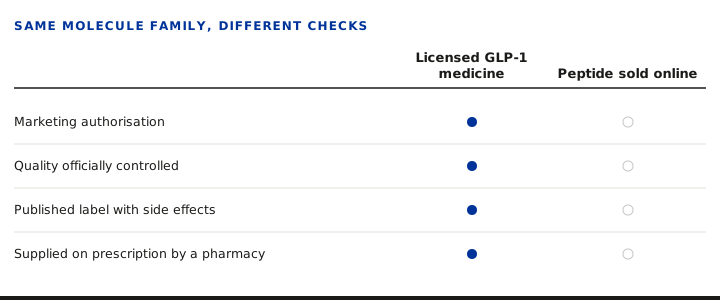
Each row describes the category as regulators describe it. Individual products vary. Sources: Directive 2001/83/EC; BASG, 27 May 2026; ANSM, 2 July 2026; Swissmedic, June 2026.
A licensed medicine has been through large trials, and its label lists the side effects found in them. Regulators oversee how it is made. Austria’s regulator says the opposite of online peptides: no official control, unknown origin, unknown manufacturer and unknown storage.2 Swissmedic adds that injected products carry no guarantee of sterility, stability or composition.1
One small test shows what that can mean. Researchers tried to buy semaglutide from six websites without a prescription. Three sites took the money and delivered nothing. The three vials that arrived did contain semaglutide, but purity was 7–14% against an advertised 99%, the content was 29–39% above the label, and one sample had raised endotoxin, a sign of possible contamination.20 That study covers three products, so it cannot tell us how common these faults are. It does show that an advertised purity figure can be wrong.
What do people get wrong about peptides?
“It is natural, so it is safe.” Your body makes peptides in tiny, tightly controlled amounts. A manufactured peptide injected at an unknown dose is a different exposure, and for many of these substances there is too little human data to say what it does.2
“It says semaglutide, so it is the same as Ozempic.” Nobody has checked the label on an online vial. EMA and national agencies warn that illegal GLP-1 products may not contain the stated substance at all and may contain harmful levels of other substances.21
“Research use only means it is high grade, or legal.” Austria’s regulator calls that label irrelevant when a website clearly targets human use.2 Swissmedic says the same.1 France advises never using a product labelled this way.3
“Retatrutide is the next Ozempic, and I can get it now.” Retatrutide is a real drug candidate in phase 3 trials. In Lilly’s topline results, people on the top dose lost an average of 28.3% of body weight at 80 weeks, 11.3% stopped because of side effects, and 12.5% had dysesthesia, an abnormal skin sensation, against 0.9% on placebo.22 Those figures come from a controlled product under medical supervision, so they say nothing about a pen from a website. France reports people hospitalised after using products sold as retatrutide.3
“I can get the same effect from a peptide drink or gummy.” Swallowed peptides are mostly digested, as the 1–2% figure for the Wegovy pill shows.14 Collagen peptides are sold as food, but EFSA found no proven link between collagen hydrolysate and joint maintenance.23
“The US has legalised them.” It has not. In July 2026 an FDA advisory committee voted 8–6, with one abstention, to let pharmacies compound BPC-157, and it backed five others, although FDA staff had advised against.24 On 30 October 2026 the US health department published a draft policy: it does not intend to take enforcement action against licensed pharmacies and physicians that compound the peptides on its list while the formal rules are written.25 One published summary says that list names BPC-157.26 The policy is not binding, it covers US compounding only, and we found no final rule as of 6 November 2026. The notice itself says compounded drugs are not FDA-approved, so FDA does not review their safety, effectiveness or quality before they are sold.25
What is the legal basis in Europe?
EU medicines law starts with a definition. Under Directive 2001/83/EC a product is a medicine if it is presented as treating or preventing disease, or if it can be used to change how the body functions through a pharmacological, immunological or metabolic action (Art 1(2)).27 If a product could be both a medicine and something else, medicines law applies (Art 2(2)).
From there, four rules do most of the work:27
- A medicine needs a marketing authorisation before it can be sold (Art 6). Neither retatrutide nor BPC-157 appears on EMA’s list of centrally authorised medicines as of 6 November 2026.28
- Prescription medicines cannot be advertised to the public (Art 88). This is why you see no adverts for Ozempic in Europe, and why a sponsored post for an injectable peptide is a warning sign.
- Online sale is limited. Countries may ban online sale of prescription medicines (Art 85c), and France states that selling GLP-1 medicines online without authorisation is illegal.29
- There are narrow exceptions. A pharmacy may prepare a product for one patient on a prescription (Art 3(1)), and products used in trials fall under clinical trial law (Art 3(3)).
Classification is decided product by product, so not every peptide is automatically a medicine. In a 2014 case about synthetic cannabinoids, the EU Court of Justice held that the second part of that definition does not cover a substance that has no beneficial effect on health, is consumed solely to induce intoxication and is harmful.30 Austria’s regulator looks at composition, concentration, effects and data, and says many of these peptides qualify.2
Calling it something else does not help. France notes that some products are sold as food supplements even though their action goes beyond what a supplement should do.3 A cosmetic is defined by contact with the outside of the body, so a peptide skin cream can be a lawful cosmetic while an injection cannot.31
Enforcement is now active. France has ordered products withdrawn, most recently in August 2026.3 Switzerland checked 46 packages in one day in June 2026, retained 23, and traced about 80% to Poland.1 In October 2026 the UK’s MHRA seized over 12,000 fake retatrutide and tirzepatide pens in Birmingham.32
Buyers are not always in the clear. Austria says purchasers, as well as sellers, may face legal consequences.2 Rules differ by country, so your national medicines agency is the place to check. Athletes have a separate problem: BPC-157, TB-500, CJC-1295 and ipamorelin are all named on the World Anti-Doping Agency’s prohibited list.17
Where are the real opportunities in peptide medicine?
Next-generation medicines. There are 14 phase 3 records for retatrutide on ClinicalTrials.gov.19 If the results hold up and regulators agree, it could reach patients through a prescription, with a label and a known dose. Lilly itself says approval is not guaranteed.22
Testing old claims properly. The BPC-157 hamstring trial is the kind of study that can settle whether the animal results apply to people.19
Trial participation. If you want access to an unapproved peptide, a registered clinical trial is the usual lawful route. It comes with screening, a known product and medical follow-up. You can search ClinicalTrials.gov or the EU’s clinical trials register, and your doctor can help you judge a study.
What should you do if you have already used one?
France’s medicines agency advises you to stop, see a health professional if you notice any side effects, and call emergency services in a life-threatening emergency.3 Tell your doctor what you took, even if you are not sure what was in it. Our guide to fake GLP-1 pens explains what to do with a suspect product.
In Europe, a real GLP-1 medicine comes with a prescription, a pharmacy and a leaflet.
Frequently asked questions
Is GLP-1 a peptide? Yes. GLP-1 stands for glucagon-like peptide-1. The active form is a chain of 30 amino acids that your gut releases after you eat. Your body breaks it down in under two minutes. Semaglutide, liraglutide and tirzepatide are modified peptides built to last much longer.
What are peptides? Peptides are short chains of amino acids, the small building blocks your body gets from the protein you eat. Proteins are the same kind of chain, only longer. US regulation draws the line at 40 amino acids. Many peptides work as messengers between organs, such as insulin and GLP-1, and peptide medicines have been used for decades in diabetes, hormonal disorders and some cancers.
Is it legal to buy peptides online in Europe? Usually not, if they are meant for people. Under EU law a product that acts on the body through a pharmacological effect can be a medicine, and a medicine needs a marketing authorisation. Austria’s regulator says the peptides it has seen have none, that a research label is irrelevant, and that buyers as well as sellers may face legal consequences. Rules differ by country.
Is retatrutide approved in Europe? No. Retatrutide is still in phase 3 trials, and it does not appear on the European Medicines Agency’s list of centrally authorised medicines as of 6 November 2026. The UK regulator says products sold as retatrutide outside clinical trials are supplied illegally.
Are all GLP-1 medicines peptides? No. Semaglutide, liraglutide and tirzepatide are peptides. Orforglipron is a small non-peptide molecule that acts on the same receptor, which is why it can be swallowed without the fasting rule that the semaglutide pill needs.
What should I do if I have already used a peptide bought online? France’s medicines agency advises stopping, seeing a health professional if you have any side effects, and calling emergency services in a life-threatening emergency. Tell your doctor what you took, even if you are unsure what was in it.
Footnotes
-
Swissmedic. Cross-agency targeted campaign “Peptides 2026”. Campaign of 22 June 2026. swissmedic.ch. ↩ ↩2 ↩3 ↩4 ↩5
-
Bundesamt für Sicherheit im Gesundheitswesen (BASG). Peptides: Illegal products from the internet with incalculable health risks. 27 May 2026. basg.gv.at. ↩ ↩2 ↩3 ↩4 ↩5 ↩6
-
Agence nationale de sécurité du médicament (ANSM). « Peptides » vendus en ligne : ne les utilisez pas, ils peuvent être dangereux. 2 July 2026, updated 31 August 2026. ansm.sante.fr. ↩ ↩2 ↩3 ↩4 ↩5 ↩6 ↩7
-
MedlinePlus, US National Library of Medicine. Amino acids. Reviewed 21 January 2025. medlineplus.gov. ↩
-
IUPAC-IUB Joint Commission on Biochemical Nomenclature. Nomenclature and Symbolism for Amino Acids and Peptides, 3AA-1, Table 1. iupac.qmul.ac.uk. ↩
-
US Code of Federal Regulations, 21 CFR 600.3(h)(6). law.cornell.edu. ↩
-
Electronic medicines compendium (emc). Summaries of Product Characteristics, sections 4.1 and 5.1: Actrapid (3849), GlucaGen Hypokit (1289), Oxytocin 10 IU/ml (1971), DesmoMelt (171), Prostap SR DCS (4650), Zoladex (1543), Sandostatin LAR (1038), Neoral (1034), accessed 20 November 2026. medicines.org.uk. ↩
-
UniProt Consortium. UniProtKB, entries P01308 (insulin) and P01275 (pro-glucagon), accessed 20 November 2026. uniprot.org. ↩ ↩2
-
US National Library of Medicine, DailyMed. Zoladex (goserelin) implant, prescribing information, section 12.1. dailymed.nlm.nih.gov. ↩
-
European Medicines Agency. Forsteo (teriparatide), EPAR product information, sections 2 and 4.1. ema.europa.eu. ↩
-
Bundesinstitut für Arzneimittel und Medizinprodukte (BfArM). Fälschung des Arzneimittels Ozempic®. Rapid Alert System, entries from 2023. See our full account of the 2023 case. ↩
-
Müller TD, et al. Glucagon-like peptide 1 (GLP-1). Molecular Metabolism. 2019. PMC6812410. The active form is GLP-1 (7–36 amide), which is 30 residues. ↩ ↩2 ↩3
-
European Medicines Agency. Saxenda (liraglutide), EPAR product information, sections 5.1 and 5.2. ema.europa.eu. ↩
-
European Medicines Agency. Wegovy (semaglutide), EPAR product information, sections 5.1 and 5.2, injection and tablet. ema.europa.eu. ↩ ↩2 ↩3
-
European Medicines Agency. Mounjaro (tirzepatide), EPAR product information, sections 4.9 and 5.2. ema.europa.eu. ↩
-
European Medicines Agency. New oral GLP-1 medicine for weight management and type 2 diabetes. News release, 16 October 2026. Once-daily tablet, non-peptide molecule. ↩ ↩2
-
World Anti-Doping Agency. 2026 Prohibited List, sections S0 and S2. wada-ama.org. ↩ ↩2
-
Vasireddi N, et al. Emerging Use of BPC-157 in Orthopaedic Sports Medicine: A Systematic Review. HSS Journal. 2025. PMC12313605. ↩
-
ClinicalTrials.gov, searched 6 November 2026. BPC-157 hamstring trial: NCT07437547, sponsor Hudson Biotech, primary completion February 2027. Retatrutide: 14 phase 3 records, sponsor Eli Lilly. ↩ ↩2 ↩3
-
Ashraf AR, et al. Safety and Risk Assessment of No-Prescription Online Semaglutide Purchases. JAMA Network Open. 2024;7(8):e2428280. doi.org. ↩
-
European Medicines Agency and Heads of Medicines Agencies. Warning about sharp rise in illegal medicines sold in the EU. 3 September 2025. ema.europa.eu. ↩
-
Eli Lilly and Company. Lilly’s triple agonist, retatrutide, delivered powerful weight loss in pivotal Phase 3 obesity trial. News release, 21 May 2026 (company topline results). investor.lilly.com. ↩ ↩2
-
EFSA Panel on Dietetic Products, Nutrition and Allergies. Scientific Opinion on collagen hydrolysate and maintenance of joints. EFSA Journal. 2011;9(7):2291. efsa.europa.eu. ↩
-
ABC News. FDA advisory committee votes to add popular peptide BPC-157 to drug compounding list. 23 July 2026. abcnews.com. Buchanan Ingersoll & Rooney. FDA Advisory Committee Voted Yes on Six Peptides. Now What? 18 August 2026. bipc.com. ↩
-
US Department of Health and Human Services. Enforcement Discretion Policy Regarding 503A Compounding Using Certain Peptide Bulk Drug Substances. Notice of availability, 91 FR 68526, 30 October 2026. federalregister.gov. ↩ ↩2
-
Testing.com. BPC-157, accessed 6 November 2026. testing.com. We could not open the policy’s appendix itself. ↩
-
Directive 2001/83/EC on the Community code relating to medicinal products for human use, consolidated version of 1 January 2022, Articles 1(2), 2(2), 3, 6, 85c and 88. eur-lex.europa.eu. ↩ ↩2
-
European Medicines Agency. Medicines data export, checked 6 November 2026. Covers centrally authorised medicines, not national authorisations. ema.europa.eu. ↩
-
Agence nationale de sécurité du médicament (ANSM). Lutte contre la vente et la publicité illégale de médicaments aGLP-1 : les actions de l’ANSM. 11 September 2025, updated 18 November 2025. ansm.sante.fr. ↩
-
Court of Justice of the European Union. Joined Cases C-358/13 and C-181/14, D. and G., 10 July 2014, ECLI:EU:C:2014:2060, paragraph 50 and operative part. eur-lex.europa.eu. ↩
-
Regulation (EC) No 1223/2009 on cosmetic products, Article 2(1)(a). eur-lex.europa.eu. ↩
-
Medicines and Healthcare products Regulatory Agency. Counterfeit weight loss pens worth £2 million seized by MHRA and West Midlands Police. 15 October 2026. gov.uk. ↩