If you are on a GLP-1 medication and you have seen the headlines about fake pens, the useful check is not the one people expect. It is not the colour of the plastic. It is where the pen came from. In Europe, semaglutide (Ozempic, Wegovy) and tirzepatide (Mounjaro, Zepbound) are prescription-only medicines that can be dispensed only by a pharmacy against a prescription, so a pen that arrived from a website, a social-media seller or an informal contact is outside the legal chain no matter how convincing it looks.12
The visual checks come second, and the case that ran through Europe in 2023 is what shows why. If you want the clinical background to these medicines, our complete guide to fiber and GLP-1 medications covers how they work and what the common side effects are.
What actually happened in Europe in 2023?
On 18 October 2023 the European Medicines Agency told EU patients and healthcare professionals that pre-filled pens falsely labelled as Ozempic (semaglutide, 1 mg) had been identified at wholesalers in the EU and the UK. The pens carried labels in German and came from wholesalers in Austria and Germany.3
The detail worth holding on to is how they were caught. The falsified pens carried batch numbers, 2D barcodes and unique serial numbers taken from genuine Ozempic packs. Every medicine pack in the EU has a unique 2D barcode and serial number tracked in an EU-wide electronic system, and when the falsified packs were scanned, the serial numbers came back inactive. That is what alerted operators.3
A barcode a customer cannot check is what stood between those pens and a pharmacy shelf.
The German federal institute BfArM took over coordination of the case on 11 October 2023 and named the packs concerned: 1 mg packs of three, serial 1946483405690 from batch MP5E511 with expiry 07/2025, found at wholesale level, and a second serial, 1031002838555 from batch NP5G866 with expiry 12/2025, offered to wholesalers but never found in the distribution chain. Because both are genuine batch numbers, BfArM was explicit that not every pack from those batches was affected.4
What was inside them?
Insulin. On 7 November 2023 BfArM reported that Novo Nordisk’s first analyses found no semaglutide in the identified falsification, and that the German official laboratory CVUA Karlsruhe found the pens contained insulin. Relabelled insulin pens were the suspected explanation, and further seized packs pointed the same way three days later.4
That single fact explains the clinical picture across three countries. In Austria, BASG reported on 19 October 2023 that a patient had been treated in hospital after using presumed falsified Ozempic, with hypoglycaemia and a seizure as the reported reaction, which BASG described as an indication that the product wrongly contained insulin. By 23 October the report had become several patients.5 In the UK, the MHRA reported on 26 October 2023 that it had seized 369 potentially fake Ozempic pens since January 2023, none before that date, and that a very small number of people had been hospitalised, with hypoglycaemic shock and coma among the effects reported, indicating the pens may have contained insulin rather than semaglutide.6
How did the pens reach patients in Austria when nowhere else?
Through a route that was not a pharmacy. The EMA’s position on 18 October 2023 was that there was no evidence any falsified pen had been dispensed to patients from legal pharmacies, and no reports of harm.3 Austria is the country where patients were nonetheless affected, and the Bundeskriminalamt’s state of investigation, as BASG reported it, is the explanation: the affected batch was obtained by those individuals from a doctor based in Austria, and the pens are likely to have come from a source other than a pharmacy. BASG stated that there was no indication the falsified products had been dispensed to patients by legal pharmacies.5
The pattern is consistent everywhere the falsifications turned up. In the UK, the pens reported by the public had been obtained through what the MHRA calls non-legitimate routes, meaning any route that does not require a prescription from a qualified prescriber.6 In Italy, AIFA stated on 4 September 2025 that no case of a counterfeit product infiltrating the Italian distribution system had been reported, and that the structure of the national legal chain makes it virtually impossible.2 In Spain, AEMPS states that falsified medicines have never been detected inside the Spanish legal medicines channel.7
What do the physical checks actually look for?
These are the differences regulators published for the pens identified in 2023. They are worth knowing, with the caveat in the next section.
The dose mechanism. BfArM describes the genuine pen as showing only clear solution in an inspection window without a scale, with the dose displayed in mg. The falsifications found so far, alongside colour differences, had a dose selector that protrudes from the pen when the dose is set.4 The WHO alert makes the same observation in its own words: falsified Ozempic pens may have a scale extending out from the pen when setting the dose.8
The four tells published in Austria. BASG published the Bundeskriminalamt’s list: the falsified pen’s blue is darker than the original; the inspection window on the falsification is completely transparent where the genuine one is surrounded by grey; the dose-setting ring can be extended on the falsification, which is not possible on the original; and the enclosed needles are both 4 mm, but the genuine needle is marked 32G and the falsified one 31G.5
The carton and the label. The WHO adds two checks that need no comparison pen: the label may be of poor quality and may not adhere well to the pen, and the carton may carry spelling mistakes on the front of the box.8
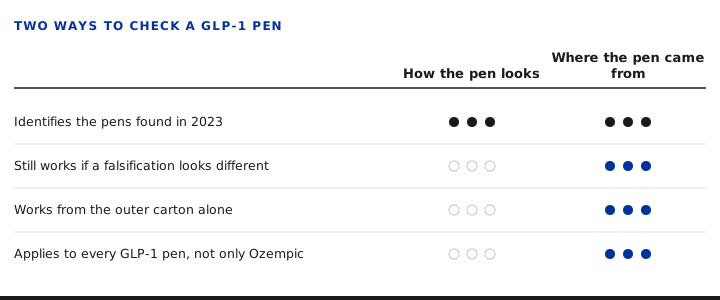
What each check can and cannot do. Sources: BfArM Rapid Alert System entries on falsified Ozempic, 11 October 2023 to 15 February 2024; BASG safety information of 19 October 2023 with updates of 23 and 31 October 2023; WHO Medical Product Alert N°2/2024, 19 June 2024; EMA news of 18 October 2023 and EMA/HMA news of 3 September 2025; ANSM alert of 9 September 2025.
Why is the source the real check, and not the pen?
Because the regulators who published those tells also published their limits, in the same notices.
BASG states that falsifications in circulation do not necessarily carry only the visual features shown, and may look different.5 BfArM states that on the secondary packaging, the outer carton, the falsification was hard to distinguish from the original, or not distinguishable at all.4 A visual check can confirm a suspicion. It cannot clear a pen.
What does hold everywhere is the legal route. France’s ANSM puts it as plainly as any regulator has: GLP-1 receptor agonists are available only on prescription and can be dispensed only in a pharmacy, across the whole of Europe, and because they must be prescribed by a doctor they cannot be sold online, even by a pharmacy. If a site is selling them, that is illegal.1 Spain reaches the same place by a different road: under Real Decreto 870/2013 only non-prescription medicines may be sold at a distance, sales may be made only by listed public pharmacies with a responsible pharmacist and no intermediaries, and the register is published at distafarma.aemps.es.7
What has changed since 2023?
The supply-chain episode closed. On 15 February 2024 BfArM reported that no further falsified medicines had been found in the German legal supply chain, and withdrew its recommendation that pharmacies open and check every Ozempic pack before dispensing, because the securPharm system raises an immediate alarm if a known Data-Matrix code is scanned a second time.4
The risk moved online. On 3 September 2025 the EMA, with the Heads of Medicines Agencies, warned of a sharp rise in illegal medicines marketed as GLP-1 receptor agonists such as semaglutide, liraglutide and tirzepatide, sold through fraudulent websites and promoted on social media. These products are not authorised, may not contain the claimed active substance at all, and may contain harmful levels of other substances. Authorities identified hundreds of fake Facebook profiles, advertisements and e-commerce listings, many hosted outside the EU, some misusing official logos and false endorsements.9
The EMA publishes its own warning signs. A product is likely to be illegal if it is advertised as endorsed by a national authority or features the official logos of a national authority or the EMA; if it is sold through unofficial websites or social media platforms; if it is claimed to be superior to authorised treatments without scientific evidence; if it is not available through licensed pharmacies or healthcare providers; or if the website offering it does not carry the common EU logo or is not listed on a national register.9
On the logo point, ANSM is blunt: agencies such as ANSM and the EMA never put their logo on a product to certify, validate or sell it. A logo used that way is a sign of fraud.1 The EMA says the same of itself: EMA and national authorities do not endorse or promote specific products or brands, and any claim suggesting otherwise is false.9
How do you check a European online pharmacy?
Only for medicines that do not need a prescription, because those are the only ones that can be sold this way. For those, the common EU logo introduced by the Falsified Medicines Directive is the one check that works the same way in every member state. The logo is clickable, it appears on the websites of all online medicine retailers in the EU registered with their national regulator, and clicking it takes you to that country’s register. Check the retailer is listed there, and do not continue if it is not.10
One detail catches out more people than the logo itself. The national flag and the text are an integral part of the logo, and only the flags of EU member states, Norway, Iceland and Liechtenstein may be displayed. A logo showing the EU flag is not authentic.10 In the UK, which sits outside that scheme, the equivalent check is that all pharmacies including online ones must be registered with the General Pharmaceutical Council.6
What does the European reporting data show?
One peer-reviewed study has looked at it directly. An analysis of EudraVigilance, the EU pharmacovigilance database, published in Frontiers in Pharmacology in April 2026, found 234 of 47,819 semaglutide individual case safety reports between 2018 and 2025 involved suspected counterfeit product, which is 0.49% of reports. Of those counterfeit-related reports, 89.3% were classified as serious, against 66.7% of the rest, and 84.2% came from outside the European Economic Area. Hypoglycaemia was the most disproportionately reported reaction in the counterfeit group.11
Read it for what it is. A spontaneous-reporting database counts reports, not pens, and the share of reports is not the share of product in circulation. What the hypoglycaemia signal does is line up with what the German laboratory found in the pens themselves.411
What should you do with a pen you are not sure about?
Do not use it. The EMA’s advice is to check the patient information leaflet to see what a genuine pen should look like, and if your pen does not show the features of the original, to return it to your pharmacy immediately and follow your national agency’s advice.3
If you have already used something bought online, ANSM advises not using it again and taking advice from a pharmacist or doctor, because unwanted effects can appear at any time; for unexpected or severe effects, see a doctor or an emergency service.1 The WHO gives the same instruction in its alert: seek medical advice if you or someone you know has used an affected product.8
Then report it, to the agency for your country: the MHRA in the UK, where suspected side effects go through the Yellow Card scheme;6 BASG enforcement in Austria, with tips about medicines not obtained through a pharmacy going to the Bundeskriminalamt;5 BfArM together with the state supervisory authorities in Germany;4 AEMPS in Spain;7 ANSM in France, which also runs a reporting route for sale offers seen online;1 and AIFA with the Carabinieri NAS in Italy.12
Everything above is about a medicine, not a supplement. If you are dealing with the ordinary gut side effects of a genuine prescription, that is a different question, and our guide to taking fiber with a GLP-1 covers the timing and spacing that helps.
The pen you never have to inspect is the one that came from a pharmacy, against a prescription.
Footnotes
-
Agence nationale de sécurité du médicament et des produits de santé (ANSM). Alerte sur les risques associés à l’achat sur internet d’aGLP-1 contrefaits. Published 9 September 2025, updated 18 November 2025. https://ansm.sante.fr/actualites/alerte-sur-les-risques-associes-a-lachat-sur-internet-daglp-1-contrefaits. GLP-1 receptor agonists are available only on prescription and dispensable only in a pharmacy across Europe, and cannot be sold online even by a pharmacy; products sold online are often counterfeit and may lack the stated active substance or contain toxic substances at dangerous concentrations; agencies such as ANSM and the EMA never apply their logo to certify, validate or sell a health product; advice not to reuse a product bought online, to consult a pharmacist or doctor, and to seek medical or emergency care for unexpected or severe effects. ↩ ↩2 ↩3 ↩4 ↩5
-
Agenzia Italiana del Farmaco (AIFA). Warning about the rise in illegal medicines sold in the EU as GLP-1 receptor agonists, 4 September 2025. https://www.aifa.gov.it/en/-/allerta-aumento-farmaci-illegali-venduti-ue-agonisti-recettore-glp-1. Relay of the EMA/HMA statement; AIFA states that the structure of the national legal production and distribution chain makes counterfeit infiltration virtually impossible and that to date no case of counterfeit product infiltrating the Italian distribution system has been reported. ↩ ↩2
-
European Medicines Agency. EMA alerts EU patients and healthcare professionals to reports of falsified Ozempic pens. News, 18 October 2023. https://www.ema.europa.eu/en/news/ema-alerts-eu-patients-healthcare-professionals-reports-falsified-ozempic-pens. Pens falsely labelled as Ozempic 1 mg identified at wholesalers in the EU and UK, German labelling, originating from wholesalers in Austria and Germany; genuine batch numbers, 2D barcodes and serial numbers, detected because the serial numbers scanned as inactive in the EU-wide system; no evidence of dispensing to patients from legal pharmacies at that date; patient advice to check the leaflet, not use a suspected pen, and return it to the pharmacy. ↩ ↩2 ↩3 ↩4
-
Bundesinstitut für Arzneimittel und Medizinprodukte (BfArM). Fälschung des Arzneimittels Ozempic®. Rapid Alert System, entries of 6 October, 11 October, 7 November and 10 November 2023 and 15 February 2024. https://www.bfarm.de/DE/Arzneimittel/Arzneimittelinformationen/Rapid-Alert-System/Arzneimittelfaelschungen/Ozempic/_node.html. BfArM assumed coordination under §62(1) AMG on 11 October 2023; affected 1 mg packs (product code 04150153985573, pack size 3): serial 1946483405690, batch MP5E511, expiry 07/2025, and serial 1031002838555, batch NP5G866, expiry 12/2025; no semaglutide found, CVUA Karlsruhe identified insulin, relabelled insulin pens suspected; genuine pen shows clear solution in a window without a scale and the dose in mg, the falsifications show colour deviations and a dose selector protruding from the pen; falsification hard or impossible to identify from the secondary packaging; recommendation to check every pack withdrawn on 15 February 2024 on the basis of securPharm. ↩ ↩2 ↩3 ↩4 ↩5 ↩6 ↩7
-
Bundesamt für Sicherheit im Gesundheitswesen (BASG). Warnung vor gefälschtem Ozempic®, safety information of 19 October 2023 with updates of 23 and 31 October 2023. https://www.basg.gv.at/marktbeobachtung/amtliche-nachrichten/detail/update-zur-warnung-vor-gefaelschtem-arzneimittel-ozempicr-1. First report of a patient treated in hospital after using presumed falsified Ozempic, with hypoglycaemia and a seizure as the reported reaction, updated on 23 October to several patients; per the Bundeskriminalamt, the affected batch was obtained from a doctor based in Austria and the pens are likely to have come from a source other than a pharmacy; no indication that falsified product was dispensed by legal pharmacies; four identification differences (darker blue, completely transparent window versus grey surround on the original, extendable dose-setting ring, 31G needle versus 32G on the original); explicit statement that falsifications in circulation need not carry only these features; reporting routes enforcement@basg.gv.at and Bundeskriminalamt@bmi.gv.at. ↩ ↩2 ↩3 ↩4 ↩5
-
Medicines and Healthcare products Regulatory Agency and Department of Health and Social Care. MHRA warns of unsafe fake weight loss pens. Press release, 26 October 2023. https://www.gov.uk/government/news/mhra-warns-of-unsafe-fake-weight-loss-pens. 369 potentially fake Ozempic pens seized since January 2023, none before; reports of fake Saxenda pens obtained through non-legitimate routes; a very small number of people hospitalised, with hypoglycaemic shock and coma indicating the pens may contain insulin rather than semaglutide; semaglutide and liraglutide are prescription-only medicines; all pharmacies in Great Britain including online ones must be registered with the General Pharmaceutical Council; suspected adverse effects reportable via the Yellow Card scheme. ↩ ↩2 ↩3 ↩4
-
Agencia Española de Medicamentos y Productos Sanitarios (AEMPS). Información sobre la venta de medicamentos a través de sitios web y aplicaciones para móviles, ICM (MI) 13/2019, 7 August 2019, https://www.aemps.gob.es/informa/medIlegales/informacion-sobre-la-venta-de-medicamentos-a-traves-de-sitios-web-y-aplicaciones-para-moviles/ ; and Notificación de sospechas de medicamentos falsificados, https://www.aemps.gob.es/industria-farmaceutica/dispositivos-de-seguridad-de-medicamentos-de-uso-humano/notificacion-de-sospechas-de-medicamentos-falsificados/. Under Real Decreto 870/2013 only non-prescription medicines may be sold at a distance, sale of prescription medicines by telematic means is prohibited, sales may be made only by legally authorised public pharmacies listed by the competent authority, directly and without intermediaries, with the register at https://distafarma.aemps.es; Real Decreto 717/2019 sets the notification duties for laboratories, distributors and pharmacies, with SEVeM as the national verification repository; AEMPS states that falsified medicines have never been detected within the Spanish legal medicines channel. ↩ ↩2 ↩3
-
World Health Organization. Medical Product Alert N°2/2024: Falsified OZEMPIC (semaglutide), 19 June 2024. https://www.who.int/news/item/19-06-2024-medical-product-alert-n-2-2024—falsified-ozempic-(semaglutide). Three falsified batches detected in Brazil (October 2023), the United Kingdom (October 2023) and the United States (December 2023), supplied in the regulated supply chain; ways to identify falsified products: check the lot and serial number, a scale extending out from the pen when setting the dose, poor label quality that may not adhere well to the pen, spelling mistakes on the front of the carton; advice to seek immediate medical advice after use and to obtain all medical products from authorised suppliers. ↩ ↩2 ↩3
-
European Medicines Agency and Heads of Medicines Agencies. Warning about sharp rise in illegal medicines sold in the EU. News, 3 September 2025. https://www.ema.europa.eu/en/news/warning-about-sharp-rise-illegal-medicines-sold-eu. Sharp rise in illegal medicines marketed as GLP-1 receptor agonists (semaglutide, liraglutide, tirzepatide), sold via fraudulent websites and social media; may not contain the claimed active substance and may contain harmful levels of other substances; hundreds of fake Facebook profiles, advertisements and e-commerce listings identified, many hosted outside the EU, some misusing official logos and false endorsements; the published list of warning signs that a medicine may be illegal; EMA and national authorities do not endorse specific products. ↩ ↩2 ↩3
-
European Medicines Agency. Buying medicines online. https://www.ema.europa.eu/en/human-regulatory-overview/public-health-threats/falsified-medicines-overview/buying-medicines-online. The common logo introduced by Directive 2011/62/EU appears on the websites of all online medicine retailers in the EU registered with their national regulatory authority; the logo is clickable and leads to the national register, where the retailer must be listed, and the purchase should not continue if it is not; the national flag and text are an integral part of the logo, only the flags of EU member states, Norway, Iceland and Liechtenstein may be displayed, and a logo displaying the EU flag is not authentic. ↩ ↩2
-
Zinzi A, Gaio M, Ruggiero R, Mascolo A, Riemma MA, Cipriani M, Laino LV, Berrino L, Rossi F, Capuano A. Unmasking counterfeit semaglutide: analysis of real-world safety data from EudraVigilance. Frontiers in Pharmacology, 29 April 2026. DOI 10.3389/fphar.2026.1805842. https://www.frontiersin.org/journals/pharmacology/articles/10.3389/fphar.2026.1805842/full. 234 of 47,819 semaglutide individual case safety reports (0.49%) between 1 January 2018 and 31 December 2025 involved suspected counterfeit product; 89.3% of counterfeit-related reports serious versus 66.7% of the rest; 84.2% reported from outside the European Economic Area; reporting odds ratio for hypoglycaemia 10.27 (95% CI 6.38 to 15.87). ↩ ↩2
-
Agenzia Italiana del Farmaco (AIFA). Medicinali online: in aumento le segnalazioni di prodotti contraffatti acquistati da canali non autorizzati, 12 April 2021. https://www.aifa.gov.it/en/-/medicinali-online-in-aumento-le-segnalazioni-di-prodotti-contraffatti-acquistati-da-canali-non-autorizzati-1. Suspected counterfeit medicines in Italy are to be reported to AIFA and to the Carabinieri of the Health Protection Command (NAS); legally operating distance sellers of non-prescription medicines are identified by the common logo and the Ministry of Health list. ↩