
Yes, you can take fiber with orforglipron, and the timing is refreshingly simple. Orforglipron (brand name Foundayo) is taken once a day at any time, with or without food or water, so it puts no fasting window around your fiber the way the oral Wegovy pill does. The reason to bother pairing the two is constipation, which is a very common side effect of the drug.
If you take a GLP-1 medication and want the general picture first, our complete guide to fiber on a GLP-1 covers the mechanism and the practical protocol, and our guide to taking fiber with a GLP-1 covers the shared timing rules. This piece is about the specific case of orforglipron.
Can you take fiber with orforglipron, and when?
Any time you like. Orforglipron’s UK product information is explicit that it is taken once daily at any time of day, without food or water restriction.1 That is the practical headline, because it is the opposite of the other oral option.
The oral Wegovy pill is semaglutide, a peptide that breaks down in the gut unless it is taken on an empty stomach with a small sip of water, followed by a 30-minute wait before anything else. That rule dictates when fiber can go. Orforglipron is a small molecule, stable in the gut, so it carries no such window. You can take your fiber with breakfast, in the evening, or split across the day, whichever you will actually keep up.
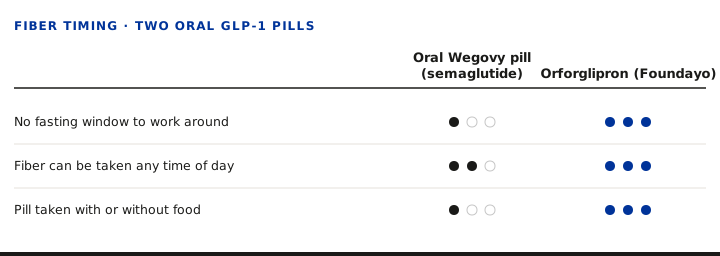
How the two oral GLP-1 pills differ for fiber timing. This compares timing logistics only, not efficacy or which drug to choose, which is a decision for the prescriber. Constipation is very common on both, so fiber is worth pairing either way. Source: emc SmPC for Foundayo (orforglipron); oral semaglutide product information.
| For fiber timing | Oral Wegovy pill (semaglutide) | Orforglipron (Foundayo) |
|---|---|---|
| Fasting window before eating | 30 minutes, empty stomach | None |
| When fiber can be taken | After the window, or evening | Any time of day |
| Pill taken with food/water | No (empty stomach, small sip) | With or without either |
There is one habit worth keeping, and it applies to any tablet, not just this one. Viscous, gel-forming fiber like psyllium can slow how a medicine swallowed at the same moment is absorbed, so leaving about half an hour to an hour between a large fiber dose and your other tablets is sensible. Orforglipron itself also slows gastric emptying and can affect how quickly other oral medicines are absorbed.1 Spacing is a reasonable default in both directions, a matter of prudence rather than a specific fiber interaction.
Why does orforglipron cause constipation?
Constipation is listed as a very common side effect of orforglipron, meaning it affects at least 1 in 10 people, alongside nausea and diarrhoea.1 The product information notes that gastrointestinal effects are strongest during the dose-increase phase and settle over time.1 Orforglipron is stepped up slowly for this reason, from a 0.8 mg starting dose through several increases over months.1
The mechanism is the one shared across this drug class: GLP-1 receptor agonists slow how fast the stomach empties, which is part of how they reduce appetite, and slower transit through the gut tends to mean firmer, less frequent stools. Orforglipron’s own label records that it delays gastric emptying.1 Fiber addresses the downstream problem directly rather than the drug.
Does fiber help with orforglipron constipation?
For constipation specifically, the fiber to reach for is a bulk-forming one such as psyllium. An updated systematic review of fiber for chronic constipation in adults found the benefit was most reliable at doses above 10 grams a day and over treatment periods of at least four weeks, with psyllium specifically effective.2 Psyllium works by trapping water and forming a gel that adds bulk and softens stool, and because it is only slowly fermented it produces very little gas, unlike rapidly fermented fibers such as inulin.3
That last point matters on a GLP-1, where the gut is already sensitive during dose increases. A fiber that adds bulk without adding a lot of gas is the gentler choice while your body is adjusting. For the fuller comparison of the two most common options, see inulin versus psyllium.
How much fiber, and how should you start?
Use the amounts that help constipation generally, and introduce them slowly. For psyllium husk, the EU herbal-medicine monograph sets the adult range at 7 to 11 grams a day for regularity, split into one to three servings and taken with plenty of water.4 Our guide to psyllium husk dosage covers the water rule and timing in full.
Starting low and building over a week or two matters more here than usual, because the drug is itself being titrated up and the gut is adjusting to both changes at once. Begin with a single small serving, keep the water generous, and give any change a few days rather than stacking extra doses when nothing has happened by the evening. If constipation is severe, does not improve, or comes with abdominal pain or vomiting, that is a reason to speak to the prescriber rather than to add more fiber, since the same product information flags severe constipation and bowel obstruction as effects to take seriously.1
Orforglipron is a prescription medicine, and where oral GLP-1 pills can actually be obtained across Europe keeps shifting, so we keep that picture in one place: our oral GLP-1 pills in Europe tracker. Whichever oral GLP-1 you end up on, the fiber question is the same one: a gentle, bulk-forming fiber, introduced slowly and taken with enough water, is the part you control.
Footnotes
-
Electronic Medicines Compendium (emc), Foundayo (orforglipron) film-coated tablets — Summary of Product Characteristics, Eli Lilly, medicines.org.uk product 102527. §4.2 method of administration: “taken once-daily at any time of day, without food or water restriction”; titration 0.8 mg → 2.5 → 5.5 → up to 17.2 mg at ≥30-day steps. §4.8: constipation, nausea and diarrhoea “Very common” (≥1/10); GI effects higher during dose escalation and decrease over time; severe constipation and bowel obstruction listed. §4.5: “Orforglipron delays gastric emptying and has the potential to affect the rate of absorption of other orally administered medicinal products.” ↩ ↩2 ↩3 ↩4 ↩5 ↩6 ↩7
-
van der Schoot A, Drysdale C, Whelan K, Dimidi E. The effect of fiber supplementation on chronic constipation in adults: an updated systematic review and meta-analysis of randomized controlled trials. The American Journal of Clinical Nutrition, 2022. 16 RCTs, 1,251 adults; benefit most reliable at doses above 10 g/day and over at least 4 weeks; psyllium specifically effective. ↩
-
Gunn D, Abbas Z, Harris HC, et al. Psyllium reduces inulin-induced colonic gas production in IBS: MRI and in vitro fermentation studies. Gut, 2022;71(5):919–927. Randomised crossover, 19 IBS patients; psyllium produced little colonic gas while inulin produced the greatest rise. ↩
-
European Medicines Agency, Committee on Herbal Medicinal Products (HMPC). Community herbal monograph on Plantago ovata Forssk., seminis tegumentum (ispaghula husk). EMA/HMPC/199774/2012, final, 14 May 2013. Adult dose 7–11 g/day for constipation and regularity, in 1–3 single doses, with sufficient liquid (at least 30 ml per gram). ↩