PHGG is made from the guar bean in three steps. The seed is split and the inner endosperm, about a third of the seed, is milled into guar gum. An enzyme then cuts the gum’s long chains to under a tenth of their length. The liquid is sterilized and spray-dried into a white powder that dissolves clear in water.
Our comparison of fiber supplement types shows where PHGG sits among the other fibers, and our PHGG monograph covers what the human trials found.
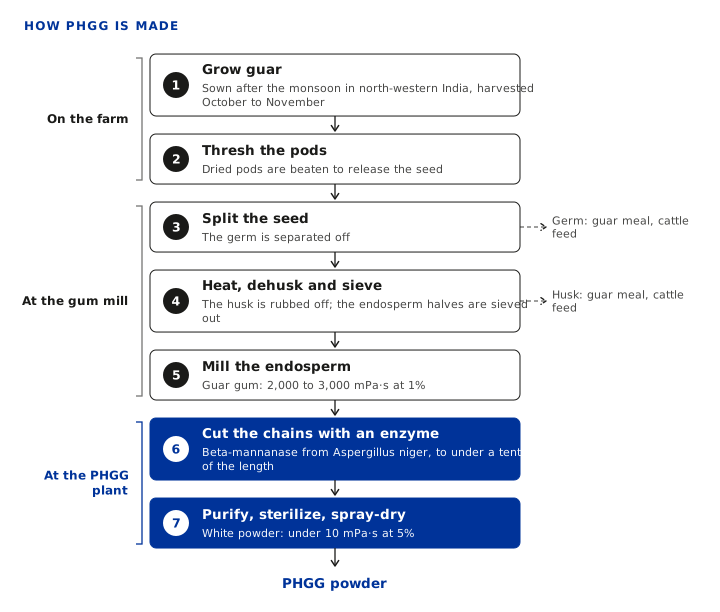
From bean to powder in seven steps. Steps 1 to 5 make ordinary guar gum; steps 6 and 7 turn it into PHGG and cut its thickness from thousands of mPa·s to under 10. Sources: APEDA Guar Gum product profile (2024); FAO/JECFA Chemical and Technical Assessment of guar gum (2008); Yoon, Chu and Juneja 2008; Yasukawa et al. 2019.
| Step | Where | What happens | Side output |
|---|---|---|---|
| 1. Grow | Farm | Sown after the monsoon in north-western India, harvested October to November | |
| 2. Thresh | Farm | Dried pods beaten to release the seed | |
| 3. Split | Gum mill | Seed split, germ separated | Germ, sold as guar meal for cattle |
| 4. Heat, dehusk, sieve | Gum mill | Husk removed, endosperm halves sieved out | Husk, sold as guar meal for cattle |
| 5. Mill | Gum mill | Endosperm ground into guar gum (2,000 to 3,000 mPa·s at 1%) | |
| 6. Enzyme | PHGG plant | Beta-mannanase from Aspergillus niger cuts chains to under a tenth of their length | |
| 7. Purify and dry | PHGG plant | Purified, sterilized, spray-dried (under 10 mPa·s at 5%) |
Where does guar grow?
Guar, Cyamopsis tetragonoloba, is a bean plant native to the Indian subcontinent. India grows about 80 percent of the world’s crop, and Rajasthan, the desert state in the north-west, grows over 70 percent of India’s share.12
It grows on light, sandy soil with 300 to 500 mm of rain a year.1 When water runs short, it stops growing but does not die.2 Like other legumes, it carries bacteria in its root nodules that pull nitrogen from the air, about 30 to 40 kg per hectare, so it does well in poor soil.1
Farmers sow it after the monsoon arrives, in the second half of July, and harvest it in late October and November, 14 to 16 weeks later.2 It needs three or four spells of rain while the seeds set in September. Too much rain makes the plant leafy and cuts the number of pods.
The pods grow in clusters, which gives guar its other name, cluster bean. In India the young pods have been cooked as a vegetable for centuries, and the plant has long been grown as cattle feed and to enrich the soil.2
Because almost all of it depends on the monsoon, the size of the harvest swings hard. In the 2002–03 drought India produced 0.2 million tonnes of guar seed. In 2013–14 the estimate was 2.7 million tonnes.1
How is guar gum taken out of the seed?
The gum sits in one part of the seed. After harvest the dried pods are beaten to release the seeds.2 Each seed has three layers: a husk on the outside (about 14 to 17 percent of its weight), the germ (43 to 47 percent) and, between them, the endosperm (35 to 42 percent).1 The endosperm is the plant’s store of food and water for the sprouting seed, and it is the only part that becomes guar gum. The figures vary a little between sources; FAO puts the endosperm at 34 to 40 percent.3
The mill process has four steps, as described in the assessment prepared for the UN’s expert committee on food additives:3
- Splitting. The seed is cracked in two and the germ is separated off.
- Dehusking. The two endosperm halves, called guar splits, are heat-treated. This loosens the husk, which is then rubbed or knocked off in mills.
- Sieving. The endosperm pieces are coarser than the germ and husk fragments, so sieves separate them.
- Milling. The clean splits are ground into a fine, off-white powder. That powder is guar gum.
The germ and husk become guar meal, a protein-rich cattle feed with up to 55 percent protein.2 Jodhpur, in Rajasthan, is the centre of this trade and supplies about 40 percent of the world’s guar gum.2
Guar gum is one of the thickest fibers in the food supply. A 1 percent solution measures 2,000 to 3,000 mPa·s.4 Water is about 1. Food makers use guar gum for that thickness. It also makes guar gum hard to add to a drink or a tube feed at a useful dose, and PHGG was developed to get around that.
How does guar gum become PHGG?
An enzyme cuts it into shorter pieces. Guar gum is a long chain of mannose sugars with galactose sugars hanging off it, about two mannose for each galactose.3 Its molecules are very large, from 50,000 to 8 million daltons.3 The long chains tangle in water, and that tangling is what makes it thick.
To make PHGG, the gum is mixed with water and treated with an enzyme called beta-endo-mannanase. The enzyme cuts the mannose backbone at points along the chain and leaves the galactose side groups in place.4 For Sunfiber, the best-known PHGG, the enzyme comes from a strain of the mould Aspergillus niger.5
The process is controlled to stop at a set chain length. After the enzyme step, the liquid is separated and purified, sterilized, and spray-dried: it is sprayed as a fine mist into hot air, and the water evaporates and leaves a powder.4
The published figures for the finished powder come from Taiyo Kagaku, the Japanese company that makes Sunfiber.4
- Average molecular weight about 20,000 daltons, under a tenth of the original length
- Viscosity under 10 mPa·s, even at 5 percent
- A white powder that dissolves colourless and almost tasteless
- Stable through heat, acid, salt and pressure, and not broken down by digestive enzymes
Taiyo makes it at its own plant in Aurangabad, India. It sells regular and agglomerated grades above 85 percent soluble fiber, and a standard grade above 80 percent for bars and cereals.6 The agglomerated grade is made of clumped particles that dissolve faster.
Taiyo describes the enzyme step as a “predigestion step”: it argues that the enzyme breaks the gum down the way gut bacteria would.4 That is the manufacturer’s view. The chemistry supports part of it, since the sugars and their links are the same, only shorter.
The EU’s specification for guar gum as a food additive allows other ways to thin it: heat, mild acid or alkaline oxidation.7 PHGG sold as a fiber supplement is made with enzymes.
How did guar gum become a food ingredient?
Through a shortage after the Second World War. Paper and textile mills relied on locust bean gum, another seed gum, and after the war it ran short. Guar gum proved the most suitable substitute.2
Guar gum was first used in US food products in 1949, and commercial extraction began in the United States in 1953.42 India commercialized the same extraction technology about a decade later.2
PHGG came later, from Japan. Taiyo’s own review dates its use as a food fiber in Japan to 1987.4 In the United States, the expert body FASEB reviewed PHGG for consumer foods in 1993. In 1995, Sandoz Nutrition filed a petition asking the FDA to affirm PHGG as safe for use in food.84
What happened to guar during the fracking boom?
Because the oil and gas industry started buying it. Fracking, or hydraulic fracturing of shale rock, uses guar gum to thicken the fluid pumped into the well. Until about 2011, guar gum was used almost entirely by the food industry.1
When US shale drilling expanded, demand jumped. US imports of Indian guar gum rose to nearly $1 billion in 2011 and $3.4 billion in 2012, then fell to $1.6 billion in 2013.1 A minor crop became, in two years, India’s largest agricultural export to the United States.1
US firms bought stock ahead of expected shortages, and traders followed. The price of guar seed rose from 2,334 rupees per quintal in January 2011 to a peak of 30,812, about thirteen times higher.9 In March 2012 India’s commodity regulator suspended guar futures trading.9 The high prices drew guar into new regions of India, and by 2013–14 prices had dropped, as US firms drew on the stock they had built up.1
Why was a guar gum diet pill taken off the market?
Because the gum swelled and blocked people’s throats and intestines. Cal-Ban 3000 was a guar gum diet pill sold in the United States. A review of 26 reports filed with the FDA found 18 cases of the oesophagus being blocked and 7 of the small intestine being blocked. One person died, though the report lacked the detail to judge the cause.10 Guar gum can swell to 10 to 20 times its size in water. Half the people with a blocked oesophagus already had a problem there, such as a narrowing or a hiatal hernia.10 Cal-Ban 3000 was removed from the US market, and similar products were banned in Australia.10 A US federal court ordered the remaining stock destroyed in 1991.11
This is why the one authorized EU health claim for guar gum, for blood cholesterol at 10 grams a day, comes with a choking warning for people with swallowing difficulties.12 PHGG’s chains are too short to form that kind of gel. Any fiber powder should still be taken with a full glass of liquid.
Where is PHGG used today?
In tube feeds, clear drinks and supplement powders. Tube feeding came first. Guar gum added to a tube-feed formula at a useful dose makes it too thick, and Taiyo’s review names tube feeds as the main use for PHGG’s low viscosity.4
That use has been studied. A 2022 meta-analysis of fiber in tube-fed hospital patients included two small trials of PHGG, 55 people in total. Diarrhoea was less common in the PHGG groups, with a pooled risk ratio of 0.47.13 The trials were published in 1994 and 2001, and no larger trial has been added since.
In Europe, OptiFibre from Nestlé Health Science is 100 percent PHGG and sold as a food for special medical purposes.14 Other brands sell it as an ordinary food supplement. In the United States, guar gum is on the FDA’s list of fibers that count as dietary fiber on a label, and Taiyo says the FDA confirmed in 2016 that Sunfiber falls under that entry.6
The EU has authorized no health claim for PHGG. Thirteen applications are listed in its register, and none was approved.12 Our PHGG monograph and our Sunfiber explainer cover what that means and what the trials found.
Every jar of PHGG starts as a bean sown in late July in the sand of Rajasthan, and its supply still depends on that year’s monsoon.
Sources
Footnotes
-
USDA Foreign Agricultural Service, GAIN Report IN4035, “An Analysis of Guar Crop in India,” New Delhi, 6 May 2014. Production share, agronomy, seed composition, nitrogen fixation, production range 2002–03 and 2013–14, export values 2011–2013, and the shale-gas demand shift. ↩ ↩2 ↩3 ↩4 ↩5 ↩6 ↩7 ↩8 ↩9
-
APEDA (Agricultural and Processed Food Products Export Development Authority, Government of India), Guar Gum product profile, 2024. Rajasthan share, sowing and harvest calendar, cluster-bean name and vegetable use, guar meal, Jodhpur’s share of world supply, and the post-war locust bean gum shortage and 1953 commercialization. ↩ ↩2 ↩3 ↩4 ↩5 ↩6 ↩7 ↩8 ↩9 ↩10
-
Kawamura Y, Guar Gum Chemical and Technical Assessment, prepared for the 69th meeting of the Joint FAO/WHO Expert Committee on Food Additives (JECFA), 2008. Seed composition, the splitting, thermal dehusking, sieving and milling sequence, molecular weight range and mannose to galactose ratio. ↩ ↩2 ↩3 ↩4
-
Yoon S-J, Chu D-C, Juneja LR. “Chemical and Physical Properties, Safety and Application of Partially Hydrolized Guar Gum as Dietary Fiber.” Journal of Clinical Biochemistry and Nutrition 2008;42:1-7. PMID 18231623. All three authors were at Taiyo Kagaku, the manufacturer of Sunfiber. Enzymatic hydrolysis, sterilization and spray drying; product specification; first US food use in 1949; use in Japan since 1987; FASEB review in 1993; enteral feeding rationale. ↩ ↩2 ↩3 ↩4 ↩5 ↩6 ↩7 ↩8 ↩9
-
Yasukawa Z, Inoue R, Ozeki M, et al. Nutrients 2019;11(9):2170. PMID 31509971. Section 2.3 describes Sunfiber as made “by treatment of guar gum with a β-endogalactomannase from a strain of Aspergillus niger.” ↩
-
Taiyo GmbH and Taiyo International, Sunfiber brand and product pages, retrieved 5 October 2026. Manufacturer statements, quoted as such, including the plant location, the product grades and the 2016 FDA letter, which has not been published. ↩ ↩2
-
Commission Regulation (EU) No 231/2012, specifications for food additives, entry E 412 Guar Gum. ↩
-
Federal Register Vol. 60, No. 134, 13 July 1995, p. 36151, Docket 95G-0156: “Sandoz Nutrition Corp.; Filing of Petition for Affirmation of GRAS Status” (GRASP 5G0414) for partially hydrolyzed guar gum. ↩
-
Lok Sabha (Parliament of India) written reply on guar seed prices, 2012; Business Standard, 23 March 2012, on the Forward Markets Commission’s suspension of guar futures. ↩ ↩2
-
Lewis JH. “Esophageal and small bowel obstruction from guar gum-containing ‘diet pills’: analysis of 26 cases reported to the Food and Drug Administration.” American Journal of Gastroenterology 1992;87(10):1424-8. PMID 1329494. ↩ ↩2 ↩3
-
United States v. Undetermined Quantities of Cal-Ban 3000, 776 F. Supp. 249 (E.D.N.C. 1991). ↩
-
Commission Regulation (EU) No 432/2012, Annex entry for guar gum; EU Register of nutrition and health claims, PHGG entries, retrieved 23 September 2026. ↩ ↩2
-
Kaewdech A, et al. “Effect of fiber supplementation on the prevention of diarrhea in hospitalized patients receiving enteral nutrition: a meta-analysis of randomized controlled trials.” Frontiers in Nutrition 2022. doi:10.3389/fnut.2022.1008464. PHGG subgroup: Homann 1994 and Spapen 2001. ↩
-
Nestlé Health Science, OptiFibre product information. Food for special medical purposes under Commission Delegated Regulation (EU) 2016/128. ↩