
Yes. The oral GLP-1 pills now reaching Europe act on the same receptor as the weekly injections, so they carry the same gastrointestinal side effects, and constipation is the one that fiber is built to address. The delivery form changes from a needle to a tablet. What happens in the gut is the same.
This is no longer a forecast. Between 14 July and 10 August 2026, two oral GLP-1 medicines cleared European regulators within about a month of each other. The convenience is the story everyone is telling. The side effect that comes with it is the one we cover here, and it connects directly to our complete guide to fiber and GLP-1 medications.
What changed in Europe this summer?
Two separate approvals, two different molecules, two different regulators.
The oral Wegovy pill. On 14 July 2026, the European Commission granted EU marketing authorization for oral semaglutide 25 mg, the tablet form of Wegovy, making it the first oral GLP-1 authorized for weight management in the European Union.1 Novo Nordisk has said it plans to launch in the first European markets in the second half of 2026. We covered the practical timing problem this pill creates in our piece on the oral Wegovy fasting rule.
Orforglipron. On 10 August 2026, the UK’s Medicines and Healthcare products Regulatory Agency authorized orforglipron, sold as Foundayo, for weight management and type 2 diabetes. The UK is the first country in Europe to authorize it.2 Unlike oral semaglutide, it is a once-daily tablet that can be taken at any time of day, with no food or water restriction.
Authorization is not the same as a prescription in hand. In the UK, orforglipron is not yet available on the NHS, and the National Institute for Health and Care Excellence is due to publish its guidance on 18 November 2026.2 The oral Wegovy pill still needs national pricing and reimbursement decisions in each EU country before it reaches public coverage. The pills are cleared. The access is arriving in stages.
Do the pills cause the same constipation as the injections?
They do, because they work the same way. A GLP-1 receptor agonist mimics the GLP-1 hormone whether it enters through a subcutaneous injection or across the stomach lining. It slows gastric emptying and suppresses appetite by the same mechanism, and that mechanism is what produces the digestive side effects.3
In the registration trials, constipation was reported in roughly 5 percent of users on diabetes-indication doses and 16 to 24 percent on weight-management doses, with higher doses associated with higher rates.3
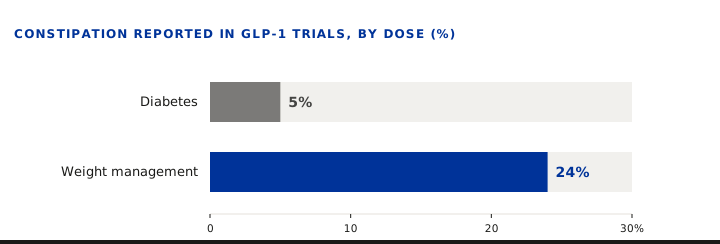
Constipation reported in GLP-1 registration trials runs from about 5% at diabetes-indication doses to up to 24% at weight-management doses, the doses the new oral pills are authorized for. Source: STEP and SURMOUNT registration trials, 2023.
| Dose class | Constipation reported |
|---|---|
| Diabetes-indication doses | ~5% |
| Weight-management doses | 16–24% |
A 2026 University of Pennsylvania study published in Nature Health read the other side of that number. It analyzed 410,198 Reddit posts from 67,008 self-reported GLP-1 users. Of the users who posted about a side effect, 15.3 percent mentioned constipation, ranking it fourth after nausea, fatigue, and vomiting.4 For the full picture from that dataset, see our breakdown of what 410,000 Reddit posts reveal.
Three things happen at once. You eat less, so you take in less fiber from food. Slowed transit means the colon reabsorbs more water from stool, leaving it harder and drier. And blunted thirst signals mean you drink less at the same time.3 Less fiber, less water, slower gut. The result is predictable, and none of it depends on how the drug got into you.
Why does an easier pill mean more constipation?
A weekly injection asks a person to handle a needle. A daily tablet does not. Removing that barrier is the entire commercial case for the oral formulations, and it widens the top of the funnel: more people start a GLP-1, and a larger group meets the gastrointestinal side effects that come with the mechanism.
The average European diet already supplies only 16 to 24 grams of fiber a day against a recommended 25 to 30 grams. Eating less on a GLP-1 widens that gap further. We wrote about the baseline in the European fiber gap. The pills do not create the fiber problem. They hand it to more people, faster.
When can you take fiber with each pill?
This is where the two new pills split, and it matters more than it sounds.
Oral semaglutide holds a strict window. The tablet must be swallowed on a completely empty stomach with no more than 120 ml of plain water, followed by at least 30 minutes with no food, no supplements, and no other medicines.1 Fiber cannot go into that window. Take it at least 60 to 90 minutes after the morning dose, or move it to lunch or dinner entirely. The full sequence is in our oral Wegovy fasting rule guide.
Orforglipron holds no window. With no food or water restriction, there is no fasting conflict to plan around, so fiber timing is genuinely free.2 That is a real convenience, and it is easy to read it as one less thing to manage. The constipation still needs managing.
For every GLP-1, injected or oral, the one interaction worth respecting is not with the drug itself but with your other tablets: viscous fiber can slow how well a pill swallowed at the same moment is absorbed. Keep fiber at least 30 to 60 minutes clear of other oral medicines. We cover the spacing rules in can you take fiber with a GLP-1.
Which fiber helps, and how do you start?
No single fiber is universally best. The choice depends on what you are treating and what your gut tolerates.
Psyllium adds mechanical bulk and softens stool, and it is recommended first-line for constipation by the American Gastroenterological Association. Chicory inulin at 12 grams a day carries the EU’s only authorized health claim for bowel function, that it contributes to normal bowel function by increasing stool frequency, under Commission Regulation (EU) 2015/2314.5 It is rapidly fermented, so it can cause temporary bloating in an already-slowed gut, which is worth knowing before you start. PHGG is gentler and better tolerated by FODMAP-sensitive people, with no EU bowel claim.
The starting protocol is the same whichever you pick. Begin at 3 to 5 grams a day, increase by about 3 to 5 grams a week, and always take fiber with at least 250 ml of water. For the constipation case specifically, our guide to the best fiber for constipation walks through the options in detail.
What fiber does not do
Fiber does not treat the medication, and it is not a weight-loss agent. It does nothing for the nausea, the fatigue, or the appetite change that also come with a GLP-1. Its job is narrow and real: for the constipation the mechanism produces, fiber and water are the first, most direct lever, and chicory inulin is the one fiber the EU allows to say so.5
It also is not a substitute for a prescriber’s advice. If constipation is severe, painful, or comes with vomiting, that is a conversation for the clinic, not a supplement question.
The pill era does not change the biology of any of this. It changes how many people will need to know it. Two tablets, the same slowed gut, and a fiber routine that fits around whichever one you take.
Frequently asked questions
Do GLP-1 pills cause constipation? Yes. The oral GLP-1 pills now reaching Europe act on the same receptor as the weekly injections, so they carry the same gastrointestinal side effects. In clinical trials, constipation is reported in about 5 percent of users on diabetes-indication doses and up to 16 to 24 percent on weight-management doses. The delivery form changes from an injection to a tablet, but the effect in the gut does not.
Is the oral GLP-1 pill available in Europe now? Access is gated. The European Commission authorized the oral Wegovy pill (oral semaglutide 25 mg) on 14 July 2026, and the UK’s MHRA authorized orforglipron (Foundayo) on 10 August 2026, but authorization is not the same as availability. Novo Nordisk plans first European launches in the second half of 2026, and in the UK orforglipron is not yet on the NHS, with NICE guidance due on 18 November 2026.
When should you take fiber if you are on an oral GLP-1? It depends on the pill. Oral semaglutide must be taken on an empty stomach followed by a 30-minute fast, so take fiber at least 60 to 90 minutes later, or with lunch or dinner. Orforglipron has no food or water restriction, so fiber timing is free, though the general rule of spacing viscous fiber at least 30 to 60 minutes from other oral tablets still applies.
Which fiber is best for GLP-1 constipation? Psyllium adds mechanical bulk and is recommended first-line for constipation by the American Gastroenterological Association. Chicory inulin at 12 grams a day carries the EU’s only authorized health claim for bowel function. PHGG is a gentle option for sensitive systems. Start at 3 to 5 grams a day, increase by about 3 to 5 grams a week, and always take fiber with water.
Is orforglipron the same as the Wegovy pill? No. Orforglipron (Foundayo, from Eli Lilly) and oral semaglutide (the Wegovy pill, from Novo Nordisk) are different molecules with different rules. Both are once-daily oral GLP-1 tablets, but oral semaglutide requires an empty-stomach 30-minute fast while orforglipron has no food or water restriction.
Footnotes
-
European Commission marketing authorization for oral semaglutide 25 mg (Wegovy pill) for weight management, granted 14 July 2026 (European Commission Decision C(2026) 5102, EU Union Register of medicinal products EU/1/21/1608), following the EMA CHMP positive opinion of 22 May 2026. Novo Nordisk press release, 15 July 2026. Oral semaglutide prescribing information: empty-stomach administration with no more than 120 ml plain water and a 30-minute fast. ↩ ↩2
-
MHRA authorization of orforglipron (Foundayo) for weight management and type 2 diabetes, 10 August 2026; the UK is the first country in Europe to authorize it. Once-daily oral tablet with no food or water restriction. Not currently available on the NHS. NICE guidance for orforglipron in overweight and obesity due 18 November 2026 (appraisal GID-TA11650). Sources: GOV.UK / MHRA press release; The Pharmaceutical Journal, “MHRA approves orforglipron weight-loss pill.” ↩ ↩2 ↩3
-
GLP-1 receptor agonist mechanism and gastrointestinal effects: prescribing information for semaglutide (Ozempic, Wegovy) and tirzepatide (Mounjaro, Zepbound). Constipation reported in 5 to 24 percent of users depending on dose, from the STEP and SURMOUNT registration trials. Mechanism of constipation: delayed gastric emptying with increased colonic water reabsorption, reduced food intake, and reduced fluid intake as compounding factors. ↩ ↩2 ↩3
-
Sehgal N. et al., “Self-reported side effects of semaglutide and tirzepatide in online communities.” Nature Health, 10 April 2026, University of Pennsylvania. Analysis of 410,198 Reddit posts from May 2019 through June 2025, identifying 67,008 self-reported GLP-1 users; 43.5 percent posted about at least one side effect; constipation ranked fourth at 15.3 percent. The 43.5 percent figure reflects self-report bias and is not a population prevalence estimate. ↩
-
Commission Regulation (EU) 2015/2314 of 7 December 2015. Authorized health claim for chicory inulin: “Chicory inulin contributes to normal bowel function by increasing stool frequency.” Condition of use: 12 g/day native chicory inulin. American Gastroenterological Association guidance recommends psyllium as a first-line fiber supplement for chronic constipation. ↩ ↩2