Yes, you can exercise on a GLP-1. In the S-LiTE trial, a year of liraglutide alone did not make people fitter. Exercise did, with or without the drug.12
Most of the practical problems come from eating and drinking less. Very little research has looked at long endurance training, such as marathons, on these drugs.
The EU labels for semaglutide (Ozempic, Wegovy) and tirzepatide (Mounjaro, Zepbound) give weight management as an add-on to “a reduced-calorie diet and increased physical activity”.34 For how fibre and the rest of your diet fit around treatment, see our complete guide to fiber and GLP-1 medications.
How much exercise is recommended on a GLP-1?
A 2026 expert consensus on nutrition and lifestyle care for people on GLP-1-based therapy recommends at least 150 minutes a week of moderate to vigorous aerobic activity, plus strength training. The obesity guidelines it cites ask for 150 to 300 minutes of moderate activity a week and strength training two to three times a week.5
If that is too much for now, the panel suggests building up in steps with your clinician, starting from 4,000 to 6,000 steps a day.5
The panel based its statements mainly on indirect evidence, some of it from weight-loss surgery care. Nestlé Health Science sponsored the project. The authors say the sponsor did not vote on the statements.5
Does a GLP-1 drug make you fitter on its own?
In the S-LiTE trial, the drug alone did not improve fitness. Researchers at the University of Copenhagen put 195 adults with obesity on an 8-week low-calorie diet. They then randomised them for one year to exercise, liraglutide 3.0 mg, both, or placebo.1
A 2026 analysis of the fitness results found that liraglutide alone “did not improve physical fitness”. Compared with the drug alone, the drug plus exercise raised peak oxygen uptake by 3.0 mL per minute per kg of fat-free mass. It also cut the time on a stair-climb test by 1.2 seconds, or 8.6%. Exercise alone gave similar gains.2
The exercise programme was not demanding. Participants did a median of 2.65 sessions and 116 minutes a week, mostly indoor cycling intervals and circuit training. People on the drug kept to the programme as well as people on placebo.2
Strength. Strength relative to body weight fell by 7.8% in the placebo group. It changed by -0.4% with exercise, +1.0% with liraglutide and +3.3% with both. The authors explain this by lower body weight while absolute strength held steady.2
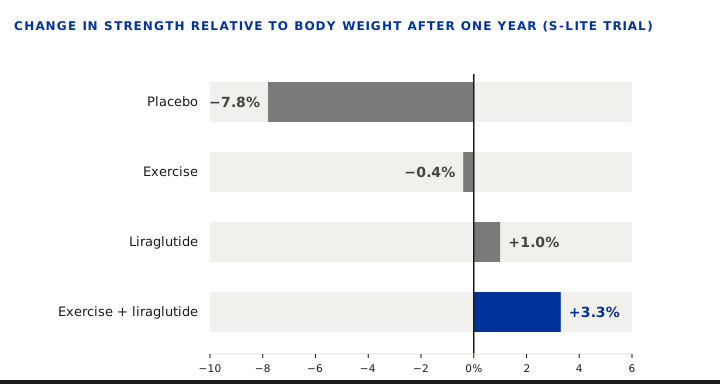
Change in knee-extensor strength divided by body weight, from randomisation to one year, in the four arms of the S-LiTE trial (193 adults with obesity, after an 8-week low-calorie diet). Source: S-LiTE fitness analysis, Sports Medicine, 2026.
| Trial arm | Change in relative strength after one year |
|---|---|
| Placebo | -7.8% |
| Exercise | -0.4% |
| Liraglutide 3.0 mg | +1.0% |
| Exercise + liraglutide 3.0 mg | +3.3% |
After stopping. One year after treatment ended, the people who had exercised had kept their body composition. People who had taken liraglutide alone had regained weight.6
A smaller 2019 trial in 24 people with type 2 diabetes also found that liraglutide 1.8 mg had no effect on peak oxygen uptake or a 6-minute walk test.7
Liraglutide is an older GLP-1 taken daily. No trial has reported fitness results like these for semaglutide or tirzepatide yet. The Novo Nordisk Foundation was among the funders of S-LiTE.1
Why can training feel harder on a GLP-1?
Heart rate. In the weight-management trials of both drugs, resting heart rate rose by about 3 beats per minute on average.89 In the semaglutide trials, 67.0% of people had a rise of 10 beats or more at some point, compared with 50.1% on placebo.8 Dr Melanie Jay of NYU Grossman School of Medicine told The Guardian that rises of 2 to 10 beats are possible at rest, with more during exercise. She added that few studies have looked at how tirzepatide affects heart rate during training.10
Nausea and tiredness. Both are most common in the first weeks and after each dose increase. Our posts on how long GLP-1 nausea lasts and GLP-1 fatigue cover what the labels say about how long they last.
Less food. The drug lowers your appetite, so you may start a session having eaten less than usual.
One runner in The Guardian’s October 2026 report ran a half marathon less than a week after her first 2.5 mg dose of tirzepatide. She felt sick the whole way and could not keep her energy gels down.10 The starting dose is 2.5 mg, taken for four weeks before the first increase.9 Nausea is most likely in the first weeks and after each increase, so avoid racing in those weeks if you can.
Can you run a marathon on a GLP-1?
Some people do. The experts The Guardian spoke to disagreed on whether it is wise, and the article concluded that “there is little research on using GLP-1s while long-distance running”.10
Heidi Skolnik, a fellow of the American College of Sports Medicine, said: “If you can eat enough to fuel your workouts and your runs and drink enough, then go for it.” If you cannot, she said, do not.10
Sports dietitian Claire Shorenstein said: “Typically, I would not want someone to be on a GLP-1 while actively training for a marathon or any other type of endurance event.”10
Her worry is low energy availability, which means eating too little for the amount of training you do. Over time this can lead to Relative Energy Deficiency in Sport (REDs). The International Olympic Committee describes REDs as a syndrome that harms both health and performance, in women and in men.11 The Guardian notes it can lower bone density and immunity, and in women can stop periods.10
No study has measured energy availability in runners taking GLP-1s. The concern comes from what the drugs do to appetite.
How do you fuel and hydrate when you are not hungry?
Eat and drink on a schedule around your sessions. Do not wait until you feel hungry or thirsty.
Fluids. Both EU labels warn that nausea, vomiting and diarrhoea can cause dehydration. They tell patients to “take precautions to avoid fluid depletion”.34 The tirzepatide label also mentions electrolyte problems and says this applies especially to older people.4 The expert consensus recommends more than 2 litres of fluid a day, with extra care during exercise and while the dose is being increased.5
Food. In a joint advisory, four US nutrition and obesity societies note that some people “get caught in a cycle of not eating due to nausea”. They suggest breakfast and then small meals every 3 to 4 hours.12 For training, that could mean a small snack before a session and food soon after.
Fibre before a run. In a survey of 388 runners who were not on GLP-1s, 23% avoided high-fibre foods before racing, to prevent stomach cramps and sudden urges to use the toilet.13 Eat most of your fibre at other times of the day. Constipation is common on GLP-1s, and our guide to GLP-1 constipation covers it.
Low blood sugar. Both labels say the risk of low blood sugar is higher mainly when a GLP-1 is taken with insulin or a sulfonylurea.34 If you take either, ask your prescriber how to manage longer sessions.
Should you change your dose around a race?
Ask your prescriber before changing anything. In The Guardian’s report, several runners split or cut doses after reading tips on Reddit. Dr Nidhi Kansal of Northwestern Medicine said splitting a weekly dose “is not how the drug was studied in any of the clinical trials”.10
Registered dietitian Kristy Baumann advised against taking a dose the day before a long run or race, because “you’d have a greater chance of GI issues”.10 This comes from her clinical work, and no trial has tested it. If a race falls in a week when your dose goes up, mention the race date at your next appointment.
Where does strength training fit?
Strength training helps you keep muscle while you lose weight. The same joint advisory recommends “preserving muscle and bone mass through resistance training and appropriate diet”.12 In S-LiTE, strength relative to body weight rose most in the group that did both exercise and the drug.2 Our post on fiber and muscle loss on GLP-1 covers protein and the wider evidence.
Aim for both kinds of exercise: aerobic sessions for fitness, and strength sessions two or three times a week.5
Frequently asked questions
Can you exercise on a GLP-1? Yes. The EU labels for semaglutide (Wegovy) and tirzepatide (Mounjaro) give weight management as an add-on to a reduced-calorie diet and increased physical activity. Expert guidance for people on these drugs is at least 150 minutes a week of moderate to vigorous aerobic activity plus strength training. If that is too much at first, the same guidance suggests starting from 4,000 to 6,000 steps a day.
Does a GLP-1 make you fitter? Not on its own. In the S-LiTE trial, liraglutide alone did not improve physical fitness over a year. Exercise did, alone or combined with the drug. The trial used liraglutide, an older GLP-1 taken daily. No similar fitness trial has reported results for semaglutide or tirzepatide.
Can you run a marathon on a GLP-1? Some people do. Experts interviewed by The Guardian in October 2026 disagreed on whether it is wise. The worry is that a drug that lowers appetite makes it harder to eat enough for heavy training, which raises the risk of low energy availability. No study has measured this in runners on GLP-1s. Heidi Skolnik, a fellow of the American College of Sports Medicine, said it depends on whether you can eat and drink enough to fuel the training.
Why is my heart rate higher when I run on Ozempic or Mounjaro? Both EU labels list a raised heart rate. In the semaglutide and tirzepatide weight-management trials, resting heart rate went up by about 3 beats per minute on average. Some people see a bigger rise during exercise, and little research has looked at heart rate during training on these drugs. Tell your prescriber about a rise that is large or new, or that comes with dizziness or palpitations.
How much water should I drink when exercising on a GLP-1? Both EU labels warn that nausea, vomiting and diarrhoea can cause dehydration, and tell patients to take precautions against fluid loss. An expert consensus for people on GLP-1-based therapy recommends more than 2 litres of fluid a day, with extra care during exercise and while the dose is being increased. Drink on a schedule, before you feel thirsty.
This article is general information about exercise and documented medicine side effects, not medical advice. Decisions about your dose or treatment belong with your prescriber.
Footnotes
-
Lundgren JR, et al. Healthy Weight Loss Maintenance with Exercise, Liraglutide, or Both Combined. N Engl J Med. 2021;384(18):1719-1730. 195 adults with obesity without diabetes, randomised after an 8-week low-calorie diet. “Only the combination strategy was associated with improvements in the glycated hemoglobin level, insulin sensitivity, and cardiorespiratory fitness.” Funded by the Novo Nordisk Foundation and others. https://doi.org/10.1056/NEJMoa2028198 ↩ ↩2 ↩3
-
Physical Fitness with Exercise and GLP-1 Receptor Agonist Treatment Alone or Combined After Diet-Induced Weight Loss: A Secondary Analysis of a Randomized Controlled Trial in Adults with Obesity. Sports Med. 2026;56(7):1785-1800. S-LiTE trial (NCT04122716), 193 adults. Exercise: median 2.65 sessions and 116 min per week at 79% of maximum heart rate. Versus liraglutide alone, combined treatment improved peak oxygen uptake by 3.0 mL/min/kg fat-free mass (95% CI 0.5-5.5) and stair-climb time by 1.2 s (8.6%); “Exercise alone led to similar benefits, whereas liraglutide alone did not improve physical fitness.” Relative strength: placebo -7.8%, exercise -0.4%, liraglutide +1.0%, combined +3.3%. https://doi.org/10.1007/s40279-025-02386-0 ↩ ↩2 ↩3 ↩4 ↩5
-
European Medicines Agency, Wegovy (semaglutide) EPAR product information, sections 4.1 and 4.4. Indication “as an adjunct to a reduced-calorie diet and increased physical activity”; section 5.1, 68-week trial of 1,961 patients: “All patients were on a reduced-calorie diet and increased physical activity”; section 4.4 “Gastrointestinal effects and dehydration”: “Patients treated with semaglutide should be advised of the potential risk of dehydration in relation to gastrointestinal side effects and take precautions to avoid fluid depletion.” Hypoglycaemia risk with a sulfonylurea or insulin. Checked 30-10-2026 against the PDF and the MHRA/emc SmPC (product 13799). https://www.ema.europa.eu/en/documents/product-information/wegovy-epar-product-information_en.pdf ↩ ↩2 ↩3
-
European Medicines Agency, Mounjaro (tirzepatide) EPAR product information, sections 4.1 and 4.4. Indication “as an adjunct to a reduced-calorie diet and increased physical activity”; patients “should be advised of the potential risk of dehydration, due to the gastrointestinal adverse reactions and take precautions to avoid fluid depletion and electrolyte disturbances. This should particularly be considered in the elderly”. Hypoglycaemia risk with a sulphonylurea or insulin. Checked 30-10-2026 against the PDF and the MHRA/emc SmPC (product 15484). https://www.ema.europa.eu/en/documents/product-information/mounjaro-epar-product-information_en.pdf ↩ ↩2 ↩3 ↩4
-
Nutritional and lifestyle supportive care recommendations for management of obesity with GLP-1-based therapies: an expert consensus statement using a modified Delphi approach. Obesity Pillars. 2026;17:100228. “An individualized, sustainable exercise program consisting of ≥ 150 min per week of moderate to vigorous intensity aerobic activity and resistance training supports weight loss maintenance”; guidelines cited recommend “150–300 min of moderate-intensity physical activity per week and resistance training 2–3 times per week”; fallback “a minimum of 4000–6000 steps/day”; “Hydration with > 2 L of fluid intake per day is necessary and awareness of adequate hydration is particularly important in cases of exercise”. Statements “primarily derived from indirect evidence”. Sponsored by Nestlé Health Science. https://doi.org/10.1016/j.obpill.2025.100228 ↩ ↩2 ↩3 ↩4 ↩5
-
Healthy weight loss maintenance with exercise, GLP-1 receptor agonist, or both combined followed by one year without treatment: a post-treatment analysis of a randomised placebo-controlled trial. EClinicalMedicine. 2024;69:102475. “Body weight and body composition were maintained one year after termination of supervised exercise, in contrast to weight regain after termination of treatment with obesity pharmacotherapy alone.” Funded by Helsefonden and the Novo Nordisk Foundation. https://doi.org/10.1016/j.eclinm.2024.102475 ↩
-
Wägner AM, et al. Effect of liraglutide on physical performance in type 2 diabetes: results of a randomized, double-blind, controlled trial (LIPER2). Diabetes Metab. 2019;45(3):268-275. 24 patients, 6 months; no differences in VO2max or 6-minute walk test. https://doi.org/10.1016/j.diabet.2018.08.010 ↩
-
European Medicines Agency, Wegovy (semaglutide) EPAR product information, section 4.8, “Increased heart rate”: “a mean increase of 3 beats per minute (bpm) from a baseline mean of 72 bpm was observed in patients treated with semaglutide. The proportions of subjects with an increase in pulse from baseline ≥ 10 bpm at any timepoint during the on-treatment period were 67.0% in the semaglutide group vs. 50.1% in the placebo group.” https://www.ema.europa.eu/en/documents/product-information/wegovy-epar-product-information_en.pdf ↩ ↩2
-
European Medicines Agency, Mounjaro (tirzepatide) EPAR product information. Section 4.2: “The starting dose of tirzepatide is 2.5 mg once weekly. After 4 weeks, the dose should be increased to 5 mg once weekly.” Section 4.8: in pooled placebo-controlled weight-management phase 3 studies, a mean increase in heart rate of 3 beats per minute (placebo <1). https://www.ema.europa.eu/en/documents/product-information/mounjaro-epar-product-information_en.pdf ↩ ↩2
-
Gould L. “‘I was so sick’: is running a marathon while on a GLP-1 a bad idea?” The Guardian, 27 October 2026. Quotes from Heidi Skolnik (ACSM fellow): “If you can eat enough to fuel your workouts and your runs and drink enough, then go for it. … But if you can’t, then don’t.”; Claire Shorenstein (sports dietitian): “Typically, I would not want someone to be on a GLP-1 while actively training for a marathon or any other type of endurance event.”; Dr Nidhi Kansal (Northwestern Medicine), on splitting a weekly dose: “it is not how the drug was studied in any of the clinical trials”; Kristy Baumann (registered dietitian), on dosing the day before a long run or race: “you’d have a greater chance of GI issues”. Dr Melanie Jay (NYU Grossman School of Medicine) on heart rate, reported indirectly. Article conclusion: “there is little research on using GLP-1s while long-distance running.” https://www.theguardian.com/wellness/2026/oct/27/can-you-run-marathon-glp-1s ↩ ↩2 ↩3 ↩4 ↩5 ↩6 ↩7 ↩8
-
Mountjoy M, et al. 2023 International Olympic Committee’s (IOC) consensus statement on Relative Energy Deficiency in Sport (REDs). Br J Sports Med. 2023;57(17):1073-1097. Defines low energy availability as “inadequate energy intake in relation to exercise energy expenditure”. https://doi.org/10.1136/bjsports-2023-106994 ↩
-
Nutritional priorities to support GLP-1 therapy for obesity: a joint advisory from the American College of Lifestyle Medicine, the American Society for Nutrition, the Obesity Medicine Association, and The Obesity Society. Am J Clin Nutr. 2025. “Some individuals get caught in a cycle of not eating due to nausea … individuals can be counseled to eat breakfast and then small meals every 3–4 h while drinking adequate fluids.” Recommends “preserving muscle and bone mass through resistance training and appropriate diet”. https://doi.org/10.1016/j.ajcnut.2025.04.023 ↩ ↩2
-
Dietary restrictions in endurance runners to mitigate exercise-induced gastrointestinal symptoms. J Int Soc Sports Nutr. 2020;17:32. Survey of 388 runners; 23% avoided high-fiber foods before racing; common symptoms included stomach pain or cramps (42%) and urge to defecate (22%). https://doi.org/10.1186/s12970-020-00361-w ↩