Fibalance is the brand name of a partially hydrolyzed guar gum (PHGG) made by ZymeBase Inc., a biotechnology company in Shanghai. It is guar gum cut by an enzyme until it dissolves in water without thickening it, and chemically it belongs to the same fiber family as every other PHGG.
It came to market in February 2024. Sunfiber, the best-known PHGG brand, has been sold for about three decades. We found no published study that names Fibalance as the test product. Our monograph on PHGG covers the fiber itself: the chemistry, the viscosity numbers and the trial results in full.
→ Read: What is Sunfiber? The older PHGG brand and its trials
Who makes Fibalance?
ZymeBase Inc. makes it. The company calls itself a green biotechnology business that works on plant carbohydrates and proteins, and it sells ingredients to food and supplement makers.1 According to its own award entry, Fibalance launched in February 2024.1 ZymeBase registered FIBALANCE as a trademark in the United States in 2024.2
ZymeBase sells Fibalance as a raw material, so shoppers meet it inside other companies’ products. In Germany, for example, the supplement brand He-Ju sells a powder labelled as 100 percent PHGG “from the branded raw material Fibalance”, bottled in Germany with China as the country of origin.3 In the US, an ingredient marketplace lists ECA Healthcare as the supplier.4
How is Fibalance made?
Fibalance starts as guar gum, the ground seed of the guar bean. ZymeBase treats it with enzymes that cut the long fiber chains into shorter ones, which is what lets it dissolve without turning a drink thick.1
The maker describes its process as “directed” enzyme hydrolysis. It says other PHGG products often contain many small sugar chains (oligosaccharides) left over from the cutting, and that Fibalance has an even chain length and contains none of them.1 The maker links these small chains to the gut discomfort it says many prebiotics cause. ZymeBase also says an international patent application on the process is pending, under number PCT/CN2023/095287.1
We could not check these statements. ZymeBase has not published its chain-length data, and its US listing gives no figure for molecular weight or viscosity, only the words “optimal molecular weight distribution” and “low viscosity”.4 The fiber content it gives is about 85 percent.1
Is Fibalance different from other PHGG?
PHGG grades can differ. A laboratory study by Sunfiber’s maker compared two of its own grades, whose chain lengths differ about fourfold.5 So PHGG products are not all identical.
What research has been done on Fibalance?
We searched PubMed and Europe PMC for Fibalance and for its maker. Neither database holds a study that names Fibalance as the test product, in people or in animals.6
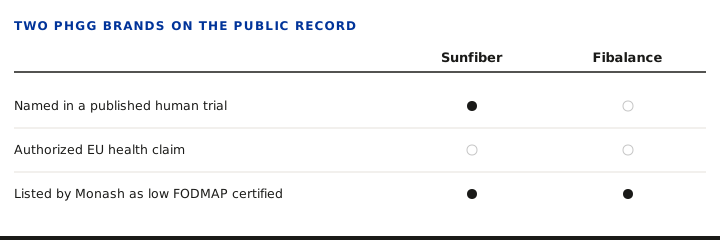
What is on the public record for each brand, checked on 23 October 2026. A filled dot means yes. Sources: PubMed and Europe PMC searches; EU Register of nutrition and health claims; Taiyo and ZymeBase statements.
The maker describes its own evidence in its award entry. It lists studies in mice with chemically induced colitis, studies in mice made obese on a high-fat diet, a gut-bacteria analysis, and a “consumer test report” on bowel habits and stool form.1 It adds a footnote saying these results are not a final claim of what the product does. None of this work is published, so no one outside the company can check how it was done or what it found.
The human trial record for PHGG comes from other grades. Of the four controlled PHGG trials we have verified, three used Sunfiber and one used OptiFibre, the Nestlé PHGG product.7 Those results describe PHGG as a fiber. Whether they carry over to a given grade has not been tested.
Is Fibalance certified low FODMAP?
ZymeBase calls its product “Low FODMAP Certified Fibalance PHGG”, and a US distributor listing says the certification comes from Monash University, which runs the main FODMAP research programme.14 ZymeBase announced the certification on its website on 26 September 2024.8 Monash University confirms it: its website lists Fibalance among the brands in its low FODMAP certification programme.9
Monash describes its certification as meaning a product was tested in its FODMAP laboratory and found suitable for a low FODMAP diet.10 It says nothing about how a given person will tolerate the fiber.
The same US listing also describes Fibalance as non-GMO, vegan, kosher and halal certified, and marks its certification documents as “Coming Soon”.4
How do regulators classify Fibalance?
European Union: no authorized claim. The EU decides claim by claim, by substance. Its register holds thirteen entries for partially hydrolyzed guar gum, and every one is non-authorized.11 They include claims for bowel function, blood sugar after meals, satiety and body weight. None is filed under a brand name. Guar gum itself holds one authorized claim, for blood cholesterol at 10 grams a day.12
ZymeBase and its distributors describe Fibalance as supporting gut bacteria, blood sugar control and weight management.14 Blood sugar, body weight and gut bacteria are all among the thirteen PHGG claims the EU register lists as non-authorized.
On current evidence, Fibalance is a young PHGG brand whose maker has described its process and its own studies but has not yet published them, and it holds no EU health claim.
Sources
Footnotes
-
ZymeBase Inc., entry “Low FODMAP Certified Fibalance PHGG”, FBIF Wow Food Awards ingredient gallery, foodtalks.cn, retrieved 23 October 2026. Manufacturer statements, quoted or translated from the Chinese as such. Gives the launch date (2024-2), the process description, the patent application number, the fiber content and the summary of the maker’s own studies. ↩ ↩2 ↩3 ↩4 ↩5 ↩6 ↩7 ↩8 ↩9
-
US trademark FIBALANCE, serial 97649465, filed 26 October 2022, registered 17 September 2024, owner ZymeBase Inc. Read via third-party mirrors of the USPTO record (gleanmark.com), retrieved 23 October 2026. ↩
-
He-Ju PHGG Fibre Powder (Fibalance), product page on Amazon.de, sold by He-Ju Europe GmbH, retrieved 23 October 2026. ↩
-
NXT Ingredients, “Fibalance PHGG by ECA Healthcare Inc”, ingredient listing, retrieved 23 October 2026. Distributor statements. ↩ ↩2 ↩3 ↩4 ↩5
-
Sasaki D, Sasaki K, Abe A, Ozeki M, Kondo A. “Effects of partially hydrolyzed guar gums of different molecular weights on a human intestinal in vitro fermentation model.” Journal of Bioscience and Bioengineering 2023. PMID 37105857. In vitro study with Taiyo co-authors, comparing two Sunfiber grades of about 20,000 and 5,000 daltons. ↩
-
PubMed search “zymebase[ad] OR fibalance[tiab] OR zymebase[tiab]” and Europe PMC search “ZymeBase OR Fibalance”, both run 23 October 2026. Each returned one record, an enzyme paper unrelated to guar gum. ↩
-
Niv E et al. Nutrition & Metabolism 2016;13:10 (Sunfiber); Yasukawa Z et al. Nutrients 2019;11(9):2170 (Sunfiber); Abe A et al. Journal of Clinical Biochemistry and Nutrition 2023;72(2):189-197 (Sunfiber); Chan TC et al. The Journal of Nutrition, Health and Aging 2022 (OptiFibre). Test products as stated in each paper’s full text. ↩
-
ZymeBase, “Fibalance PHGG Earns Low FODMAP Certification from Monash University”, zymebase.com, dated 26 September 2024, retrieved 23 October 2026. Manufacturer announcement. ↩
-
Monash University, “Low FODMAP Certified partners”, monashfodmap.com, retrieved 26 October 2026. Lists Fibalance (and Sunfiber) among its certified brands; the Monash certification team confirmed the listing by email on 26 October 2026. ↩
-
Monash University, “Find certified low FODMAP foods”, monashfodmap.com, retrieved 23 October 2026. ↩
-
European Commission, Food and Feed Information Portal, EU Register of nutrition and health claims, entries under “Guar gum partially hydrolyzed”, “Hydrolised guar gum” and “Partially Hydrolysed Guar Gum (PHGG)”, retrieved 23 September 2026. ↩
-
Commission Regulation (EU) No 432/2012, Annex entry for Guar Gum: “Guar gum contributes to the maintenance of normal blood cholesterol levels”, 10 g a day. EFSA opinion 2010;8(2):1464. ↩