Metamucil is psyllium husk. Benefiber, in the US, is wheat dextrin. In Europe you find these fibres under other names. For Metamucil, buy psyllium husk, sold as plain powder or as pharmacy brands such as Fybogel, Mucofalk, Plantaben and Spagulax. For Benefiber, the closest match is PHGG.
Both brands are built for North American shoppers. Procter & Gamble runs Metamucil sites for the United States, Canada and Australia, and Haleon runs Benefiber sites for the United States and Canada.12 We looked for a Metamucil product in the Spanish and French medicines registers and found none.3 If you have used either brand and now live in Europe, the fibre is still easy to buy. For how fibre fits into GLP-1 treatment, start with our complete guide to fibre and GLP-1 medications.
What is the European equivalent of Metamucil?
Any product made from psyllium husk. Metamucil’s fibre is psyllium husk, from the seed of Plantago ovata.1 The same husk goes by several names on European labels:
- Psyllium husk on most food supplements
- Ispaghula husk on UK and French medicines
- Plantago ovata husk (cáscara de Plantago ovata) in Spain
- Indische Flohsamenschalen in Germany
All four name the same seed husk.4
In several countries the husk is also sold as a licensed medicine that you can buy without a prescription:
- UK: Fybogel (Reckitt). Ispaghula husk, 3.5 g per sachet. Pharmacy and general-sale versions exist.5
- Germany: Mucofalk (Dr. Falk Pharma). Indian psyllium husk, 3.25 g per 5 g sachet, sold without a prescription.6
- Spain: Plantaben (Cooper Consumer Health). Plantago ovata husk, 3.5 g per sachet, no prescription needed.7
- France: Spagulax (Almirall). Ispaghula husk; the effervescent sachet contains 2.143 g. Psylia and Parapsyllium are also on the market.3
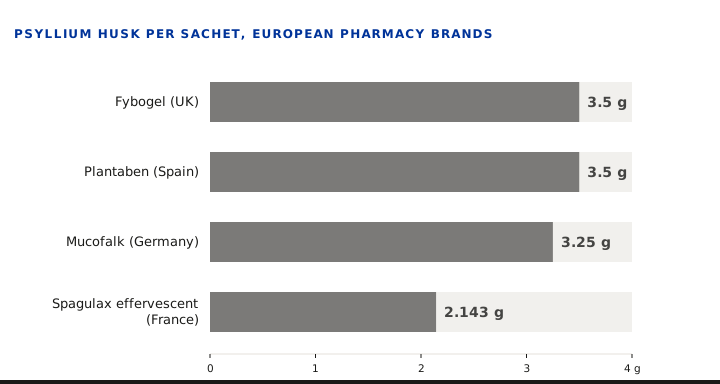
Psyllium husk per sachet in four European pharmacy brands. Sources: emc (UK), Dr. Falk Pharma (DE), AEMPS CIMA (ES), Base de données publique des médicaments (FR), retrieved 9 November 2026.
Plain psyllium husk powder is also sold as an ordinary food in the UK, Germany, France, Spain and Italy. Our country guides list options, for example the UK guide.8
The difference between the two is legal classification. A medicine comes with a licensed dose and a patient leaflet. A food supplement is the same husk sold under food law.
What is the European equivalent of Benefiber?
Start with the ingredient list, because the Benefiber name has covered two fibres. US Benefiber Original is wheat dextrin.9 But the name has also been attached to a different fibre: an EU register entry lists “Sunfiber (syn.: Benefiber)” as partially hydrolysed guar gum.10
Benefiber’s practical advantage is that it dissolves clear, tastes of nothing and does not thicken a drink.11 A fibre with the same traits is PHGG (partially hydrolysed guar gum). It also dissolves clear and tasteless, is low FODMAP and ferments slowly.12 Typical doses are 5 to 10 g a day. We compare PHGG brands in our guide to OptiFibre alternatives.
If you took Benefiber for constipation, consider psyllium instead. The one trial that tested wheat dextrin itself, at 15 g a day for four weeks in healthy men, found no significant change in stool frequency or consistency compared with placebo.13 Psyllium has the broadest evidence of any supplement fibre for chronic constipation.1 Our Metamucil vs Benefiber comparison explains the difference: psyllium forms a gel, wheat dextrin does not.
How do you choose between them?
Choose by what you want the fibre to do.
- For constipation: psyllium husk, in any of its names. Start low and work up towards 7 to 10 g a day, with at least 250 ml of water per serving.1
- For a fibre you will not notice in a drink: PHGG.12
- For an EU-authorised claim on the label: neither psyllium nor wheat dextrin has one. Chicory inulin holds the EU bowel-function claim at 12 g a day.14
Check three things on any tub: the fibre named in the ingredient list, the grams of fibre per serving, and whether sweeteners or flavourings have been added.
Does any of this change on a GLP-1 medication?
Choose the fibre the same way, and increase the dose more slowly. GLP-1 medications slow how fast the stomach empties. There is no known interaction between fibre and the injection itself. Start with one single-ingredient fibre, increase the dose slowly and drink enough water. A gel-forming fibre like psyllium can slow how well a tablet swallowed at the same time is absorbed, so keep it at least half an hour to an hour apart from other tablets.15 Our guide to taking fibre with a GLP-1 covers timing in detail.
If you liked Metamucil, psyllium husk is easy to find in Europe. If you liked Benefiber, try PHGG.
Footnotes
-
Psyllium husk is a gel-forming soluble fibre with the broadest clinical evidence for chronic constipation; research doses 7 to 10 g per day, each serving with at least 250 ml water. Metamucil’s fibre is psyllium husk (metamucil.com, metamucil.ca, retrieved 9 November 2026). Procter & Gamble runs Metamucil sites for the United States (metamucil.com/en-us), Australia (metamucil.com.au) and Canada (metamucil.ca), retrieved 9 November 2026. See also our Metamucil vs Benefiber comparison. ↩ ↩2 ↩3 ↩4
-
Benefiber sites for the United States (benefiber.com, “intended for residents of the United States only”) and Canada (benefiber.ca, “intended for Canadian residents only”), Haleon group of companies, retrieved 9 November 2026. ↩
-
AEMPS CIMA medicines register (Spain), search “Metamucil”, 0 results; Base de données publique des médicaments (France), full CIS and composition files, no product named Metamucil. Spagulax (Almirall), Psylia (Techni-Pharma) and Parapsyllium (Alfasigma France) listed as authorised and marketed; Spagulax effervescent sachet 2.143 g ispaghula seed husk. Retrieved 9 November 2026. ↩ ↩2
-
Active-ingredient names as given by the national registers and manufacturer: “ispaghula husk” (emc, UK), “ispaghul (tégument de la graine d’)” (BDPM, France), “Plantago ovata Forssk. cáscara” (AEMPS CIMA, Spain), “Indische Flohsamenschalen (Plantago ovata)” (Dr. Falk Pharma, Germany). ↩
-
Fybogel Hi-Fibre Lemon, Summary of Product Characteristics: “A sachet contains 3.5g ispaghula husk”; legal categories P and GSL across the Fybogel range. emc (medicines.org.uk), retrieved 9 November 2026. ↩
-
Mucofalk product page, Dr. Falk Pharma, listed as non-prescription; 5 g (1 sachet or 1 level scoop) contains 3.25 g ground Indian psyllium husk. Retrieved 9 November 2026. ↩
-
Plantaben 3,5 g polvo efervescente, Cooper Consumer Health B.V., AEMPS CIMA registration 56342: active ingredient Plantago ovata husk 3.5 g, no prescription required. Retrieved 9 November 2026. ↩
-
Psyllium husk powder sold as a food supplement: our country guides for the UK, Germany, France, Spain and Italy, last refreshed 3 November 2026. ↩
-
Benefiber Original powder, benefiber.com: “made from wheat dextrin”. Retrieved 20 October 2026. ↩
-
European Commission, EU Register of nutrition and health claims: entry for “Sunfiber (syn.: Benefiber) (enzymatically partially depolymerised guar gum)”, status non-authorised. Retrieved 20 October 2026. ↩
-
Wheat dextrin is non-viscous; its viscosity was below the detection limit of the viscometer. Reichert RG et al., Nutrients, 2016;8(2). PMC4882681. ↩
-
PHGG dissolves clear and tasteless, is low FODMAP and ferments slowly; typical dose 5 to 10 g per day; narrower evidence than psyllium. See our OptiFibre alternatives guide. ↩ ↩2
-
Perreau C et al., Frontiers in Nutrition, 2026 (NUTRIOSE FB06, 15 g per day, 4 weeks, randomised, double-blind, placebo-controlled pilot in healthy men). doi:10.3389/fnut.2026.1810842. ↩
-
Commission Regulation (EU) No 432/2012, Annex: no authorised health claim for psyllium or wheat dextrin. Chicory inulin bowel-function claim at 12 g per day: Commission Regulation (EU) 2015/2314. ↩
-
Fibre on GLP-1 medications: no known interaction with the injection; start with a single-ingredient fibre and ramp slowly; viscous fibre can slow absorption of a tablet swallowed at the same moment, so keep it at least 30 to 60 minutes apart from other tablets. See our guide to taking fibre with a GLP-1. ↩