Powder. If you want a full research dose from a supplement, powder is the only form that gets there in a scoop or two. A psyllium capsule holds about half a gram, so 7 g is roughly 20 capsules a day. Gummies use different fibers, so they answer a different question.12
The rest of this page is the arithmetic, taken from the makers’ own labels. For the bigger picture, start with our complete guide to fiber and GLP-1 medications.
Why is this really a dose question?
Because the fiber does not change. Only the container does. Psyllium in a capsule is the same psyllium as in a tub. Inulin in a gummy is the same inulin as in a sachet. No study shows one form works better per gram, and there is no reason it would.
What changes is how much each unit can hold, and so how many you need. The research doses are not small. The EU health claim for chicory inulin is based on 12 g a day.3 Psyllium trials use 7 to 10 g.4 PHGG studies use 5 to 10 g.5 Most European adults eat 18 to 20 g of fiber against a 25 to 30 g target, so a supplement is usually asked to close a 7 to 12 g gap.6
Seven grams. Hold that number against each format.
How much fiber is in a capsule?
About half a gram. The leading US psyllium capsule contains roughly 0.52 g of psyllium husk, and five capsules deliver “at least 1.8 grams” of soluble fiber. The label allows five capsules up to four times a day: 20 capsules for a little over 7 g.1 A popular competitor’s capsules give 1.1 g per three; at the maximum nine a day, that is about 3.3 g.7
The same maker’s powder gives about 2.4 g of soluble fiber per serving.1 So one scoop is worth about seven capsules. Three scoops reach 7 g. So do 20 capsules.
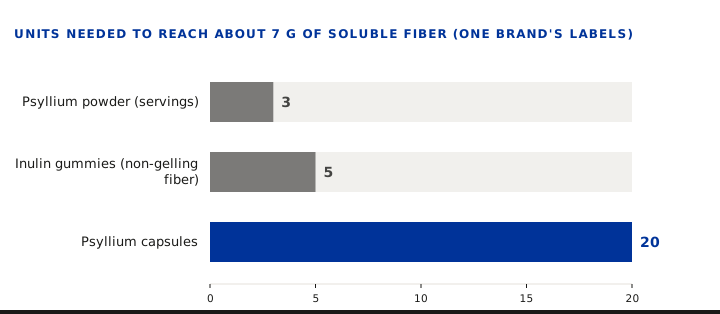
Units needed for about 7 g of soluble fiber, from one maker’s labels (illustrative). Gummies get there with a different, non-gelling fiber. Sources: Metamucil product labels and P&G healthcare-professional FAQ, 2026.
| Format | Fiber per unit (label) | Units for about 7 g | Fiber type used |
|---|---|---|---|
| Psyllium powder | ~2.4 g soluble fiber per serving | 3 servings | Any, including gel-forming |
| Psyllium capsules | ≥1.8 g per 5 capsules (~0.36 g each) | ~20 capsules | Any, in very small amounts |
| Fiber gummies | 5 g per 3 gummies (~1.7 g each) | ~4 to 5 gummies | In practice inulin, resistant dextrin or pectin; not psyllium |
Illustrative arithmetic from the labels cited in the text; capsule and gummy figures are for the leading US brand and vary by product.
Why capsules hold so little. A capsule is a fixed volume, and dry psyllium is bulky. A research dose does not fit in a shell you can swallow. That is why capsule labels talk about servings of five and daily maximums of 20, not grams. Capsules are a top-up format. The problem starts when they are sold as the full dose.
The choking warning is real. In the US, any dry bulk-fiber product (psyllium, guar gum, glucomannan, methylcellulose and others), capsules and tablets included, must carry a warning that taking it without enough fluid “may cause it to swell and block your throat or esophagus and may cause choking”, and that people who have trouble swallowing should not use it.2 The rule exists because these products have blocked oesophaguses. The leading capsule label says: one capsule at a time, sitting upright, with a full glass of liquid.1 Twenty capsules a day is twenty of those.
Can a gummy deliver a real dose?
Yes, of some fibers. The leading fiber gummy gives 5 g per three gummies and allows three servings a day, so nine gummies could reach 15 g.8 A typical UK gummy gives 4 to 5 g of chicory inulin per three, with a daily limit of about eight.9
Now look at the ingredients. The gummies we checked are built on inulin, resistant dextrin or pectin. None uses psyllium or glucomannan. That is not a law of nature, but it is a real constraint: those fibers bind so much water and thicken so strongly that fitting a useful dose into a small, chewable gummy that keeps its texture on the shelf is very hard. Makers reach for fibers that behave in confectionery.
Why does that matter? Different fibers do different jobs. Psyllium works largely through the thick gel it forms: it bulks and softens stool and, in trials, increases fullness. When researchers measured a non-gelling dextrin fiber, its viscosity was too low to detect while a gel-forming fiber measured in the tens of thousands of centipoise, and the non-gelling fiber produced less than half the fullness.10 Inulin and resistant dextrin work differently, by fermentation in the colon, and that helps too: resistant maltodextrin added about 0.7 bowel movements a week versus placebo in a meta-analysis.11 So a gummy is a fair way to take inulin. It is not a way to take psyllium.
Check the sugar. Some gummies are sugar-free. Others list glucose as the second ingredient after inulin.9 A fiber gummy that is mostly sugar is a sweet with a fiber claim.
When do capsules or gummies make sense?
When you already eat well and want a small top-up. If you get 25 g from food and want two more grams of inulin at your desk, a gummy is fine. If you cannot stand psyllium in water, a few capsules with a meal give you 1 to 2 g of gel-forming fiber you would otherwise skip.
What neither can do is stand in for the dose the constipation, cholesterol and fullness research is built on. For that, use powder.
Which form is best on a GLP-1?
Powder, split across the day. GLP-1 medicines slow the stomach and blunt appetite. That is why constipation is so common on them, and why 15 to 20 capsules a day, each with a full glass of water, is a routine few people keep. Powder puts the same dose into one or two drinks you were having anyway.
Powder also lets you start low and go slow, which is what makes fiber tolerable on a GLP-1. Begin around 5 g and build up with water.12 Take half at lunch and half at dinner. That spreads the load on a slowed gut and keeps the fiber away from your morning tablets and the oral semaglutide fasting window.13 The spacing rule is in can you take fiber with a GLP-1; the full checklist for choosing a supplement is in what to look for in a fiber supplement for GLP-1 users.
The fiber in the tub, the capsule and the gummy is the same. Only the scoop fits the dose.
Frequently asked questions
Is fiber powder better than fiber capsules?
Per gram of the same fiber, no. Per realistic daily dose, yes. A psyllium capsule holds about half a gram, and a five-capsule serving of the leading brand provides at least 1.8 g of soluble fiber, so reaching the 7 to 10 g used in psyllium research means around 20 capsules a day.14 One scoop of powder does the same job. Capsules suit people topping up a fiber-rich diet, not people relying on the supplement for the dose.
Do fiber pills work?
Yes, at the dose they contain, which is the catch. Fiber pills and capsules contain the same psyllium, glucomannan or methylcellulose as powders, and US labels for these dry forms must carry a choking warning because the fiber swells when it meets water.2 Each capsule holds roughly half a gram, so a full research dose takes 14 to 20 capsules taken one at a time with a full glass of water. For most people that is not a habit that survives a month.
Are fiber gummies as effective as powder?
Not for the same job. The fiber gummies on the market are built on chicory inulin, resistant dextrin or pectin rather than psyllium, typically 4 to 5 g per three gummies; psyllium binds too much water to fit a useful dose into a small chewable gummy.89 Those fibers support stool frequency through fermentation but do not deliver the viscous effect that psyllium research relies on for bulking and fullness.1011 A gummy is a reasonable inulin top-up; it is not a psyllium substitute.
How many fiber capsules equal one scoop of powder?
Using the leading psyllium brand’s own labels, one powder serving provides about 2.4 g of soluble fiber and five capsules provide at least 1.8 g, so roughly seven capsules match one scoop.1 To reach 7 g of soluble fiber you would take about three scoops of powder or about 20 capsules, which is the label’s daily maximum.
Which fiber form is best on a GLP-1 medication?
Powder, split across the day. GLP-1 medicines slow the stomach and blunt appetite, so a routine that asks you to swallow 15 to 20 capsules, each with a full glass of water, is hard to keep. A powder lets you start at a small dose, increase gradually and take half at lunch and half at dinner, which also keeps fiber clear of your morning tablets and the oral semaglutide fasting window.1213
Footnotes
-
Metamucil Fiber Capsules (original) product label, metamucil.com: “Swallow 1 capsule at a time and take in an upright position”; “2 to 5 capsules up to 4 times per day”; “One serving of Metamucil capsules has at least 1.8 grams of this soluble fiber.” Serving = 5 capsules; powder “approximately 2.4 g of soluble fiber per serving” per the Procter & Gamble healthcare-professional FAQ (pgsciencebehind.com/en-us/metamucil/faqs). Per-capsule psyllium content approximately 0.52 g per the US Drug Facts label. Accessed 16 September 2026. ↩ ↩2 ↩3 ↩4 ↩5 ↩6
-
21 CFR § 201.319, Water-soluble gums, hydrophilic gums, and hydrophilic mucilloids as active ingredients; required warnings and directions. Applies to products “marketed in a dry or incompletely hydrated form” including “Capsules, granules, powders, tablets, and wafers”; listed ingredients include guar gum, glucomannan, methylcellulose, plantago seed (psyllium) and polycarbophil. https://www.law.cornell.edu/cfr/text/21/201.319 ↩ ↩2 ↩3
-
EFSA Panel on Dietetic Products, Nutrition and Allergies (2015). Scientific Opinion on the substantiation of a health claim related to “native chicory inulin” and maintenance of normal defecation by increasing stool frequency. EFSA Journal 13(1):3951. Effective intake 12 g/day. ↩
-
Wei ZH, Wang H, Chen XY, et al. (2009). Time- and dose-dependent effect of psyllium on serum lipids. European Journal of Clinical Nutrition 63(7):821-827; psyllium research doses of 7 to 10 g/day as summarised in our US fiber supplements guide. ↩ ↩2
-
Giannini EG, Mansi C, Dulbecco P, Savarino V (2006). Role of partially hydrolyzed guar gum in the treatment of irritable bowel syndrome. Nutrition 22(3):334-342. ↩
-
EFSA Panel on Dietetic Products, Nutrition and Allergies. Scientific Opinion on Dietary Reference Values for carbohydrates and dietary fibre. EFSA Journal 2010;8(3):1462 (25 g/day). Deutsche Gesellschaft für Ernährung, D-A-CH Reference Values (30 g). SACN, Carbohydrates and Health, 2015 (30 g). Stephen AM et al. Dietary fibre in Europe: current state of knowledge. Nutrition Research Reviews 2017;30(2):149-190 (adult intakes). See how much fiber per day. ↩
-
NOW Foods Psyllium Husk Caps label: 1.1 g fiber per 3-capsule serving; maximum 9 capsules/day, about 3.3 g. As documented in our US fiber supplements guide. ↩
-
Metamucil Fiber Gummies product page, metamucil.com: three gummies per serving, “5g of fiber per serving”, “Up to 3 servings/day”, “no added sugar”; fiber blend of inulin (chicory root fiber) and Fibersol (soluble corn fiber, a resistant maltodextrin) per the P&G healthcare-professional FAQ. Accessed 16 September 2026. ↩ ↩2
-
The BYTES Co. Digestive Fibre Support gummies, Holland & Barrett product listing: full ingredients “Inulin (Chicory Root), Glucose, Pectin, Citric Acid …”; “Take 2 gummies up to 4 times a day. Do not exceed 8 gummies daily.” Retailer listings for Wellthy by Boots and Known Nutrition fibre gummies state 4.5 g inulin per three gummies. Accessed 16 September 2026. ↩ ↩2 ↩3
-
Reichert RG et al. Viscous versus non-viscous fibre, satiety and glycaemia: wheat dextrin viscosity below the limit of detection versus a viscous comparator at tens of thousands of centipoise; satiety area-under-curve roughly 215 versus 470 cm·min (p<0.001). Nutrients, 2016. See Metamucil vs Benefiber. ↩ ↩2
-
Watanabe T, et al. Systematic review and meta-analysis of resistant maltodextrin and bowel function: stool frequency increased by a mean 0.71 (95% CI 0.48 to 0.94) versus placebo. Clinical and Experimental Gastroenterology, 2018 (PMID 29535547). ↩ ↩2
-
General clinical guidance on increasing dietary fiber: start at a low dose (around 5 g per day) and increase gradually with adequate water. UCSF Health, as cited in can you take fiber with a GLP-1. ↩ ↩2
-
UK ispaghula (psyllium) husk Summary of Product Characteristics (MHRA): take at least half an hour to one hour apart from other medicines. Oral semaglutide dosing: empty stomach, at least 30 minutes before food, drink or other oral medicines. See can you take fiber with a GLP-1. ↩ ↩2