
If you are on a GLP-1 and want a fiber for appetite, no single one is the best pick: the medication is already the appetite lever and no fiber matches it. Among the viscous fibers that engage the same satiety hormones, oat beta-glucan has the most consistent evidence. Treat any of them as an adjunct, not a substitute.
Viscous, gel-forming fibers do engage the same satiety machinery the drug uses. The effect is real but modest, and it depends more on how thick a gel the fiber forms than on anything else. For the whole picture of how fiber fits alongside the medication, our complete guide to fiber and GLP-1 medications is the place to start.
Does fiber act on the same appetite pathway as a GLP-1?
Yes, which is why the question is reasonable. Viscous soluble fibers absorb water and form a gel in the stomach, slowing gastric emptying and keeping food in contact with the gut for longer. As nutrients reach the lower intestine, they trigger the release of the satiety hormones CCK, GLP-1, and PYY, and when fiber ferments in the colon, the short-chain fatty acids it produces stimulate the same hormone-releasing cells.1 Those are the hormones a GLP-1 medication is built around. Fiber nudges the pathway the drug targets.
A 2026 scoping review of human trials mapped this fiber by fiber. Short-chain fatty acids from fermentation, propionate above all, activate the FFAR2 and FFAR3 receptors on gut L-cells to release the body’s own GLP-1.2 The review’s central finding cuts against reading too much into that: beta-glucan produced the most consistent effect on subjective fullness (positive in 6 of 9 studies) even though its hormone response was inconsistent (positive in only 3 of 9). The authors describe a mechanism “complementary to, but not necessarily dependent on, GLP-1 stimulation.”2 The fiber that works best for fullness is not the one that best mimics the drug.
What makes a fiber more filling?
Viscosity, more than anything else. The cleanest evidence comes from an acute crossover trial that separated the thickness of the gel from every other variable. Compared with a ready-to-eat cereal, higher-viscosity oat beta-glucan increased fullness (p=0.04), suppressed the desire to eat (p=0.01), and lowered prospective food intake (p<0.01) across the four hours after the meal.3 The effect tracked the beta-glucan’s molecular weight and the thickness of the gel. Starch digestion and glucose release did not differ between the meals (p>0.05). It was the gel, not the blood sugar.3
The fibers that form the thickest gels, oat beta-glucan, glucomannan, and psyllium, are the mechanistically strongest picks for fullness. A fiber that dissolves to a thin liquid will not do this job, whatever else it is good for.
Does fiber actually curb appetite in trials?
In short studies, yes. Over the longer run, the signal fades. When fiber is tested as a real appetite or weight intervention rather than a four-hour lab meal, the effect shrinks. In a controlled trial of glucomannan, the fiber with the EU’s only weight-loss claim, only 10 to 20% of participants reported actually feeling less hungry, and taste complaints drove people to stop taking it.4 A 2025 meta-analysis of 27 psyllium trials found no significant effect on BMI or waist circumference.5 Psyllium is excellent for regularity and forms a gel, but the 2026 review found it produced almost no endogenous GLP-1 response, and its strength is the bowel, not the appetite.2
Most of the appetite evidence also comes from short studies. The 2026 review reported that 71% of the trials it examined were acute, and that the gut microbiome, which does much of fiber’s slower work, often shows no measurable change until an intervention runs past three to four weeks.2 The strong fullness numbers come mostly from single meals; the longer real-world picture is thinner. That is a reason to keep expectations modest, not to skip fiber.
What is fiber actually for while you are on a GLP-1?
The things the medication does not do, or makes worse. A February 2026 perspective in The Journal of Nutrition put it plainly: fiber can support appetite, glucose and insulin stability, and weight management during and after treatment, while stating that fiber cannot replicate the pharmacologic effect of a GLP-1. It is an adjunct, never a substitute.6
- Gut comfort and regularity. Slowed gastric emptying is part of how these drugs work, and constipation is one of their most common side effects. A gentle daily fiber is aimed squarely at that.
- Steadier glucose. Oat beta-glucan carries EU recognition for blunting the post-meal glucose rise at 3g per 30g of carbohydrate.7
- Fullness per calorie, and the maintenance phase. When appetite is already suppressed and portions are small, the quality of each meal matters more. Fiber helps meals feel complete, and it becomes more relevant after stopping the drug, when appetite returns.
None of that is a weight-loss claim, and none of it asks fiber to be the drug.
Which fiber should you choose for appetite?
No single winner, and the fiber you will actually keep taking still beats the theoretically best one. If fullness is the goal, the evidence favors a short list.
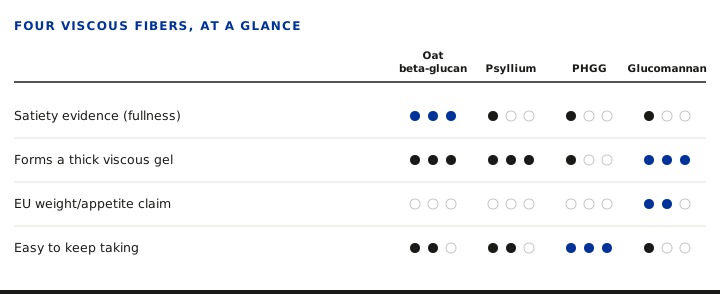
Oat beta-glucan has the most consistent satiety evidence; glucomannan forms the thickest gel yet holds only a contested weight-loss claim; PHGG is the easiest to keep taking; psyllium earns its place on regularity, not appetite. Source: de Jong et al. 2026 (Frontiers in Endocrinology); Commission Regulation (EU) 432/2012; Foods 2023;12(11):2122.
| Fiber | Satiety evidence | Thick viscous gel | EU weight/appetite claim | Easy to keep taking |
|---|---|---|---|---|
| Oat beta-glucan | Strong | Yes | None | Moderate |
| Psyllium | Mixed | Yes | None | Moderate |
| PHGG | Limited, indirect | Low viscosity | None | Easiest |
| Glucomannan | Weak in trials | Thickest | Only, and contested | Hardest (palatability) |
- Oat beta-glucan has the most consistent evidence for subjective fullness and forms a high-viscosity gel.2 3 It also carries recognised EU claims for cholesterol and post-meal glucose.7
- Glucomannan forms the thickest gel of the common fibers and holds the EU’s only weight-loss claim, though the direct trial evidence undercuts it and palatability is a real obstacle.8 4
- Psyllium is a strong choice when regularity is the priority, less so for hunger.2 5
- PHGG (partially hydrolysed guar gum) is the gentlest and least gassy, which is why people keep taking it, and the fiber you keep taking beats the theoretically optimal one you quit.4
The bigger lever sits upstream of all of this. The EU’s adequate intake for fiber is 25g a day, and Germany’s DGE and France’s ANSES point higher, at around 30g.9 Most adults fall well short. Closing that gap with a viscous fiber you tolerate does more for everyday fullness than chasing the perfect powder. Our guide to how much fiber you need per day sets the targets, and the best fiber for weight loss covers the same fibers through the weight lens.
On a GLP-1, appetite is the drug’s job. Fiber’s is the comfort around it, the bowel, the glucose, the fullness of a smaller plate, and it does that job well when you let it be the adjunct it is.
Footnotes
-
Mechanism of fiber-induced satiety: viscosity, delayed gastric emptying, ileal-brake delivery of nutrients, and secretion of CCK, GLP-1, and PYY, with short-chain fatty acids from fermentation stimulating the same L-cells. Review: Critical Reviews in Food Science and Nutrition 2022. https://www.tandfonline.com/doi/full/10.1080/10408398.2022.2130160 ↩
-
de Jong JCBC, Lentjes MGW, Pietersma KF, Pasman WJ, Wopereis S, Hoevenaars FPM. “Dietary fibers to boost endogenous GLP-1 secretion and satiety: a scoping review.” Frontiers in Endocrinology 2026. Human-RCT scoping review: beta-glucans most consistent on subjective satiety (6 of 9 studies) despite inconsistent GLP-1 responses (3 of 9), a mechanism “complementary to, but not necessarily dependent on, GLP-1 stimulation”; SCFAs (propionate most potent) activate FFAR2/FFAR3 on L-cells to stimulate endogenous GLP-1; psyllium/arabinoxylan-rich fibers show minimal GLP-1 response and mixed satiety; 71% of reviewed trials were acute, and microbiota changes often need beyond 3 to 4 weeks. https://www.frontiersin.org/journals/endocrinology/articles/10.3389/fendo.2026.1880500/full ↩ ↩2 ↩3 ↩4 ↩5 ↩6
-
Rebello CJ, et al. “The role of meal viscosity and oat β-glucan characteristics in human appetite control: a randomized crossover trial.” Nutrition Journal 2014 (n=48 enrolled, 43 completed, 3-treatment crossover). Higher-viscosity instant oatmeal increased fullness (p=0.04), suppressed desire to eat (p=0.01), and reduced prospective intake (p<0.01) vs ready-to-eat cereal over four hours; the effect tracked beta-glucan molecular weight and gastric viscosity; starch digestion and glucose release did not differ (p>0.05), indicating a viscosity-mediated rather than glycemic effect. https://pmc.ncbi.nlm.nih.gov/articles/PMC4052334/ ↩ ↩2 ↩3
-
Five-arm randomized controlled trial of fiber supplements under energy restriction (n=100 randomized, 80 completers, 8 weeks). 3 g/day glucomannan alone produced no significant weight or BMI reduction vs placebo; only 10 to 20% of participants reported decreased appetite, with palatability driving unwillingness to continue; authors state results “do not support the recommendation of the European Food Safety Authority for the use of glucomannan as a weight loss aid.” Foods 2023;12(11):2122. https://www.mdpi.com/2304-8158/12/11/2122 ↩ ↩2 ↩3
-
Dose-response systematic review and meta-analysis of psyllium (27 randomized controlled trials): non-significant pooled change in BMI of -0.06 and no significant change in waist circumference; psyllium well tolerated. Journal of Health, Population and Nutrition 2025. https://link.springer.com/article/10.1186/s41043-025-01103-x ↩ ↩2
-
“Fiber supplementation during and after glucagon-like peptide-1 receptor agonist treatment: a perspective on clinical benefits.” A perspective paper, not a trial, explicit that fiber cannot replicate the pharmacologic effect of a GLP-1. The Journal of Nutrition, February 2026. https://www.sciencedirect.com/science/article/abs/pii/S0022316626000854 ↩
-
Oat beta-glucan EU recognition: cholesterol-maintenance claim at 3 g/day (Commission Regulation (EU) No 432/2012; EFSA 2010). EFSA scientific opinion adopted 28 January 2026 on reduction of the post-prandial glucose peak, condition of use at least 3 g oat beta-glucans per 30 g available carbohydrate (EC authorisation follows the opinion). EFSA Journal 2026;24(2):e9942. https://efsa.onlinelibrary.wiley.com/doi/10.2903/j.efsa.2026.9942 ↩ ↩2
-
Glucomannan weight-loss claim wording and conditions of use (3 g/day in three 1 g doses with water before meals, in the context of an energy-restricted diet): Commission Regulation (EU) No 432/2012. https://eur-lex.europa.eu/LexUriServ/LexUriServ.do?uri=OJ:L:2012:136:0001:0040:en:PDF ↩
-
EFSA adequate intake for dietary fiber in adults: 25 g/day (EFSA, 2010). Germany’s DGE and France’s ANSES set higher reference points of around 30 g/day. Most European adults fall short of these targets. ↩