Reaching 25g of fiber a day, the minimum the European Food Safety Authority recommends, is genuinely hard on a normal healthy diet.1 Meat, fish, eggs, dairy, and protein powder contain no fiber at all, so a protein-forward day can land near 12g without a single obvious mistake. Hitting 25g takes deliberately building meals around beans, whole grains, or fruit.
That is the short answer. The longer one is worth seeing, because “eat more fiber” is easy to say and strangely hard to picture. Most people have no idea how much they currently get, or how far a normal-looking day falls short. This is the everyday version of the European fiber gap: not a statistic about the continent, but a plate in front of you.
So we counted. Below are three full days of eating, with the fiber in each meal drawn from USDA food-composition data and realistic single-person portions.2 The days are not extreme. Nobody in them is eating badly on purpose. The only thing that changes between them is which foods carry the fiber.
Why does a healthy day fall short? Start with what has zero fiber
Fiber is a part of plant cell walls. That single fact explains most of the gap, because it means an entire category of “healthy” food contributes nothing.
Black coffee: zero. Whey protein, collagen, creatine, a fish-oil capsule: zero. Salmon, chicken breast, sirloin steak, canned tuna, sardines, eggs: all zero.2 Greek yogurt and hard cheese: also zero. None of these are unhealthy foods. But none of them move your fiber number even slightly.
This is the trap in one line. The foods a health-conscious eater tends to build a day around, lean protein and dairy, are exactly the foods with no fiber in them. Your entire daily total has to come from the plants on the plate, and often there are fewer of those than it feels like.
How much fiber is in a typical health-conscious day?
Here is a day that would pass almost anyone’s idea of eating well. Skip breakfast, black coffee and a few supplements. A lunch of pan-seared salmon with a generous side of roasted broccoli. A dinner of sardines with brown rice. A handful of almonds somewhere in between.
| Meal | On the plate | Fiber |
|---|---|---|
| Morning | Black coffee, vitamin D, omega-3, collagen, whey | 0g |
| Lunch | Salmon (175g) + roasted broccoli (200g) | 6.6g |
| Dinner | Sardines + brown rice (150g cooked) | 2.4g |
| Snack | Almonds (28g) | 3.5g |
| Total | 12.5g |
Twelve and a half grams.2 That is a careful, protein-forward, vegetable-including day, and it reaches exactly half the target. It also sits right in the middle of the range that average European adults actually eat, 15 to 24g, which tells you this is not an unusually low day but a normal one.3 The broccoli is doing most of the work. Take it away, or swap it for a smaller portion, and the day drops under 6g. Nothing here is a mistake. It is simply what happens when the anchor of every meal is a food with no fiber in it.
What does a worse, still very normal, day look like?
Now a day that still feels healthy but leans on the wrong plants. Scrambled eggs on white toast. A chicken Caesar salad at lunch, the kind that reads as “the healthy option.” Steak with mashed potato and a few green beans for dinner. Greek yogurt and cheese to snack.
| Meal | On the plate | Fiber |
|---|---|---|
| Breakfast | 2 eggs + 2 slices white toast | 1.6g |
| Lunch | Chicken Caesar (romaine, chicken, parmesan, croutons) | 2.6g |
| Dinner | Steak + mashed potato (150g) + green beans (80g) | 4.9g |
| Snack | Greek yogurt + cheese | 0g |
| Total | 9.1g |
Nine grams.2 A salad for lunch and a vegetable at dinner, and the day still comes to barely a third of the target. Romaine lettuce is mostly water, so a large bowl of it adds under 2g. The white toast, the peeled mashed potato, and the small side of beans do not rescue it. This is roughly where a lot of disciplined eaters actually live without realizing it, and it is why “but I had a salad” is not the reassurance it feels like.
What does a fiber-first day look like?
Same three meals, same amount of food on the plate, built the other way around. Oats with chia and raspberries for breakfast. A lentil soup with two slices of dense rye bread for lunch. A black bean chili for dinner.
| Meal | On the plate | Fiber |
|---|---|---|
| Breakfast | Oats (50g) + chia (1 tbsp) + raspberries (60g) | 13.1g |
| Lunch | Lentil soup (150g lentils) + rye bread (2 slices) | 15.4g |
| Dinner | Black bean chili (1 cup beans) + peppers, onion, tomato | 15.0g |
| Total | 43.5g |
Forty-three grams.2 This is the same person, the same three-meal structure, and nearly four times the fiber of the day before. A single cup of black beans delivers 15g on its own, more than either of the entire previous days.2 Legumes and whole grains are not slightly better, they are in a different league.
One caveat. If you currently eat around 12g, do not jump to 43g tomorrow. That much of a change at once will make your gut deeply unhappy. The target is 25 to 30g, not the highest number you can reach, and it is best approached gradually with plenty of water.4 We have a separate guide on how to start a fiber supplement without bloating that applies just as well to food.
Why is 25g so hard on a diet built for weight loss?
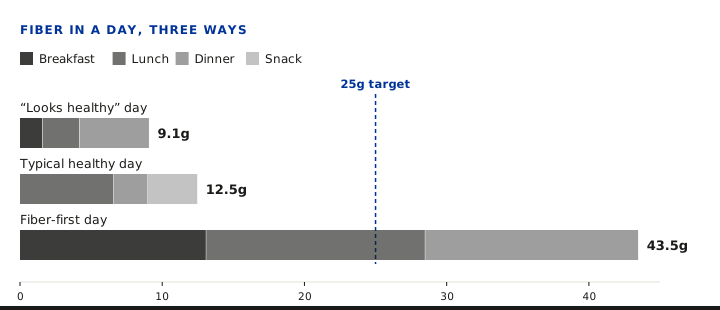
The same three-meal structure produces 9.1g, 12.5g, or 43.5g of fiber a day depending only on which foods carry it. Only the fiber-first day clears the 25g target. Source: USDA FoodData Central (SR Legacy); EFSA, 2010.
Line the three days up and the pattern is obvious. The gap between 9g and 43g is not effort, willpower, or calories. Every day above has roughly the same amount of food. The difference is entirely which foods were asked to carry the fiber.
This is why eating “to lose weight” so often makes the problem worse rather than better. The standard playbook raises protein, which is fiber-free, and cuts the exact foods where fiber concentrates: bread becomes a thing to avoid, grains get cut for their carbs, fruit gets rationed for its sugar, and legumes rarely appear at all because they read as “carby.” Each of those choices is defensible on its own. Stacked together, they produce a plate that looks disciplined and clean and happens to be one of the lowest-fiber ways a person can eat. For the recommended targets themselves, and how they differ across the EU and US, see how much fiber you actually need per day.
What actually moves the number?
The three days answer that too. You do not need a new diet. You need to make sure something fiber-dense is load-bearing in the day rather than optional.
Treat one legume meal as non-negotiable. A lentil soup, a bean chili, a chickpea stew. One cup of beans or lentils is 12 to 15g, which closes most of the gap in a single meal.2
Fix breakfast, or fix the grain. Oats with a spoon of chia clears 9g before you add fruit. Swapping white bread or white rice for a dense whole grain is a 3 to 5g swing for the same portion.2
Keep the skins and add the small stuff. A pear with its skin is 5.5g, a handful of raspberries almost 4g, an avocado half nearly 7g.2 None of these is dramatic alone, but they are the difference between landing at 20g and clearing 25g. For a fuller map of where the fiber lives, our guide to the best high-fiber foods by European diet breaks it down by cuisine.
The uncomfortable truth in the three days is that hitting 25g is not about eating more. It is about noticing that most of what you eat contributes nothing, and deciding, on purpose, what will.
What if you are already eating less?
Everything above assumes a full appetite. If something is suppressing yours, the same three-meal structure delivers even less, because the portions shrink while the zero-fiber anchors tend to stay.
That is the situation for anyone on a GLP-1 medication such as semaglutide (Ozempic, Wegovy) or tirzepatide (Mounjaro). Appetite drops, total food drops by roughly a third, and a typical day that was already near 12g can fall below 10g while the target stays exactly where it was. We cover that specific case, and how to close a widened gap, in how much fiber you need on a GLP-1. The principle is the same for everyone: fiber has to be chosen, because almost nothing delivers it by accident.
Footnotes
-
EFSA Panel on Dietetic Products, Nutrition and Allergies. Scientific opinion on dietary reference values for carbohydrates and dietary fibre. EFSA Journal (2010). EFSA sets an adequate intake of at least 25g per day for adults. ↩
-
Fiber values from USDA FoodData Central (fdc.nal.usda.gov), SR Legacy reference data, retrieved 2026-07-08. Values are for cooked preparations of vegetables, grains, and legumes unless noted, applied to the portions stated in each table. Real foods vary by brand and preparation: rolled oats run about 9 to 11g per 100g, and a dense whole-grain rye can exceed the standard-rye figure used here, so the fiber-first day is if anything a conservative count. ↩ ↩2 ↩3 ↩4 ↩5 ↩6 ↩7 ↩8 ↩9
-
Stephen AM, Champ MM-J, Cloran SJ, et al. Dietary fibre in Europe: current state of knowledge on definitions, sources, recommendations, intakes and relationships to health. Nutrition Research Reviews (2017). Average adult intake across European countries is 15 to 24g per day. ↩
-
National guidelines set the bar higher in several countries: Germany’s DGE recommends 30g per day, France’s ANSES 25 to 30g, and the UK’s SACN 30g. ↩