
“Best fiber for gut health” sounds like it should have a single answer. It does not, because gut health is not one thing. Feeding beneficial bacteria, producing short-chain fatty acids, staying regular, and staying comfortable are four different jobs, and the fiber that wins one loses another. The useful question is not which fiber is best, but which fiber is best for the job you actually care about. For the biology underneath this, see our companion pieces on soluble versus insoluble fiber and chicory inulin: the science; for why most people fall short of fiber in the first place, the European fiber gap.
Which fiber is best for gut health?
Here is the short version, sorted by the job:
- To shift which bacteria you have: chicory inulin has the most consistent human evidence. It reliably raises Bifidobacterium, one of the bacterial groups associated with a healthy gut.12
- To produce short-chain fatty acids like butyrate: resistant starch is the most reliable, raising SCFAs in roughly 70 percent of trials.3
- For regularity: chicory inulin at 12g per day carries the only EU-authorised bowel-function claim,4 and psyllium husk is the standard clinical first choice for bulk and regularity.5
- For tolerability: partially hydrolysed guar gum (PHGG) is a moderately fermentable, gentle middle option, and psyllium is well tolerated when introduced slowly.5
The rest of this article is why those distinctions exist, and where the popular “just eat fermentable fiber” story quietly breaks down.
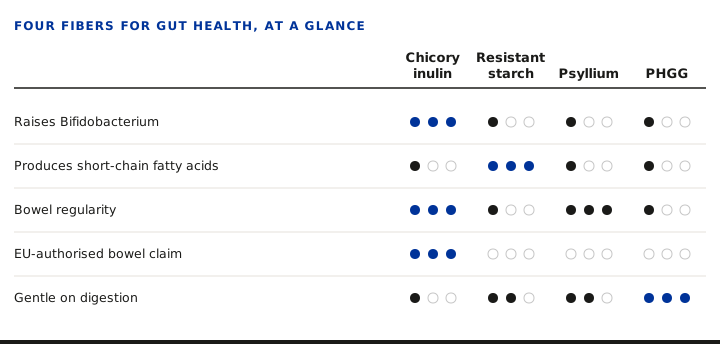
No single fiber wins every gut-health job: chicory inulin leads on Bifidobacterium, regularity, and is the only one with an EU-authorised bowel claim; resistant starch leads on short-chain fatty acid production; psyllium matches inulin on regularity; PHGG is the gentlest. Sources: Vinelli et al. 2022 (Nutrients); Baxter et al. 2019 (mBio); Sobh et al. 2022 (Am J Clin Nutr); Commission Regulation (EU) 2015/2314; Food & Function 2026.
| Gut-health job | Chicory inulin | Resistant starch | Psyllium | PHGG |
|---|---|---|---|---|
| Raises Bifidobacterium | Strong | Weak | Weak | Weak |
| Produces short-chain fatty acids | Weak | Strong | Weak | Weak |
| Bowel regularity | Strong | Weak | Strong | Weak |
| EU-authorised bowel claim | Yes (12g/day) | No | No | No |
| Gentle on digestion | Weak | Moderate | Moderate | Strong |
Does fiber actually improve your gut microbiome?
This is where the evidence is more interesting than the marketing. Fiber reliably changes which bacteria you have. The step most articles assume comes next, that this automatically raises the beneficial short-chain fatty acids, is where human trials disagree.
Fermentable fibers do shift composition. Inulin-type fructans, the fibers in chicory root, consistently increase Bifidobacterium across human studies.12 A meta-analysis of chicory-derived inulin-type fructans found the same bifidogenic effect alongside improved bowel function.4 That part of the story holds up.
The part that does not hold up cleanly is the leap to butyrate. A 2022 systematic review of 44 trials in healthy adults found that dietary fibers modified the microbiota but did not produce a consistent rise in short-chain fatty acids: only 7 of those trials showed a significant increase in total SCFAs.1 A controlled trial in 174 adults made the disconnect concrete. Inulin significantly increased all four of the abundant Bifidobacterium species, yet butyrate rose only about 17 percent, a change that was not statistically significant.2 The authors concluded that bifidobacteria may not drive the butyrate-producing effect of these fibers in the short term.
So the honest reading is a decoupling. Fiber changes your microbiome more reliably than it raises measurable butyrate, at least over the weeks that trials run and in people who are already healthy. “Feed your good bacteria and they will flood you with butyrate” is a tidy story that the human data does not fully support. The composition shift is real; the metabolic payoff is less certain than the label copy implies.
Which fiber produces the most short-chain fatty acids?
If short-chain fatty acids are specifically what you are after, the fiber with the most consistent human evidence is not inulin but resistant starch. A systematic review of randomised trials found that SCFAs increased after resistant starch in 16 of 23 studies, roughly 70 percent, with most trials using 20 to 40g per day of type-2 resistant starch over one to four weeks.3
There is a mechanistic catch worth understanding, because it explains why even resistant starch does not work for everyone. Its butyrate effect depends on specific keystone bacteria, notably Ruminococcus bromii and Eubacterium rectale, that ferment resistant starch and cross-feed the butyrate producers.2 If your gut is thin on those species, the same dose does less. This is the same lesson the inulin data teaches from a different angle: the fiber is only half the equation, and the microbes you already carry are the other half.
That nuance matters for expectations. It is the difference between “this fiber raises butyrate” as a population-average statement and as a personal guarantee. The population average is reasonably supported for resistant starch. The personal guarantee is not available for any fiber.
Can you eat more fiber to raise Akkermansia?
Akkermansia muciniphila has become the microbiome celebrity, so it deserves a precise answer rather than a hopeful one. You cannot feed it directly with fiber. Akkermansia lives on the intestinal mucus layer and feeds primarily on mucin, not on dietary fiber.6
Fiber helps it indirectly. Fermentation produces butyrate, butyrate strengthens the mucus layer, and a thicker mucus layer gives Akkermansia more to graze on. Inulin-type fructans have raised Akkermansia abundance in some human studies through exactly that indirect route.16 The distinction is not pedantic. “Eat inulin to feed Akkermansia” describes a mechanism that does not exist; “inulin can raise Akkermansia by improving the gut environment” describes one that the evidence supports.
There is a second reason to be measured about it. A 12-week randomised, double-blind, placebo-controlled trial found that supplementing Akkermansia itself improved metabolism only in participants who started with low levels. Those who already had high levels saw no added benefit.7 More is not automatically better. For the fuller picture of how these microbes behave during and after GLP-1 treatment, see our companion piece on GLP-1 medications and the gut microbiome.
Which fiber is gentlest on digestion?
Tolerability is the quiet reason people abandon fiber, and it is more mechanical than most supplement copy suggests. How much gas a fiber produces early on depends largely on how fast it reaches the colon. In a crossover trial in 30 adults, psyllium slowed how quickly material moved through the gut, and the speed of delivery to the colon explained between 44 and 60 percent of the variation in early gas production.8 Fiber that arrives at the colon slowly gives the bacteria a gentler, more gradual meal.
That reframes the choice. Psyllium is well tolerated by many people precisely because it slows transit rather than arriving all at once. Partially hydrolysed guar gum is moderately fermentable and generally gentle, which is why it suits sensitive digestion. Highly fermentable fibers like inulin deliver a faster, larger fermentable load, which is why they are the most likely to cause bloating if introduced too quickly. None of this is a verdict on which fiber is “better”; it is a map of who tolerates what, and why starting with a small dose and building up over a week or two is the reliable way to avoid the gas that ends most fiber habits.
How should you choose?
Match the fiber to the endpoint, and be honest about which endpoints have solid evidence and which have a formal claim behind them.
For regularity, the evidence and the regulation line up best. Chicory inulin carries the only EU-authorised health claim in this area: at a daily intake of 12g, native chicory inulin “contributes to normal bowel function by increasing stool frequency.”4 That is a bowel-function claim, not a microbiome claim, and it is worth stating exactly rather than inflating. Psyllium is the widely used clinical alternative for bulk and regularity.5
For shifting your microbiome toward Bifidobacterium, chicory inulin again has the most consistent human data,12 with the important caveat from the section above that a composition shift does not guarantee a butyrate payoff.
For short-chain fatty acid production, resistant starch has the most consistent evidence, within the limits of its dependence on the right keystone bacteria.3
For comfort, favour a slower-delivering or gentler fiber, and build up gradually.8
What you should not do is buy a fiber for a microbiome promise it cannot keep. No dietary fiber carries an EU-authorised claim to improve the microbiome, act as a prebiotic, or restore gut flora, because the evidence has not met that bar. The defensible claims are narrower and more specific than the category’s marketing, and choosing on the specific evidence rather than the broad promise is how you actually get what you are paying for. For the practical framework we use to compare supplements, see what to look for in a fiber supplement.
Gut health is plural. The fiber aisle sells it as singular, and that is the gap between what the label says and what the trials show.
Footnotes
-
Vinelli V, et al. “Effects of Dietary Fibers on Short-Chain Fatty Acids and Gut Microbiota Composition in Healthy Adults: A Systematic Review.” Nutrients 2022;14(13):2559. 44 trials; only 7 showed a significant total-SCFA increase despite consistent microbiota modification. https://www.mdpi.com/2072-6643/14/13/2559 ↩ ↩2 ↩3 ↩4 ↩5
-
Baxter NT, et al. “Dynamics of Human Gut Microbiota and Short-Chain Fatty Acids in Response to Dietary Interventions with Three Fermentable Fibers.” mBio 2019;10(1):e02566-18. Randomized, n=174, 2 weeks: inulin raised all four abundant Bifidobacterium species (each P<0.05) while butyrate rose ~17% (P=0.14, non-significant); resistant-starch butyrate response depended on R. bromii / E. rectale cross-feeding. https://journals.asm.org/doi/10.1128/mbio.02566-18 ↩ ↩2 ↩3 ↩4 ↩5
-
Sobh M, et al. “Tolerability and SCFA production after resistant starch supplementation in humans: a systematic review of randomized controlled studies.” American Journal of Clinical Nutrition 2022;115(3):608-618. SCFAs increased in 16 of 23 trials (~70%); typically 20-40g/day type-2 resistant starch, 1-4 weeks. https://ajcn.nutrition.org/article/S0002-9165(22)00178-2/fulltext ↩ ↩2 ↩3
-
Commission Regulation (EU) 2015/2314 of 7 December 2015, authorising the health claim for native chicory inulin (verified first-party via EUR-Lex, CELEX:32015R2314). Authorised wording: “Chicory inulin contributes to normal bowel function by increasing stool frequency”; condition of use: a daily intake of 12g native chicory inulin. Underlying opinion: EFSA Journal 2015;13(1):3951 (Q-2014-00403). The bifidogenic and bowel-function meta-analysis: Nagy DU, et al. Critical Reviews in Food Science and Nutrition, 2022 (PROSPERO CRD42020162892; BENEO-funded, two of seven authors BENEO-employed). https://eur-lex.europa.eu/eli/reg/2015/2314/oj/eng ↩ ↩2 ↩3
-
Fiber-type behaviour (psyllium as a partially fermented bulking fiber and a standard clinical first choice for regularity; PHGG as a moderately fermentable, gentle option) as set out in our soluble vs. insoluble fiber explainer and its cited gastroenterology sources. ↩ ↩2 ↩3
-
Depommier C, et al. (Cani group). “Supplementation with Akkermansia muciniphila in overweight and obese human volunteers.” Nature Medicine 2019;25:1096-1103. Akkermansia is a mucin-degrading bacterium that feeds on the intestinal mucus layer rather than directly on dietary fiber. https://www.nature.com/articles/s41591-019-0495-2 ↩ ↩2
-
Zhang Y, et al. “Akkermansia muciniphila supplementation in patients with overweight/obese type 2 diabetes: efficacy depends on its baseline levels in the gut.” Cell Metabolism 2025;37(3):592-605.e6. Randomized, double-blind, placebo-controlled, n=58, 12 weeks: benefit only in participants with low baseline Akkermansia. https://pubmed.ncbi.nlm.nih.gov/39879980/ ↩
-
Crossover randomized trial (n=30), Food & Function 2026 (NCT06291272). Psyllium significantly slowed orocaecal transit versus maltodextrin (p=0.046) and methylcellulose (p=0.033); transit time explained 44-60% of the variance in early breath-hydrogen (gas). Measures gas production, not symptom severity. https://www.ncbi.nlm.nih.gov/pmc/articles/PMC12869852/ ↩ ↩2